

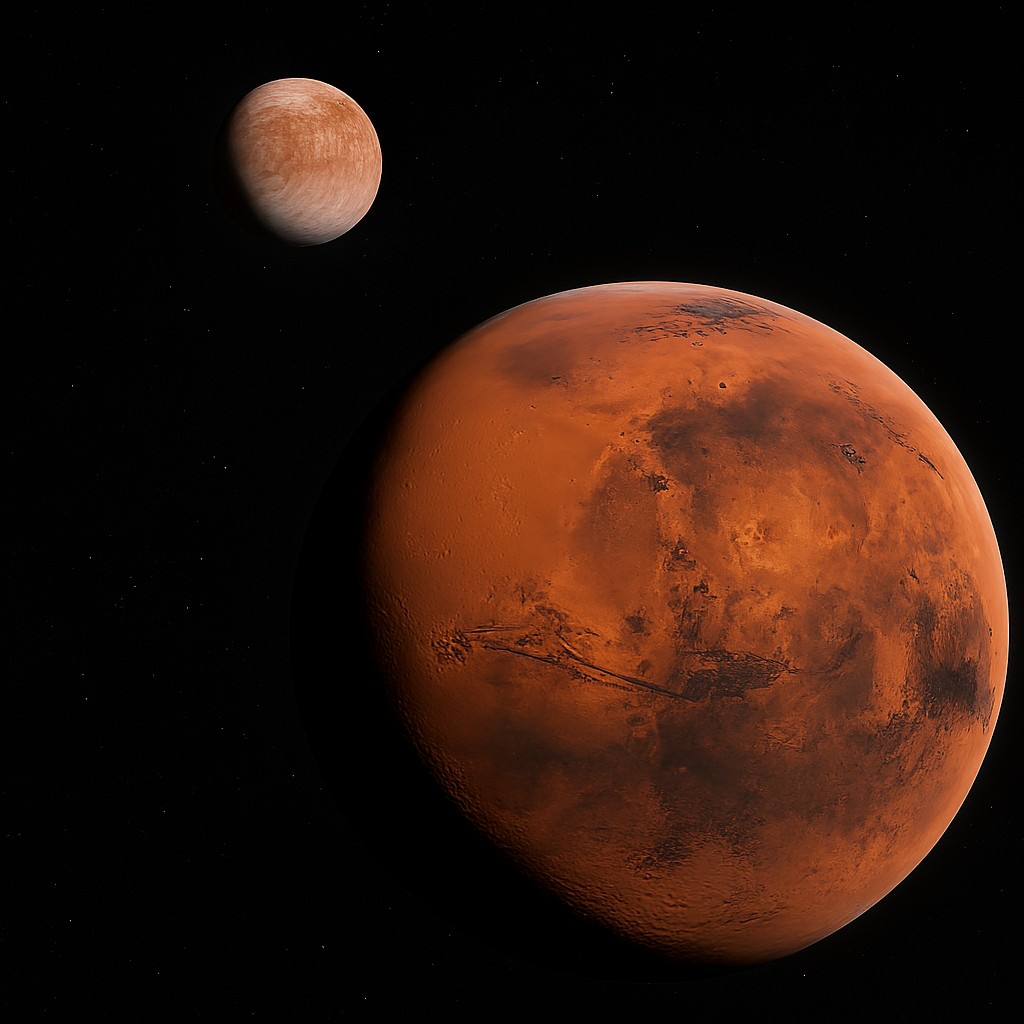
Today, only two tiny moons orbit Mars: Phobos and Deimos. But new research suggests that the Red Planet may once have had a much larger and more massive moon. This ancient moon was probably 15 to 18 times more massive than Phobos and had enough gravity to create real tides in the seas and lakes of Mars billions of years ago.
Evidence for this fascinating theory was found in the layered rocks of Gale Crater, which was once a lake. NASA’s Curiosity rover photographed formations called rhythmites — alternating thin layers of different colors and thicknesses. Similar structures on Earth are often formed under the influence of tides: waves bring sand, and during periods of calm, fine silt settles.
Martian tides
A team led by Suniti Karunatilaka from Louisiana State University studied these rhythms. Their analysis showed that the layers have a periodicity characteristic of tidal phenomena. To confirm this, the researchers applied a mathematical technique called the integral Fourier transform. The result revealed additional cyclicalities in the thickness of the layers, which may indicate the influence of two celestial bodies: the Sun and a hypothetical massive moon of Mars, similar to the Earth-Moon system.
This discovery may be the first direct evidence of the existence of a larger Martian moon in the past. According to one theory, Phobos and Deimos are the remnants of an ancient moon that was torn apart by the planet’s gravity in the distant past.
Discussions and counterarguments
However, not all scientists are ready to accept this hypothesis unconditionally. Some experts, such as Nicolas Mangold from the laboratory in Nantes, point out that the lakes in the Gale and Jezero craters were too small to form noticeable tides, even with a large moon. Other scientists, including Christopher Fedo, suggest that the rhythms could have been caused by seasonal changes in the flow of rivers into the lake, rather than by tides.
In defense of his theory, study author Ranjan Sarkar offers an alternative explanation: the ancient Martian ocean may have been hydrologically connected to the lake in Gale through underground cavities or cracks common on Mars’ fragmented surface. This could have amplified the tidal effect.
The results of the work will be presented at the annual meeting of the American Geophysical Union. The discovery has sparked scientific debate and provided a new avenue for understanding the geological and climatic history of our neighbor. The search for evidence continues, and each new analysis of Martian rocks may bring us closer to unraveling the mystery of Mars’ lost moon.
Earlier, we reported on how Curiosity’s discovery reveals the mystery of Mars’ lost atmosphere.
According to New Scientist

