

A rare Martian meteorite found in Northwest Africa (NWA 16254) became a scientific sensation. Its study by Chinese scientists from Chengdu University of Technology sheds new light on the complex volcanic processes and deep heterogeneity of Mars. This rock, Gabbroic Shergottite, is the first meteorite of its kind to show unique geochemical depletion, giving us a glimpse into the thermal history of the Red Planet billions of years ago.
Journey from the depths
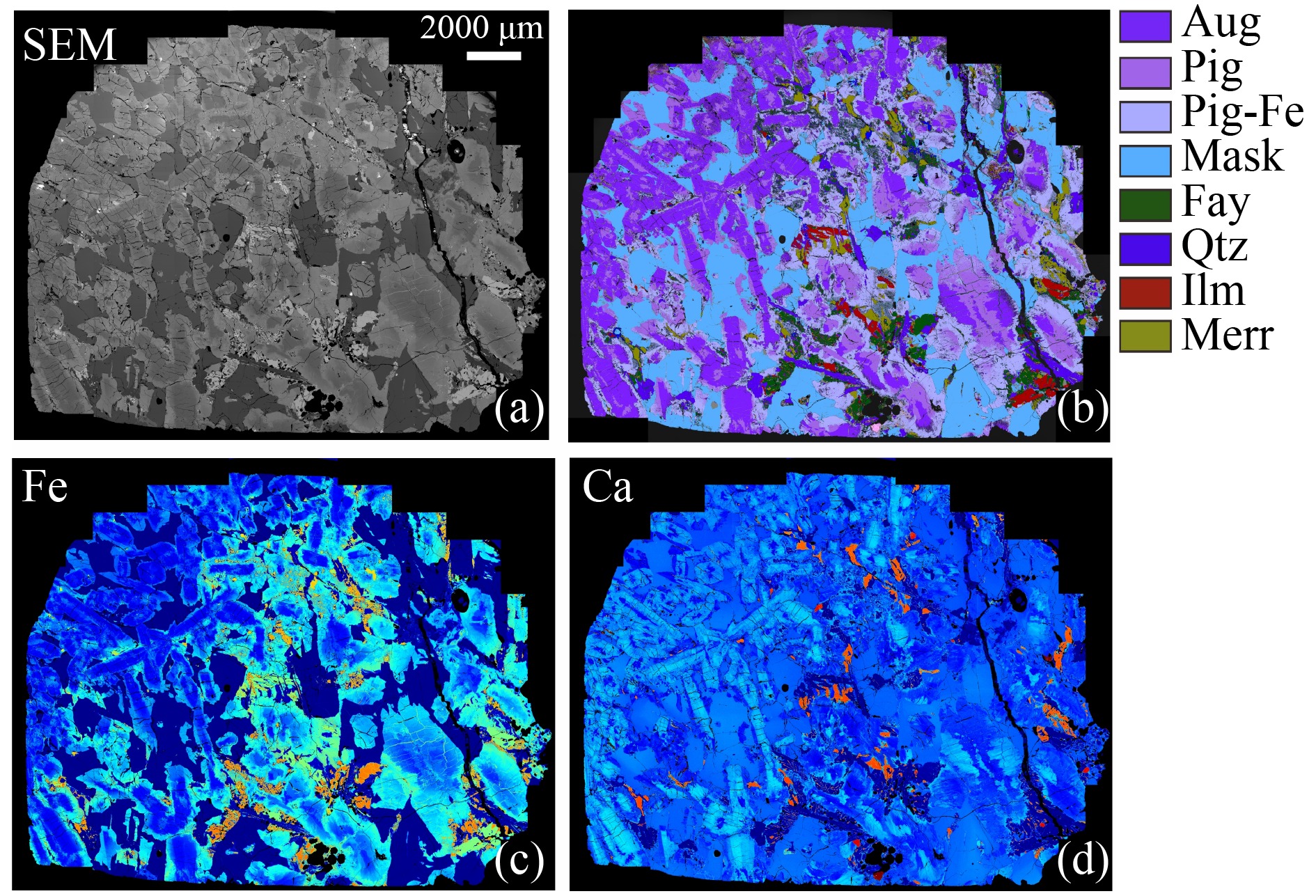
Under the guidance of Dr. Jun-Feng Chen, the team reconstructed the history of the meteorite. Using detailed mineral maps and accurate chemical analyses, they discovered a two-stage process of its formation. First, at great depths under high pressure (4.3–9.3 kbar), magnesium-rich pyroxene grains crystallized from the magma. Then, when the melt rose higher (pressure less than 4 kbar), cooling slowed down. This allowed iron-rich rims to form around these crystals and plagioclase to grow. The coarse-grained texture of the meteorite indicates that the magma originated from an old, depleted source in the Martian mantle.
Unique geochemical fingerprint
What makes NWA 16254 truly special? Its geochemical signature. The rocks show significant depletion of light rare earth elements and extremely low oxygen fugacity (fO₂), indicating reducing conditions during crystallization.
These characteristics are very similar to another rare Martian meteorite, QUE 94201, suggesting a common magmatic source. The gabbroic texture of NWA 16254, typical of slow cooling deep beneath the surface, makes it an invaluable archive of Mars’ underground processes.
Volcanic evolution of Mars
These discoveries challenge current ideas about the volcanic evolution of Mars. The consistently low fO₂ of the meteorite, confirmed by the presence of special minerals (Ti³⁺-enriched ilmenite), proves that stable reducing conditions prevailed during its formation. This clearly demonstrates the heterogeneity of the Martian mantle — it was not uniform everywhere.
The question arises: how exactly did the redox conditions on the planet change over billions of years? The answer could rewrite our understanding of its past.
For a more in-depth analysis, scientists used advanced methods: mineral mapping (TIMA) and laser mass spectrometry (LA-ICP-MS). They discovered important geochemical differences between the cores and edges of pyroxene crystals, which revealed the dynamics of magma movement in the chamber.
The well-preserved geochemical characteristics of NWA 16254 make it an ideal object for future isotopic studies. They can accurately date the melting of the mantle and will allow us to refine models of Mars’ differentiation, revealing its thermal history and evolution.
Earlier, we reported on how the most amazing geological discovery was made on Mars.
According to Sci Tech Daily

