

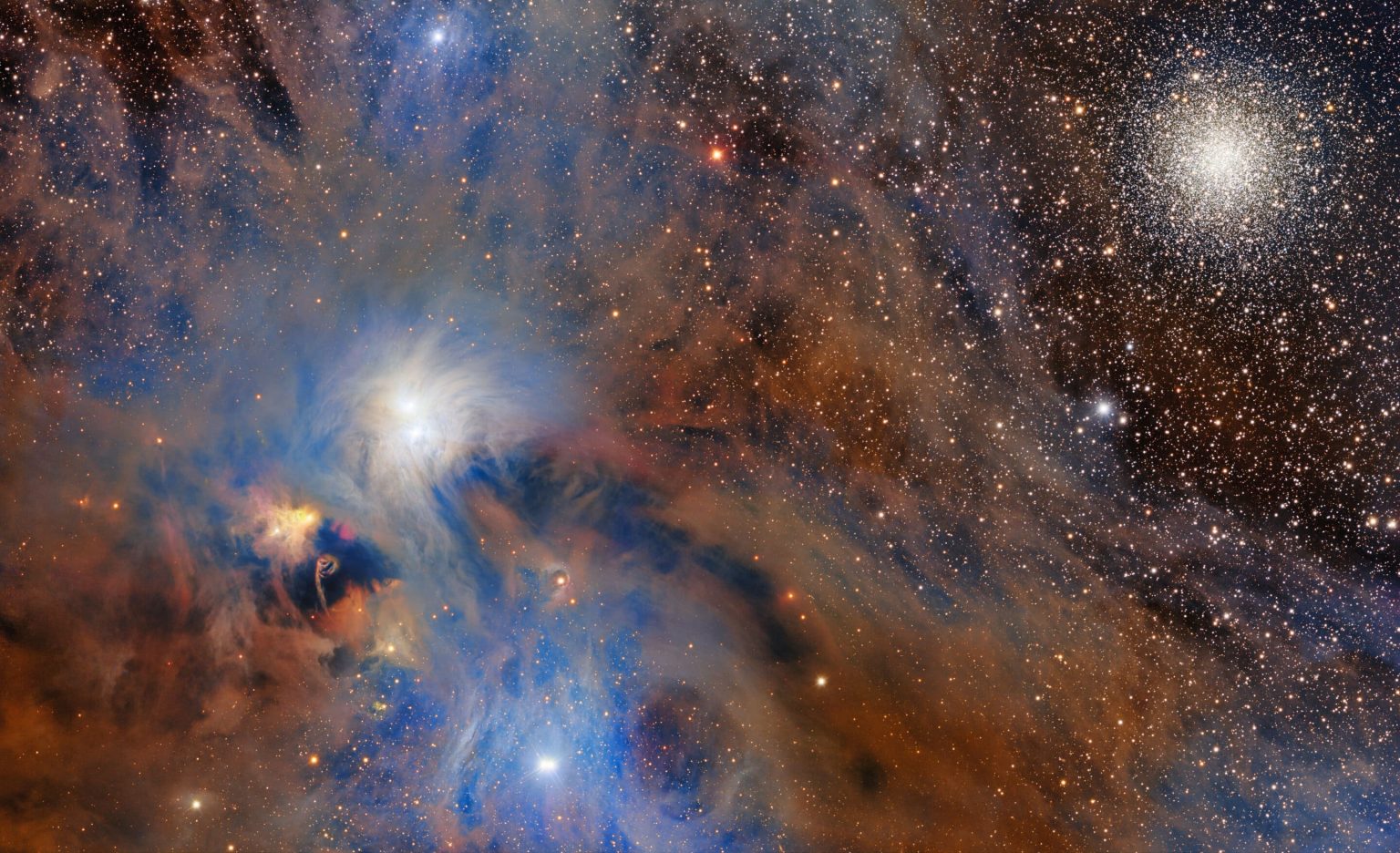
A region of the sky in the constellation Corona Australis was photographed in such detail that the image resembles Vincent van Gogh’s painting The Starry Night. The image combines swirling clouds of glowing gas with a scattering of stars from a distant globular cluster. In reality, these objects are separated by thousands of light-years.
An Ultra-High-Resolution Camera
The image was obtained using the 570-megapixel Dark Energy Camera, or DECam, phys.org reports. The instrument operates on the four-meter Víctor Blanco Telescope at the Cerro Tololo Inter-American Observatory in Chile.
Its design combines 74 detectors and a lens almost one meter in diameter. The instrument was originally created for the Dark Energy Survey, which mapped hundreds of millions of galaxies between 2013 and 2019. It is now also used to photograph individual regions of the sky.
A Binary System Inside the Nebula
The orange cloud on the left side of the image contains R Coronae Australis, a pair of stars orbiting each other with a period of between 43 and 47 years. The primary star has not yet reached the main sequence. It has already accumulated almost all of its matter, but thermonuclear reactions have not yet begun in its core.
The second body turned out to be a red dwarf, although this was only confirmed in 2019. Red dwarfs are the most common type of star in the Milky Way. They have a low mass, slowly use up their hydrogen reserves, and their existence lasts much longer than stars like the Sun.
How the Gas Glows
Radiation from the hot young star reflects off the surrounding clouds of gas and dust, producing reflection nebulosity. At the same time, its ultraviolet radiation ionizes the nearby gas, causing it to glow on its own. This created the combined object NGC 6729, whose shape and brightness change because of orbital motion within the R Coronae Australis system.
Farther to the right are the reflection nebulae NGC 6726 and NGC 6727, which contain newly formed stars. Below them, they merge into another similar region designated IC 4812, making the left side of the image appear as a continuous whirl of matter.
One of the Nearest Regions
The Corona Australis Molecular Cloud occupies the left half of the image. It is one of the closest regions to the Solar System where new stars are forming. It is located approximately 430 light-years from Earth.
By comparison, the famous Orion Nebula lies almost three times further away, at about 1,350 light-years. This is why the protostellar clouds of the Corona Australis can be seen in much greater detail than similar objects in more distant regions of the Galaxy.
A Cluster in the Background
In the upper-right corner is the globular cluster NGC 6723, known by the nickname “the Chandelier.” It is a gravitationally bound spherical group containing between tens of thousands and millions of stars, including many that are comparatively young.
Despite its apparent proximity to the molecular cloud, the cluster lies far behind it, approximately 29,000 light-years from Earth. The two objects appear in the same image only because they happen to lie along the same line of sight.
The region has long been popular among astrophotographers. During summer, the constellation Corona Australis rises only slightly above the horizon at mid-northern latitudes, so the best view is available from the Southern Hemisphere.

