

Life in space is vastly different from what we see in science fiction movies and lacks many of the earthly comforts we take for granted. As the design challenges for the Artemis II mission’s restrooms have clearly demonstrated, maintaining hygiene in space is a real problem. However, one of the biggest daily inconveniences remains the inability to wash dirty clothes.
Due to strict weight limits on cargo, astronauts take only the bare minimum of clothing on board, which fits into just two small suitcases. They sometimes have to wear the same underwear for weeks on end. When the clothing becomes unusable, it is simply loaded into a special module, which is sent to burn up in the upper layers of Earth’s atmosphere. The method is impressive, but not perfect.
So why can’t we just use regular water? According to NASA crew operations instructor Elisca Hicks, free-floating water is extremely dangerous in microgravity. Drops flying uncontrollably through the air could land on sensitive electronic components or get trapped in hard-to-reach compartments of the spacecraft, which would inevitably lead to short circuits or mold growth.
Of course, the interiors of the ISS (International Space Station) are a strictly controlled, almost sterile environment. However, the human body constantly sheds sweat, dead skin cells, and bacteria. Multi-layered fabrics become a perfect breeding ground for microbes, which make the clothing smelly and dirty.
An innovative approach to fighting microbes
For modern orbital missions, the status quo of burning laundry balls might be “good enough.” But for long-duration journeys into deep space, this approach won’t work. A team of scientists led by aerospace engineer Gabe Xu from the University of Alabama in Huntsville solved this problem by creating the concept of a “laundry gun.”
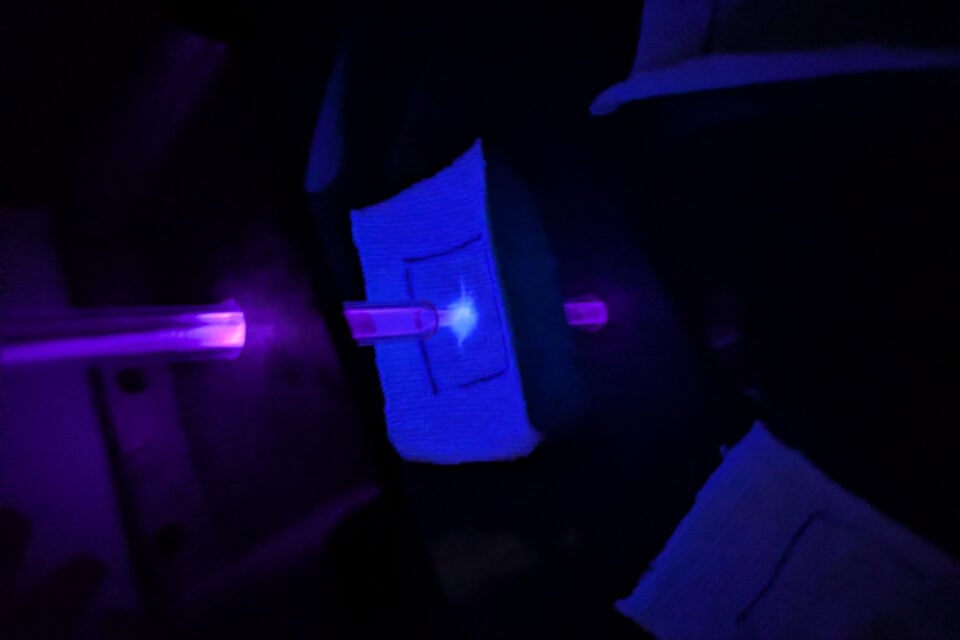
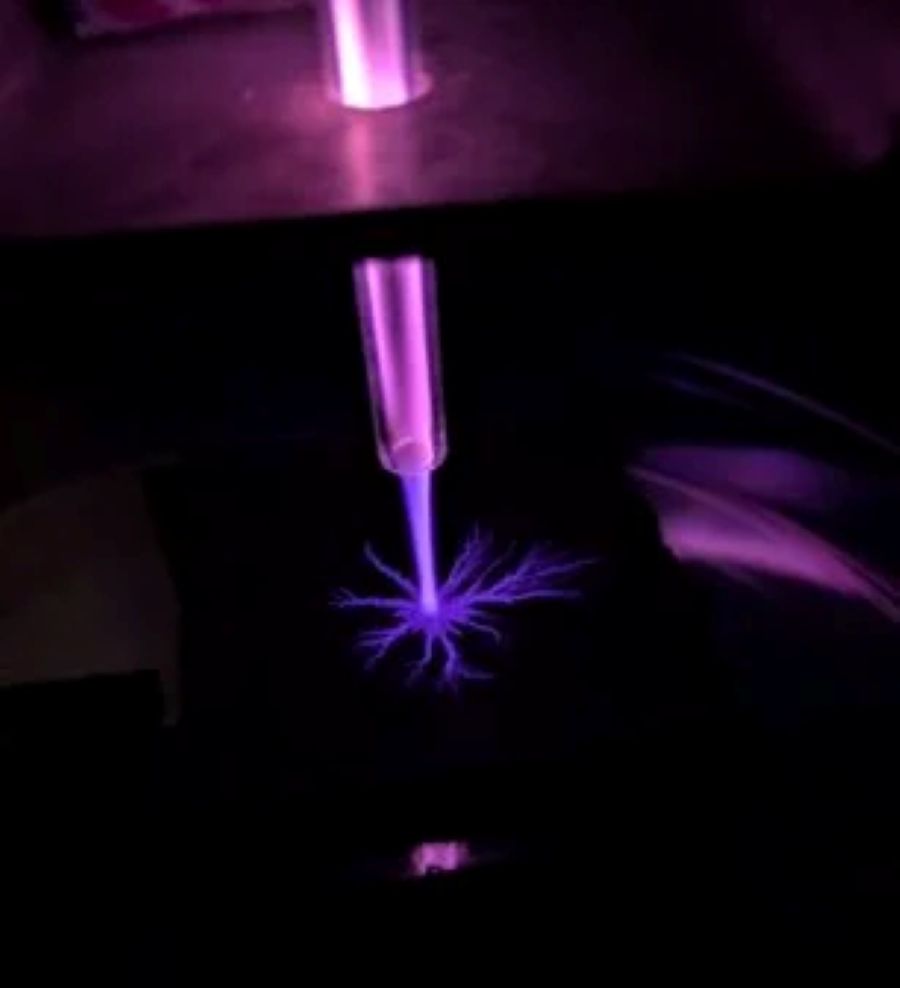
This device uses a low-temperature disinfection method. The gun generates a jet of cold plasma at room temperature using a specific mixture of helium, ordinary air, and water vapor. When exposed to high voltage, active oxygen species—such as ozone—are generated in the tissue. When this plasma beam strikes the material, it causes intense “oxidative stress,” which is lethal to most types of bacteria.
As experiments on cotton samples have shown, this treatment can keep clothing microbiologically clean, which is critical for maintaining the crew’s health.
From a lab concept to Martian bases
For now, the technology is still only at the proof-of-concept stage. The current laboratory prototype emits a thin plasma beam no thicker than a standard pencil, which makes processing large surfaces too time-consuming.
In addition, scientists will have to solve the ventilation problem. Ozone, a byproduct of the reaction, is excellent at killing bacteria, but in high concentrations it is harmful to the human respiratory system. On Earth, we would simply open a window to air out the room and get rid of the smell of cleaning products. Obviously, there will be no such luxury aboard a spacecraft or in a Martian living module.
The developers’ next step will be to scale up the device to the size of a soda can and integrate a reliable filtration system to neutralize ozone.
If the technology can be successfully adapted, its potential will extend far beyond ordinary laundry. In the future, such devices could be used to sterilize spacesuits and scientific instruments before venturing onto the surfaces of other planets.
Earlier, we discussed five NASA innovations that have made our lives on Earth easier.
According to Gizmodo

