

Stars are formed from gas that usually enters a galaxy as a result of merging with other star systems. But what if all this happens in the middle of the nearest void? In a new study, scientists have answered this question.
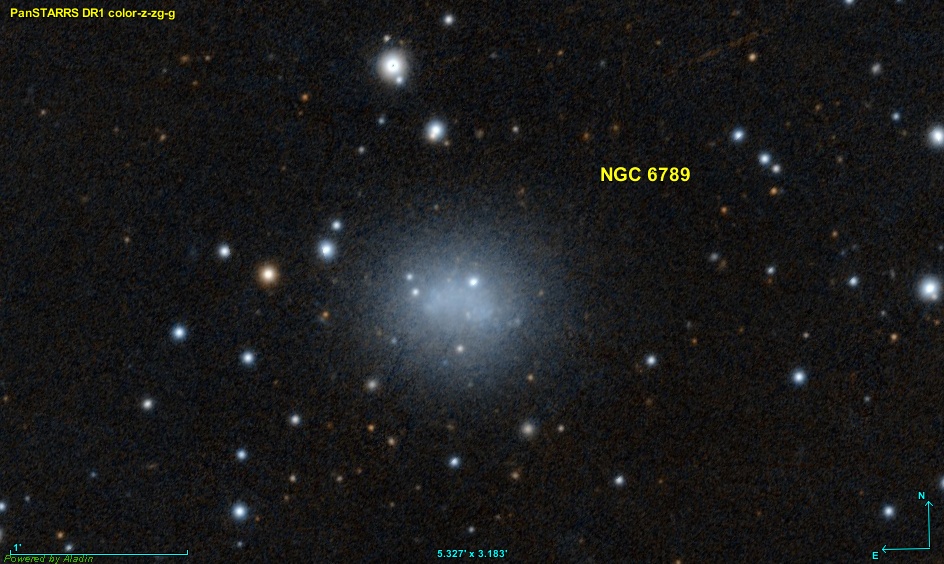
Solitary galaxy
A team of astronomers led by Ignacio Trujillo from the University of La Laguna in Spain attempted to answer one of the most difficult questions in modern astrophysics: what percentage of star formation is due to galaxy mergers. To do this, they studied the star system NGC 6789.
Galaxy mergers are a fairly common process that astronomers have observed many times. Despite all the concerns, these events pose no danger to stars. On the contrary, waves of gas rolling over galaxies fill them with material for the formation of new stars and thus simulate star formation.
This is true for the Milky Way, which has already undergone two mergers during its formation. But what can be said about systems such as NGC 6789? It was discovered back in 1883 and is known for being located within the so-called Local Void. This region of space is characterized by the fact that there are virtually no galaxies within it.
If the theory about the role of starburst galaxies in star formation is correct, then it should be fading in NGC 6789. But this is not the case. Previous studies have shown that approximately 4% of its material, or 100 million solar masses, has been formed over the last 600 million years.
Local gas
A new study has shown that the blue galaxy NGC 6789 has a central region of star formation, while its surroundings are significantly redder. However, they are well integrated and show no signs of past collisions.
Scientists thoroughly checked the galaxy’s ellipticity, and it turned out to be perfect. It should be noted that there is no incoming companion with a mass of up to 200,000 solar masses near it, and there has not been one for the last billion years.
There are also no traces of any intergalactic flows. It should be noted that all these millions of worlds formed over the last few million years are created from local gas. In other words, star formation can occur quite actively even without galaxy collisions.
According to phys.org

