

The European Southern Observatory has published an image of an intriguing object known as Ve 7–27. It was previously thought to be a planetary nebula. However, observations made with ESO’s Very Large Telescope (VLT) have shown that it is actually a young star still in the process of formation.
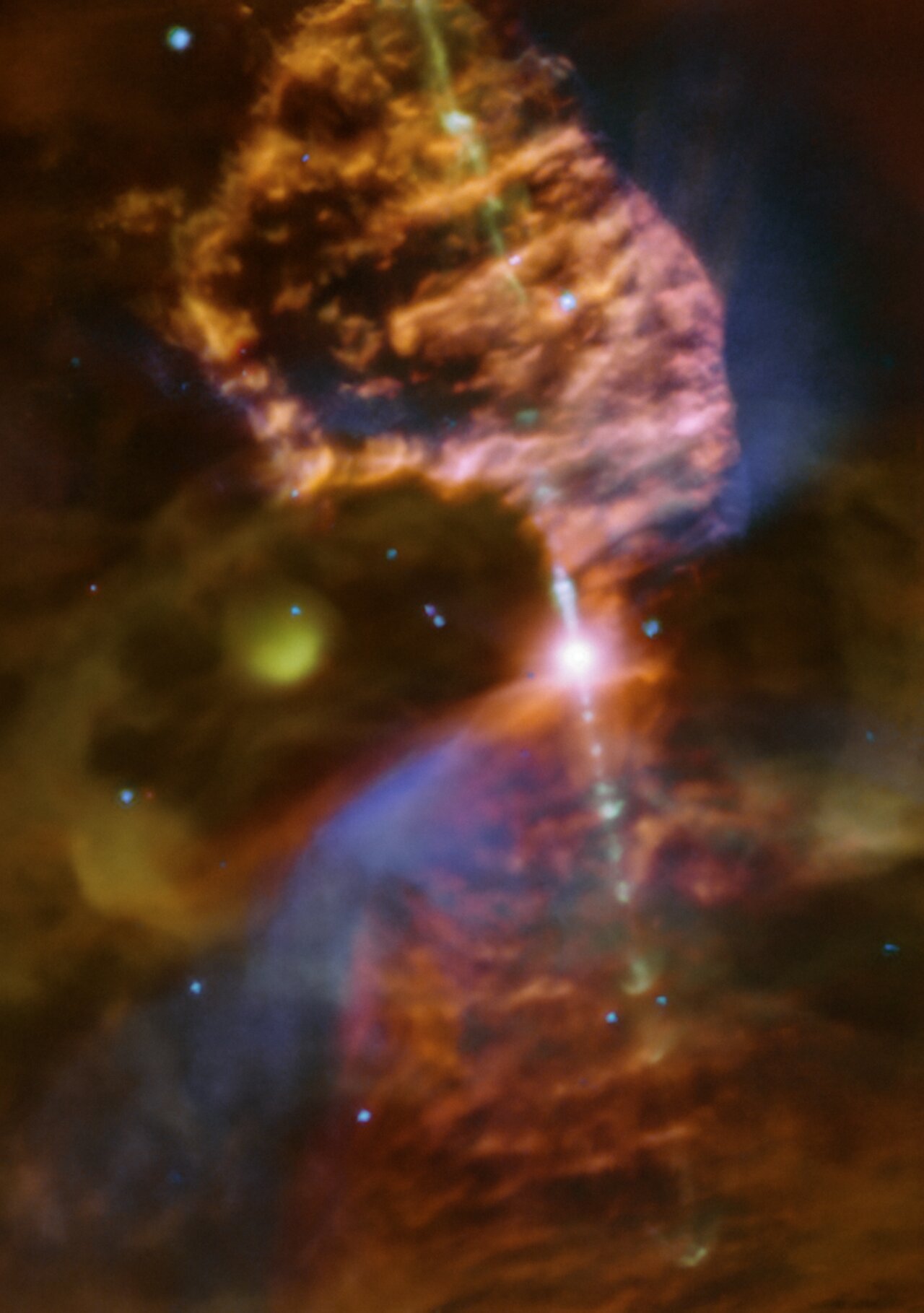
Ve 7–27 is located 4,500 light-years from Earth in the direction of the constellation Vela. For a long time, it was believed to be a planetary nebula. This is the name given to the final stage in the life cycle of sun-like stars, during which they shed their atmosphere, leaving only their bare core. Its radiation ionizes the ejected material, making the nebula visible.
But in the case of Ve 7–27, it turned out to be completely different. Thanks to the MUSE instrument mounted on the VLT, astronomers were able to obtain the first detailed image of this object. It turned out that it was not a planetary nebula, but a newborn star. It emits powerful jets with clumps of matter along them, which is typical for protostars. “Ve 7-27 is not the ‘last breath’ of a dying star, but a newborn star,” said Janette Suherli, lead author of the study that made this amazing discovery.
At the same time, there really is a dead star hidden next to Ve 7-27. The compact yellowish-green spot on the left side of the center of the VLT image corresponds to a nebula formed as a result of the collapse of a massive star. At its center is a neutron star.
MUSE observations have shown that the young star Ve 7-27 is located in a cloud of material ejected during a supernova explosion. It is enriched with heavy elements that could become part of the planets forming around it.
The distance to the supernova remnant had never been precisely determined before, but now astronomers have been able to prove that this object is close to Ve 7-27. Knowing the distance, they can now estimate its size, expansion rate, and determine the time of the explosion, resolving decades of controversy. According to the researchers, the pattern they observed represents an exceptional case of the coexistence of star birth and death in the same environment.
According to ESO

