
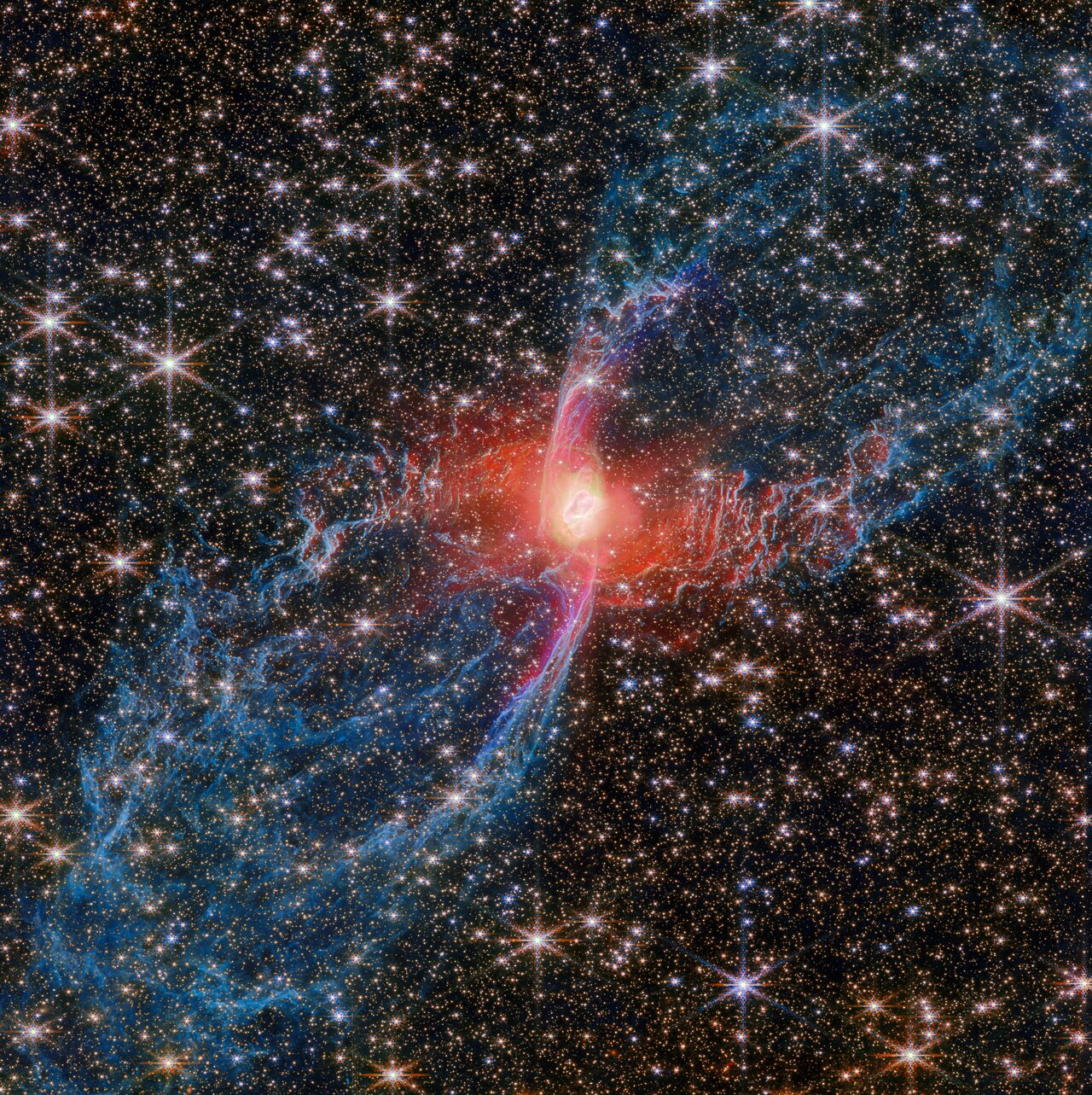
Astronomers working with the James Webb Space Telescope (JWST) have published a new exciting image. It shows an object that looks somewhat like a giant red spider. This is the planetary nebula NGC 6537.
Planetary nebulae such as NGC 6537 form when sun-like stars reach the end of their life cycle. They begin to swell, turning into cold red giants, until at some point they shed their outer layers of atmosphere. The exposed, superheated core ionizes the ejected material with its radiation, causing it to glow. As a result, bizarre structures similar to NGC 6537 are formed in space. By cosmic standards, this phase is very fleeting. Planetary nebulae can be observed for only a few tens of thousands of years before they disappear.
Thanks to the Near Infrared Camera (NIRCam), JWST has revealed previously unseen details of this picturesque planetary nebula. The photo shows its central star. In optical images, such as images from the Hubble Space Telescope, it appears blue and dim. But in the NIRCam images, the star appears red. Thanks to its sensitivity in the near-infrared range, JWST has detected a cloud of hot dust surrounding it. It appears to orbit the star in the form of a disk.
Although only one star is visible in the center of the Red Spider Nebula, there may be a hidden companion. This could explain the shape of the nebula, including its characteristic narrow “waist” and wide ejections of matter. This hourglass shape is also seen in other planetary nebulae, such as the Butterfly Nebula, which JWST also recently observed.
The spider’s “legs,” shown in blue, glow due to the radiation of H2 molecules containing two hydrogen atoms bonded together. They are closed bubble-like structures, each extending for about 3 light-years. Gas flowing from the center of the nebula has inflated these huge bubbles over thousands of years.
As JWST observations show, gas is also actively escaping from the center of the nebula. The elongated violet “S”-shaped structure located in the center of the nebula follows the light of ionized iron atoms. This feature marks the spot where the jet generated by the star collided with material previously ejected by it. Their interaction formed the wavy structure of the nebula that we see today.
According to Esawebb

