

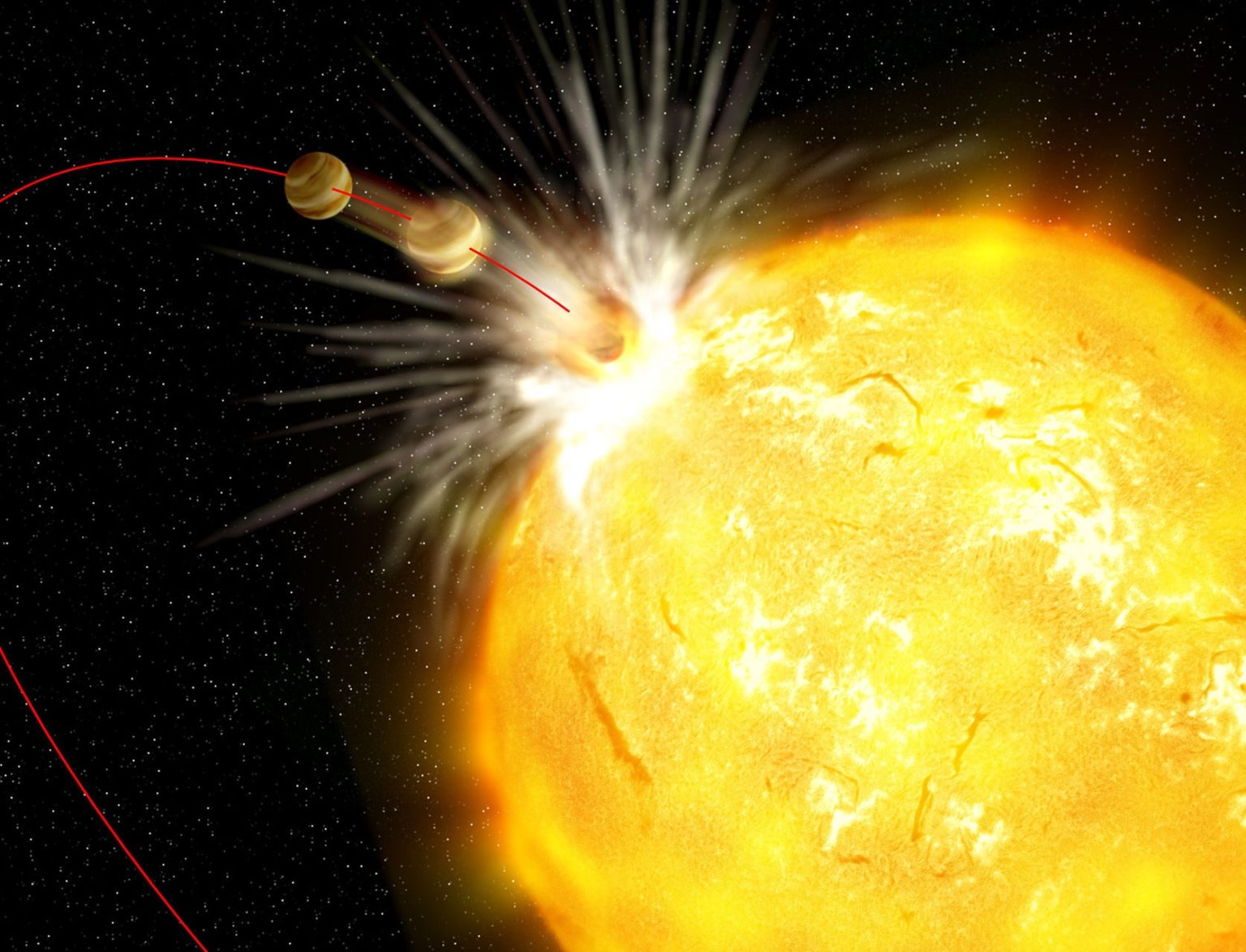
Astronomers have studied a mysterious binary star system in which two stars, which likely formed at the same time, now have radically different chemical compositions. The new study suggests that one of them may have swallowed its own planets.
Binary system with an unusual chemical composition
In binary systems, the two stars typically form from the same molecular cloud and therefore share the same age and chemical composition. Astronomers believe that any differences in their metallicity point to an event involving mass transfer, the accretion of planetary components, or other internal processes. HD 81809 is one such unusual system in which both stars are G-type sun-like stars but are at different stages of evolution.
The primary star, HD 81809A, has passed through the main-sequence phase, exhausted its hydrogen supply in the core, but has not yet become a red giant—it is currently a subgiant. On the other hand, HD 81809B is still a main-sequence star. It is enriched in lithium, and there is a difference in iron content between the two stars—the primary star is metal-poor with an iron content of −0.57 dex, while the secondary star has a metallicity approximately equal to that of the Sun—0.00 dex.
This difference in the chemical composition of the two stars does not align with standard trends in chemical evolution. The discrepancy of 0.57 dex is too large to be explained by standard mechanisms. Although some studies have proposed formation scenarios consistent with standard theories, there remain inconsistencies regarding the explanation of the observed luminosity and age of the stars.
Eating up the planet as a hypothesis
A previous study published in The Astrophysical Journal hypothesized that recent accretion could have altered the chemical properties of the surface layers of HD 81809B. This is also supported by the detection of a debris disk in this system.
In a new article authored by Nuno Moedas of the Technical University of Denmark, the team examines this scenario in greater detail to determine whether the absorption of metal-rich planets by a secondary star could reproduce the chemical properties of the system. Building on a physically more plausible scenario from a previous study, in which both stars formed from a single molecular cloud, they used a computer simulation code called Modules for Experiments in Stellar Astrophysics (MESA) to test the hypothesis of planetary accretion by simulating various accretion processes with different mass ranges and chemical compositions.
Computer simulations show a chemical mismatch
Computer simulations show that, to account for the star’s unusually high metallicity, it would have needed to accumulate approximately 25–75 Earth masses of metals over a period close to its current age of nearly 10 billion years. But if the planet’s absorption occurred at a very early stage in the star’s life, the required accretion mass would be 150 Earth masses of metals, which, according to the researchers, is “unlikely.” Therefore, the event must have occurred recently.
However, the analysis also predicts a much higher lithium content than astronomers observe. The discrepancy in lithium content would disappear if the mass of the accreted material did not exceed 6 Earth masses.
“The models predict that such a metal-rich accretion would over-enrich lithium at the surface; matching the observed lithium instead requires accreting less than 6 M⊕,” the article states. “This tension highlights the need for precise knowledge of the accreted material’s chemical composition.”
However, compared to previously proposed scenarios, planetary ingestion appears to be the most likely explanation. The authors note that the detection of rotation and magnetic activity on HD 81809B—which may exhibit characteristics typical of a planetary ingestion event—would provide further evidence.
According to phys.org

