

Astronomers are observing a remarkable star orbiting the supermassive black hole at the center of our Milky Way. These studies will help scientists examine relativistic effects more closely and test the general theory of relativity.
The Limits of Newtonian Physics and General Relativity
Although general relativity is an elegant theory of gravity, In many cases, Newton’s classical theory of universal gravitation is sufficient. The English physicist’s model is accurate enough to guide spacecraft through the Solar System and to describe most stars orbiting Sagittarius A*, the supermassive black hole at the center of the Milky Way, phys.org reports. Only for the stars closest to the black hole do effects become noticeable that can only be explained by the general theory of relativity.
There are gravitational effects that Newton did not predict, such as gravitational waves and the warping of space-time, but for most phenomena there is practically no difference between the models of Newton and Einstein. The differences between Einstein’s model and alternative models of relativistic gravity are even subtler. Testing these limits is extremely difficult. However, a newly discovered star may help.
A Star Orbiting Sagittarius A*
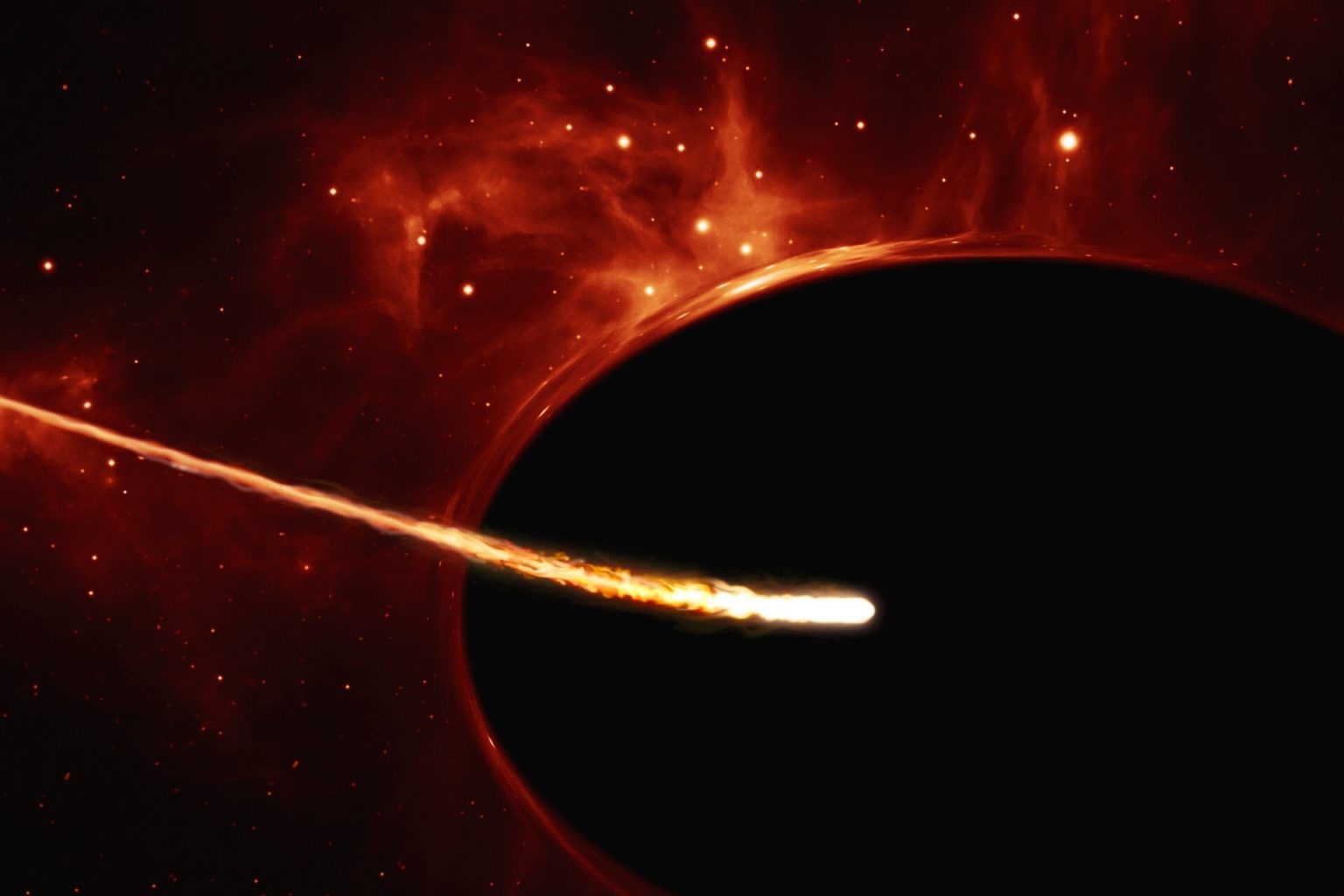
The star has the modest name S301 because it is number 301 on the list of recognized S-stars orbiting Sagittarius A*. It is slightly more massive than the Sun and completes one orbit around Sagittarius A* every 8.7 years. This is the shortest known orbital period of any S-star, and S301’s orbit is extremely elliptical.
At its closest approach, it passes at a distance of approximately 140 Sagittarius A* radii, or about 24 astronomical units. In other words, if Sagittarius A* were located at the center of our Solar System, its event horizon would lie just inside Mercury’s orbit, while at closest approach S301 would pass between the orbits of Uranus and Neptune. It would also be moving at more than 8% of the speed of light.
This makes S301 the best laboratory for testing HAZ effects. Its motion allows one of the most precise tests of general relativity near a supermassive black hole. One of the main effects is the precession of the pericenter of the orbit. A similar phenomenon is observed for Mercury, whose precession became one of the classic confirmations of general relativity. However, for Mercury, the difference between Newton’s and Einstein’s predictions is only 43 arcseconds per century—an extremely small amount. In contrast, in S301, the pericenter shifts by about 2° during each revolution around Sagittarius A.
Secondary Relativistic Effects
The extreme motion of S301 allows us to study not only classical but also higher-order relativistic effects. Among them are gravitational redshift and transverse Doppler shift. Both phenomena have already been confirmed in laboratory experiments and during astronomical observations, but S301 will allow us to study them in a much stronger gravitational field.
More importantly, long-term observations of this star could provide one of the most precise tests of general relativity and help test alternative relativistic theories of gravity that predict subtle deviations from Einstein’s model.
Deviations appear only in extreme conditions and appear in members of the order ((v/c)^2) or ((v/c)^3). These include, in particular, effects related to the rotation of the black hole and the interaction of its own angular momentum with the orbital motion of the star. Future large telescopes, such as the Giant Magellan Telescope (GMT), will be able to observe the spectra of S301 with sufficient precision to measure second- and third-order effects.
The effects of the black hole’s rotation and its interaction with the star’s rotation also appear at these orders. Future large telescopes, such as the Giant Magellan Telescope, will be able to observe S301’s spectrum with sufficient precision to measure second- and third-order effects.
Limitations of Observing S301
For now, however, observing S301 remains challenging. The center of our galaxy is obscured by clouds and dust, so we cannot observe it in visible light. Because S301 is a Sun-like star, it is not particularly bright even in the infrared.
We can observe its motion, but we are not yet able to obtain meaningful spectral data.
However, as with everything in relativity, it is only a matter of time.

