

The axion is a hypothetical neutral particle that physicists studying dark matter have been trying to discover for many years. A new experimental device developed by a team of young scientists at the University of Hamburg could help advance research in this field.
Progress made by young researchers
In the era of precision cosmology, research often involves large-scale science: major observatories, highly sophisticated instruments, international collaborations, and substantial funding. However, even in such a leading-edge field, progress is still possible—particularly in the search for elusive dark matter—thanks to more flexible approaches carried out by small teams and young researchers, supported by institutions and a healthy dose of ingenuity.
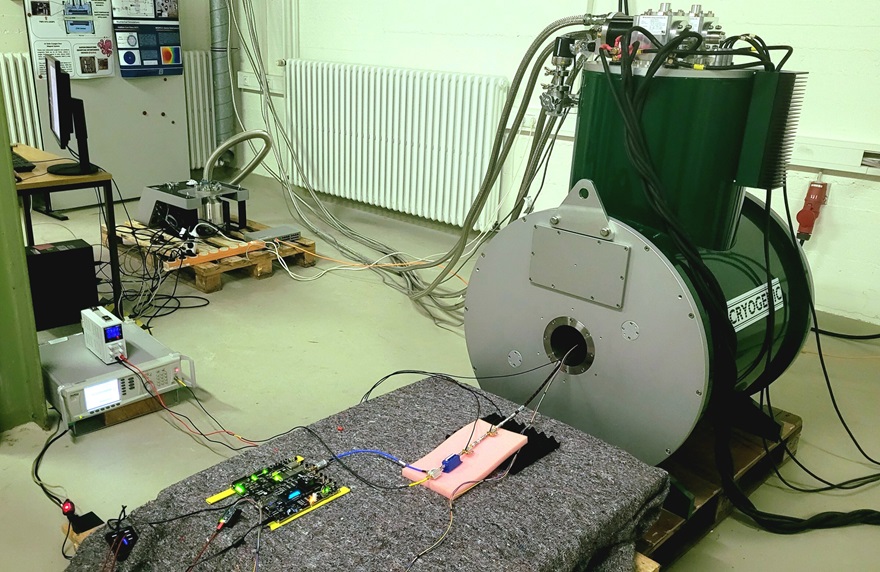
In an article titled “A New Limit for Axion Dark Matter with SPACE,” published in the Journal of Cosmology and Particle Physics, a group of students at the University of Hamburg built a chamber detector to search for axions—one of the most promising candidates for dark matter—and set new experimental limits on their properties.
This result was achieved with relatively limited resources, demonstrating that even small-scale experiments can make a significant contribution to solving one of the most unresolved problems in modern physics.
A device for detecting dark matter
Scientists believe that the advantage of working with dark matter or axions is that it is expected to be present everywhere in our galaxy—in other words, dark matter could literally be right next to us.
The researchers first built an experimental setup, starting with a resonant chamber made of highly conductive materials, as well as the necessary electronics, cables, supports, and measuring instruments. “The detector we’ve built is, in essence, the simplest version of a chamber detector for dark matter,” says Nabil Salama, one of the study’s authors.
The team didn’t start from scratch: in addition to funding, it relied on existing infrastructure and equipment provided by the university and partner research groups. The experiment was tested, calibrated, and launched to collect data for analysis.
“We reduced very complex experiments to their essential components,” says Salama. “The result is a less sensitive setup, limited to a small search window, but still capable of producing new scientific data.”
Signal not found; new restrictions have been set
“The search for axions involves exploring a wide range of possible parameters,” adds Agit Akgümüs, the paper’s first author. “Our experiment covers only a small region, with limited sensitivity, but it still helps narrow down the possibilities. To actually find the particle, we need either much larger experiments or many different ones, each probing a specific region.”
During the final stage of data collection, the team did not record a single signal that could be attributed to the actions. This is not a failure, but an important scientific result: it allows researchers to rule out the existence of axions with certain properties within the mass range under investigation, particularly those that interact more strongly with photons. Thus, the study helps narrow down the range of parameters and guide further research.
Scientists have shown that dark matter search experiments can be scaled down to much smaller projects—almost to the point where they can be carried out almost entirely by students—while still yielding meaningful scientific data.
Experiments are becoming more accessible
During the peer-review process, the reviewer made a particularly striking comment, Salama recalls. According to the reviewer, once the axion is discovered and its properties—especially its mass—are known, experiments of this kind could become much more accessible, potentially even suitable for educational laboratories.
“We were told that setups like ours could one day become standard student lab experiments,” says Salama. “In a way, we may have anticipated that future, showing that it is already possible to build and operate such an experiment on a small scale.”
According to phys.org

