

A team of Japanese astronomers, comprising both professionals and amateurs, has detected signs of a rarefied atmosphere around a small celestial body in the outer Solar System. This object is so small that, logically, it should not have a stable atmosphere, which raises the question of when and how this atmosphere formed. Future observations aimed at studying the atmosphere’s characteristics in greater detail will help solve these mysteries.
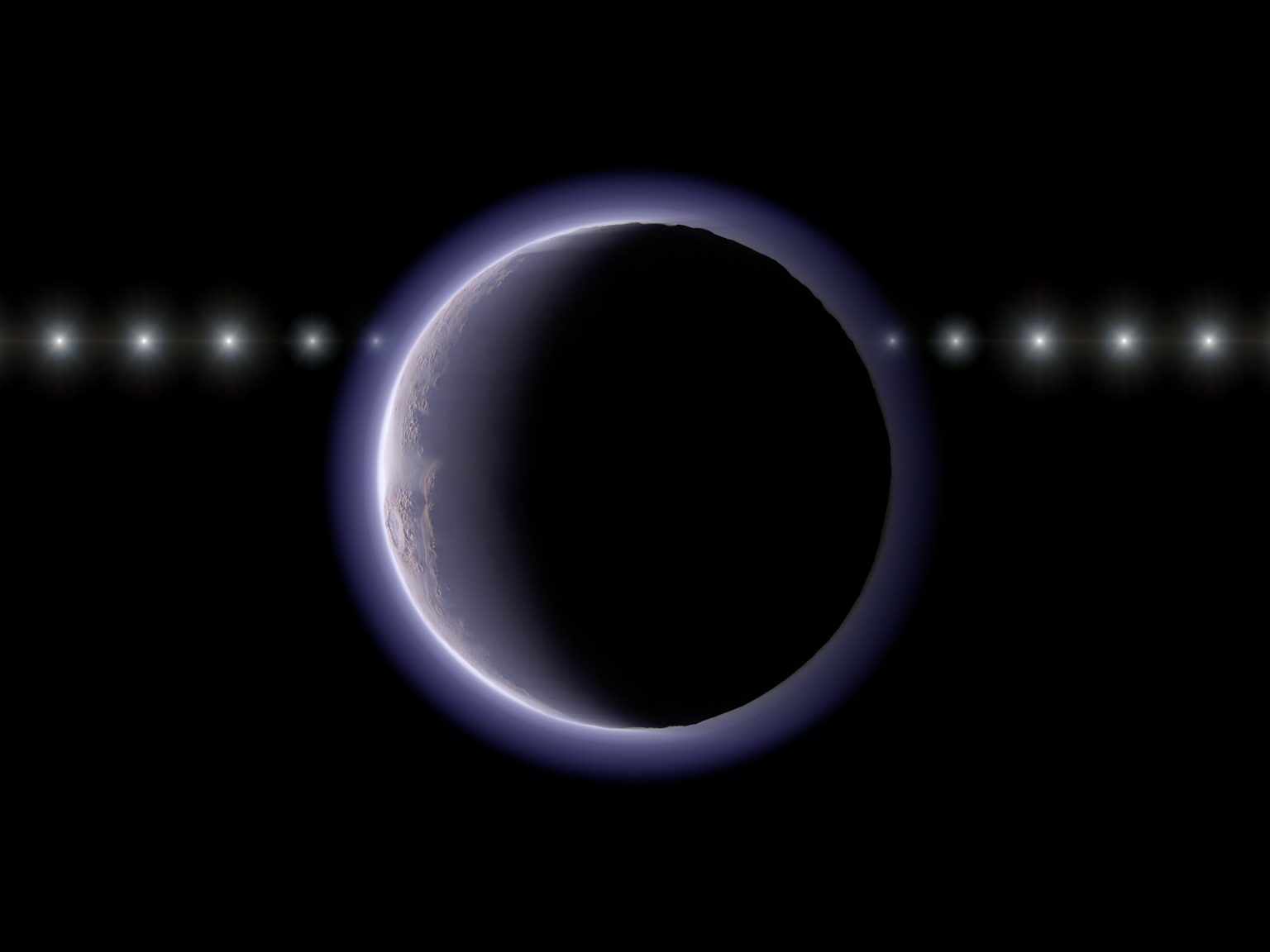
Trans-Neptunian objects
In the cold depths of the outer Solar System lie thousands of small objects known as trans-Neptunian objects (TNOs), as they are located beyond Neptune’s orbit. A thin layer of atmosphere has been detected around Pluto, the most well-known of these bodies; however, studies of other similar bodies have not yielded positive results. Most TNO are so cold and their surface gravity is so weak that they are not thought to be capable of retaining an atmosphere.
But astronomers enjoy anticipating the unexpected, so they took advantage of a fortuitous “natural experiment” to investigate the atmosphere surrounding an object from the group of distant Poisson objects (TNOs) known as (612533) 2002 XV93. This object, designated 2002 XV93, has a diameter of approximately 500 km. By comparison, Pluto’s diameter is 2,377 km.
A thin layer of atmosphere around a 500-kilometer-wide object
The orbit of XV93 in 2002 was such that, as seen from Japan, it passed directly in front of the star on January 10, 2024. When the star disappears behind 2002 XV93, it may gradually dim, indicating that the light is being attenuated as it passes through a thin layer of the atmosphere; or it may suddenly go out when it disappears behind the solid surface of the TNOs.
A team of astronomers led by Ko Arimatsu at the Ishigakijima Astronomical Observatory (NAOJ) observed this star from several observation sites in Japan when XV93 passed in front of it in 2002. The data obtained indicate that the light has been attenuated by the atmosphere.
Reasons for the formation of the atmosphere
Calculations show that the atmosphere detected around 2002 XV93 will last less than 1,000 years unless it is replenished. Consequently, it likely formed or was replenished recently.
Observations from the James Webb Space Telescope have found no evidence of frozen gases on the surface of 2002 XV93 that could sublimate to form an atmosphere. One possible explanation is that some event caused frozen or liquid gases to be released from the depths of the TNOs and rise to the surface. Another possibility is that the comet collided with 2002 XV93, releasing gas that formed a temporary atmosphere. Further observations are needed to distinguish between these two scenarios.
According to phys.org

