

The Mars Express probe has photographed an ancient valley on Mars once carved out by a catastrophic flood. The images reveal several geological processes that have shaped the planet’s surface over billions of years.
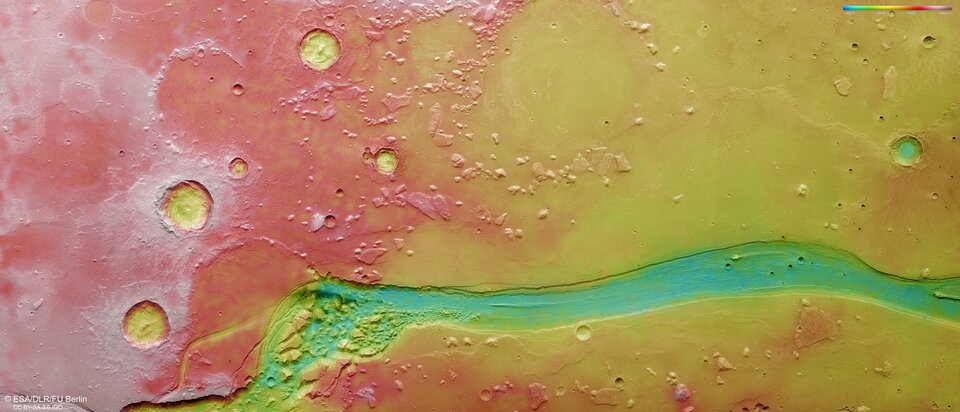
A valley as long as the entire length of Ukraine from west to east
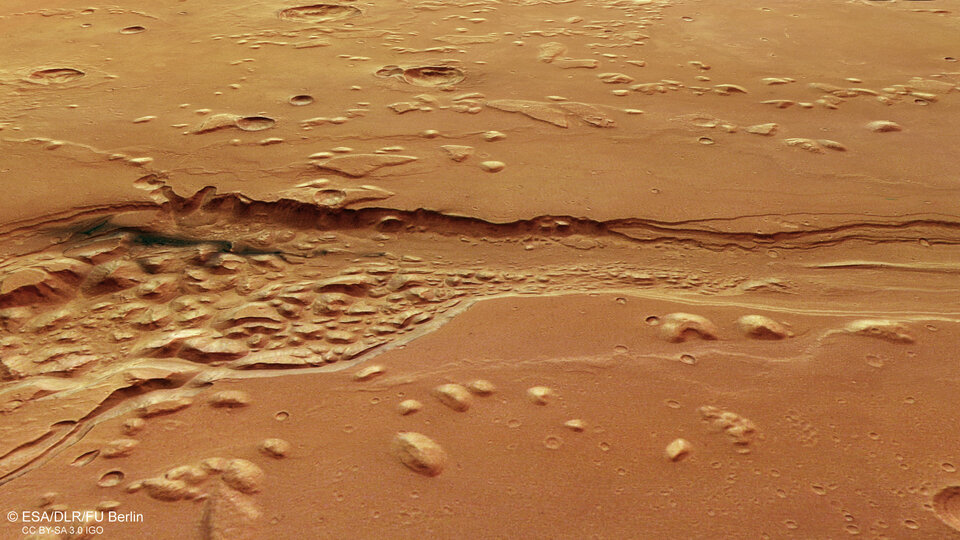
Shalbatana Vallis is located near the Martian equator and stretches 1,300 km from west to east—roughly the length of Ukraine. The main channel, about 10 km wide and 500 meters deep, formed approximately 3.5 billion years ago when massive amounts of underground water burst to the surface and rapidly carved through the rock.
Over time, the valley became shallower due to materials that gradually settled on its floor. These include a distinct dark layer of volcanic ash that winds had carried across the Martian surface. The exact composition of the deposits has not yet been determined.
Rugged terrain and craters
Next to the valley, you can see what is known as a chaotic landscape. It consists of a jumble of boulders and mounds that formed when the underground ice began to melt and the surface above it subsided.
Additional landforms include numerous meteorite craters in various states of preservation, solidified lava fields with characteristic wrinkled ridges, as well as isolated flat mesa-like hills—remnants of older surfaces.
Mars Express in Mars exploration
The images were taken by the HRSC (High-Resolution Stereo Camera), one of the eight scientific instruments on board Mars Express.
The ESA probe has been in Mars orbit since 2003 and has been mapping the planet’s surface in high resolution, in color and in 3D, for over two decades.
According to esa.int

