

Searching for the remains of ancient microorganisms on Mars is no easy task. After all, radiation over tens of millions of years could have completely destroyed even their traces. However, as recent experiments have shown, they could be well preserved in pure ice.
Microbes on Mars
Mars is a planet where life could once have existed. Finding it is not easy. However, scientists at NASA’s Goddard Space Flight Center and Pennsylvania State University have recently conducted research and now know where to look.
The problem lies in the unfavorable conditions that have existed on Mars for millions of years: lack of oxygen, liquid water, and cold temperatures. However, the worst thing is radiation, which can destroy not only the protein walls of cells, but also the molecules contained within them.
However, as a recent experiment has shown, microorganisms such as E. coli can survive in ice for 50 million years. Or at least complex organic compounds may remain from them, which are easy to detect.
Experimental results
To test their hypothesis, researchers produced two types of samples containing E. coli, also known as intestinal bacillus. The first represented pure ice, the second represented mud containing 10% frozen water. Both types of samples were placed in a gamma radiation chamber at the Radiation Science and Engineering Center at Pennsylvania State University. The chamber was cooled to -60°C to simulate conditions on Mars.
Of course, scientists couldn’t wait 50 million years. However, they were able to provide a significantly higher radiation intensity than on Mars for a certain period of time, and thus the samples received the appropriate dose of radiation. After that, they were examined.
Experiments showed that in samples containing only 10% ice, organic structures were completely destroyed. However, in samples of pure ice, E. coli could be preserved for quite a long time on Mars. And that is an interesting possibility.
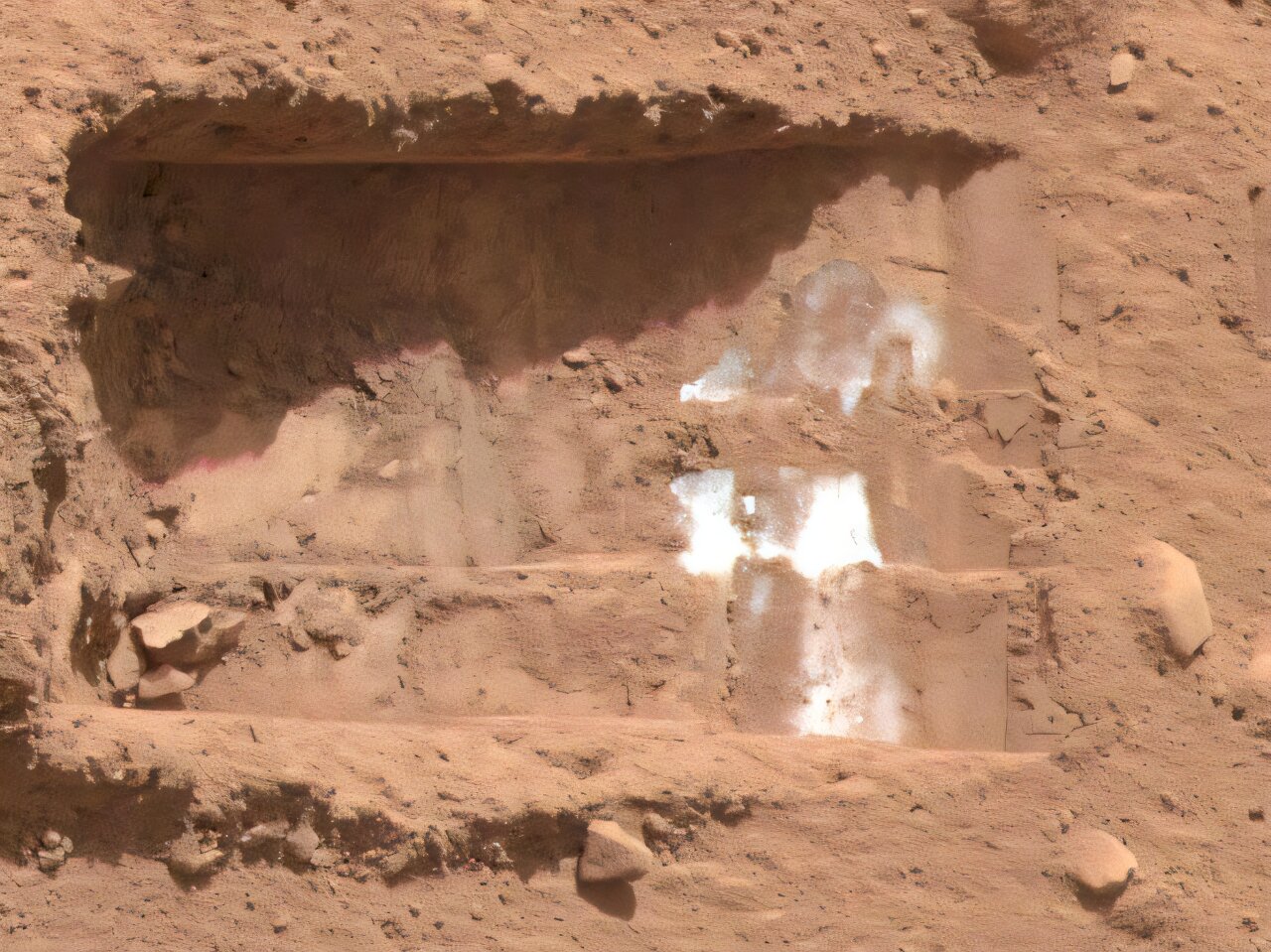
The fact is that the fourth planet from the Sun has enough formations that are significantly younger than 50 million years old. And life could well have survived there. The only problem is that they mainly consist of mud frozen together with ice. And in order to find pure ice, it is necessary to dig deep below the surface. But still, this is a good result.
These studies are also promising for the search for life beyond Mars. Jupiter’s moon Europa has much more pure ice. This means that samples of life from its subglacial ocean could be preserved there for hundreds of millions of years.
According to phys.org

