

The European Space Agency has published a video created from images taken by the Mars Express mission. It demonstrates what a flight over the ancient regions of the Red Planet would look like.
The video begins in Shalbatana Vallis, a huge drainage channel carved out by water flows during a catastrophic flood that occurred approximately 3.5 billion years ago. It stretches for 1,300 km.
Shalbatana Vallis stretches from the highlands of Xanthe Terra, located on the equator, to the giant lowlands in the north known as Chryse Planitia. Its path is marked by a large number of craters formed during the asteroid and comet bombardment of Mars, which lasted for billions of years.
Chryse Planitia has a much flatter relief, smoothed by water that once flowed across its expanses. In some places, formations resembling islands can be seen. According to scientists, these are areas of the original surface that managed to avoid erosion.
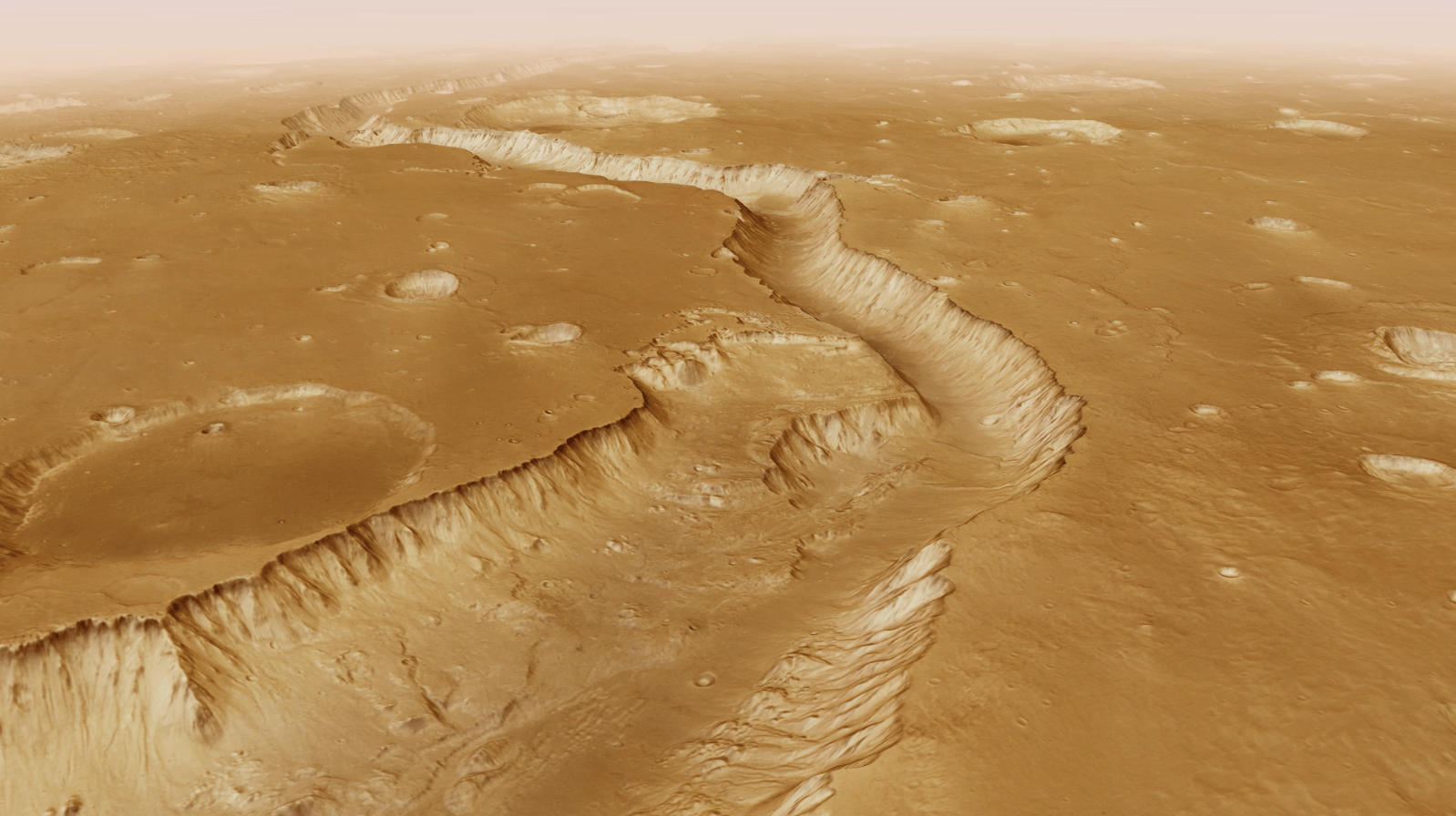
Next, we can see a vast region consisting of a large number of hills of various shapes. Such chaotic reliefs on Mars were formed as a result of groundwater release.
The video concludes with a flight over the ancient Da Vinci crater. It has a diameter of 100 km and a flat bottom. Inside Da Vinci is a smaller, fresher impact crater surrounded by material ejected during its formation.
Mars Express is far from the only mission studying Mars. You can learn about other spacecraft exploring the Red Planet in our article.

