

Astronomers recently discovered supernova SN 2023zkd, which was likely the result of a deadly confrontation between a star and a black hole. This discovery was published in the Astrophysical Journal and may change our understanding of how supernovae are born.
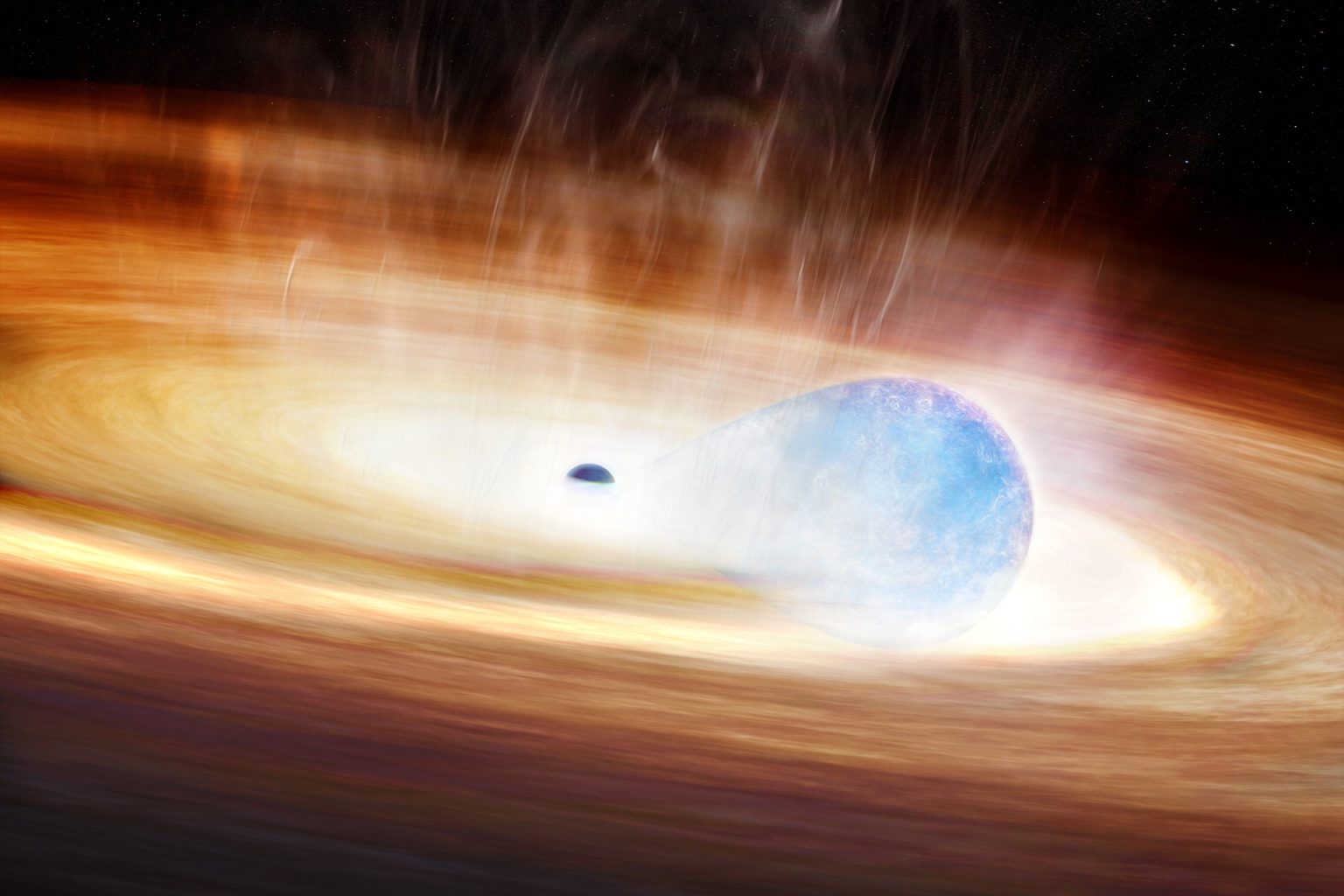
Supernova SN 2023zkd was discovered in July 2023 using the Zwicky Transient Facility telescope in California. Artificial intelligence, which analyzes data on stellar explosions on a daily basis, marked it due to its unusual behavior.
“The open supernova had two strange features. First, it seemed to explode twice: first it became brighter, then dimmed, and then flared up again. Secondly, supernovae usually reach their peak brightness in a matter of days or weeks, but in this case, the star gradually became brighter over several years before exploding,” said lead author Alexander Gagliano.
Death dance with a black hole
Researchers suggest that the strange behavior can be explained by the star falling into the gravitational trap of a black hole. Two objects began to approach each other, causing enormous gravitational stress, which led to the premature explosion of the star.
There is another scenario: perhaps the black hole completely tore the star apart before it had a chance to explode on its own. In this case, the stellar debris collided with the gas surrounding the black hole, triggering a flare.
How artificial intelligence helps find anomalies
The LAISS system, which detected SN 2023zkd, analyzes data on the luminosity of supernovae and their galaxies, comparing them with known samples. If something unusual is found, a specially configured bot notifies scientists.
“It’s an incredible instrument for finding rare phenomena,” says Gagliano. Thanks to such technologies, astronomers are discovering more and more exotic cosmic events.
The discovery of SN 2023zkd is just the beginning. Studying such supernovae will help us better understand how stars and black holes interact.
Earlier, we reported on how one of the largest black holes was discovered.
According to sciencealert.com

