

Chinese scientists have created an AI framework that allows them to find new patterns in large sets of space data. They have already tested it on astrophysical observation data and confirmed that it is capable of deriving new formulas.
What artificial intelligence can do
Everyone knows that in recent years, artificial intelligence has learned to perform many tasks that were previously thought to be beyond the capabilities of human intelligence. However, scientists have recently succeeded in creating a system that is capable of literally generating new scientific knowledge.
At least, that’s what they claim. We are talking about an AI framework developed at Tsinghua University in China. It is a computer system that combines a neural network with various mathematical programs and databases.
Everyone knows how AI based on neural networks works—it first needs to be trained on a large amount of data, showing it where the cats are and where the dogs are, so that it can recognize them in other images. The same applies to language: once it understands its patterns, the computer will be able to write something itself.
AI has already been used in science to sift through large amounts of data. For example, neural networks have been searching images of galaxies and classifying them for several years. However, this is not the level that scientists have always dreamed of. Not a computer capable of creating new theories.
Creating formulas
Science is the search for new patterns and rules that govern how the world works. Scientists observe their surroundings, notice certain features, and test them experimentally by measuring data and creating mathematical models based on that data.
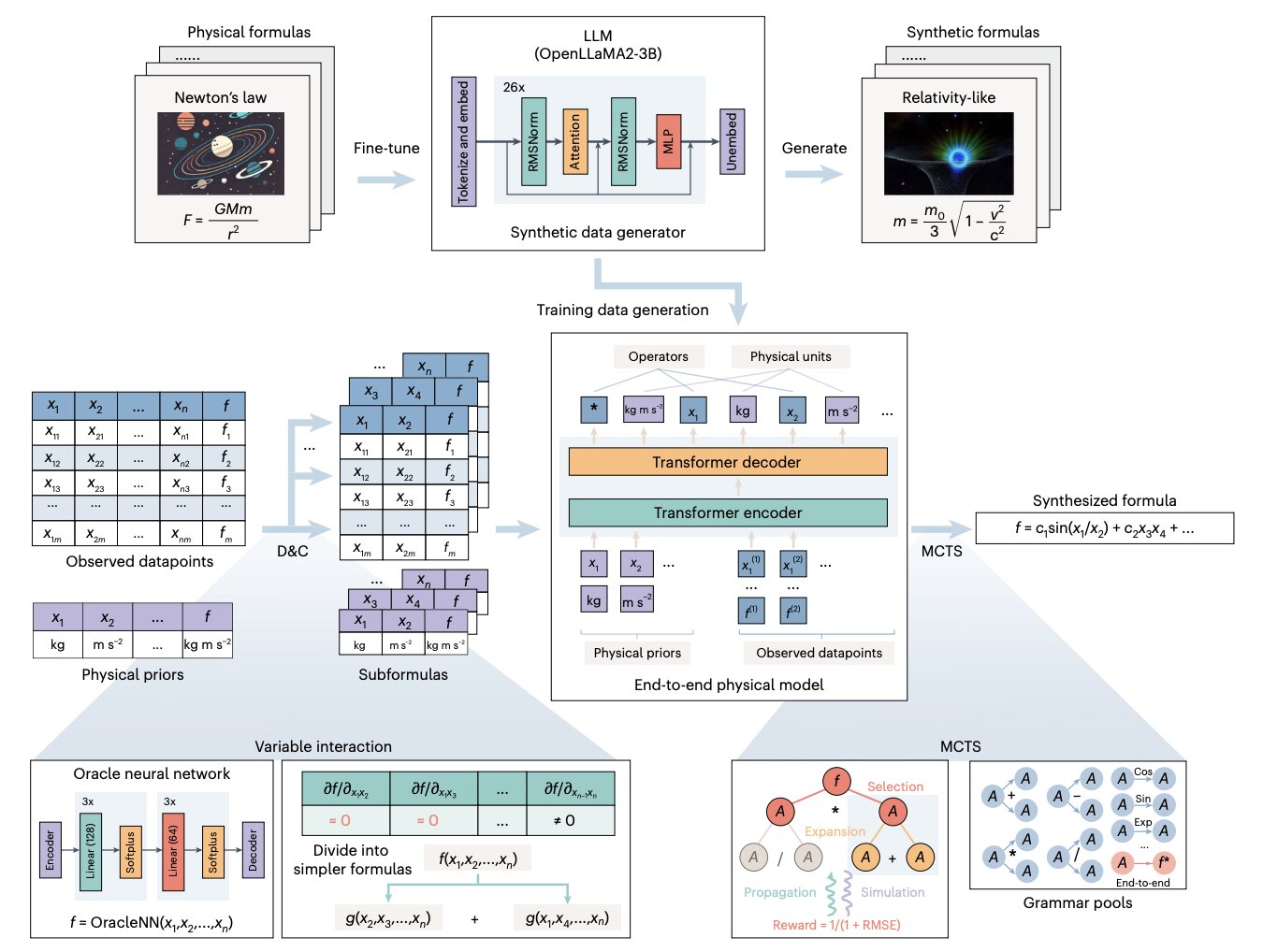
This is precisely what the new PhyE2E system does. It sifts through data sets and can search for certain mathematical patterns in them, just as other AI systems can see cats and dogs in pictures. To do this, it was trained for a long time on patterns previously established by humans.
In general, PhyE2E can analyze any array of physical data using various mathematical methods. However, the developers decided to test it specifically in astrophysics—a field where a huge amount of observations have been accumulated. As a result, the system was able to independently construct five formulas based on this data, very similar to those previously created by humans.
Essentially, the new artificial intelligence model developed by this research group learns to break down complex physical problems into simpler parts. Based on existing and well-established equations, it can generate new formulas that effectively describe the relationship between different variables.
PhyE2E may soon be used to analyze other experimental and astrophysical data, which could provide formulas that better describe specific physical phenomena or interactions. In the future, it could also be adapted and applied to other disciplines, potentially contributing to scientific discoveries in various fields.
According to phys.org

