
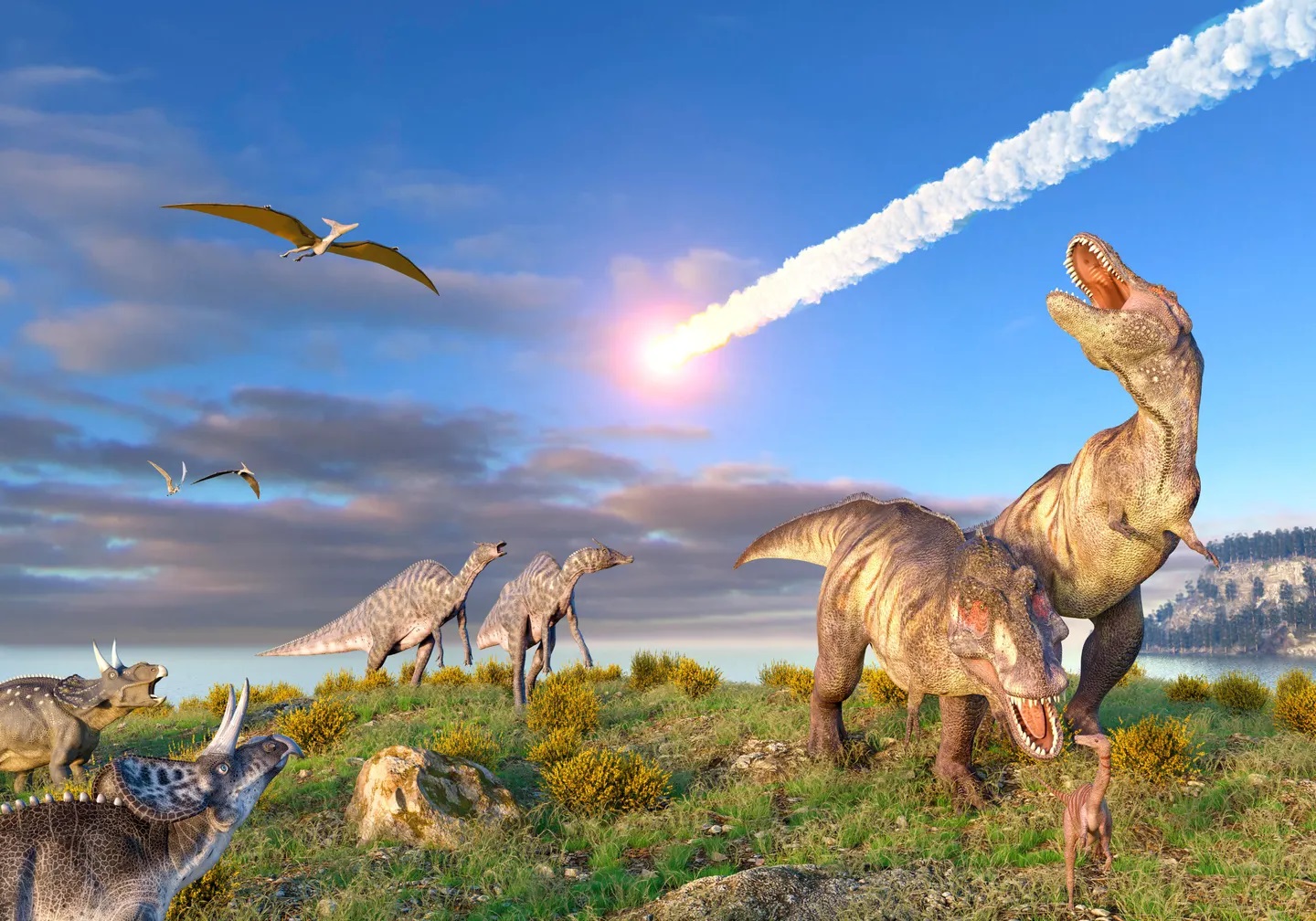
The asteroid that caused the extinction of the dinosaurs also created an underground environment suitable for new life, and, according to the results of new research, this environment persisted for millions of years longer than previously thought.
Hydrothermal system beneath the crater
This discovery surprised an international team of scientists, who reached these conclusions by combining the latest methods of analyzing samples taken from the Chicxulub crater in Mexico with computer simulations of the geological consequences of the asteroid impact that formed the crater 66 million years ago.
A study published in the journal Communications Earth & Environment sheds new light on how life may have first emerged in hydrothermal systems during the earliest stages of Earth’s history, and could help guide the search for life on other planets.
Despite the extensive surface destruction caused by the asteroid impact, the heat released by the impact heated fractured rocks and groundwater, creating a powerful hydrothermal system beneath the crater. The researchers present evidence that it has existed for at least 8 million years—about four times longer than previous estimates suggested. This makes it the longest-lived of the known impact hydrothermal systems formed by asteroid impacts.
Research on the Chicxulub Crater
The Chicxulub Сrater was formed by an asteroid impact on the Yucatán Peninsula in Mexico approximately 66 million years ago. The impact of the 10-kilometer-wide (6-mile-wide) asteroid had catastrophic consequences, triggering a mass extinction that wiped out about three-quarters of the planet’s plants and animals, including all non-avian dinosaurs.
It left behind a crater nearly 200 kilometers (124 miles) in diameter, and the destructive effects of the impact penetrated deep into the Earth’s crust. Under these extreme conditions, the rocks, melted by the impact, came into contact with the seawater of the Gulf of Mexico, forming a porous material containing countless tiny cavities filled with water heated during the impact—conditions that are ideal for the existence of microorganisms.
In 2016, a team of scientists traveled to the crater to drill through the top of its rim as part of Expedition 364, organized by the International Oceanographic Program and the International Continental Scientific Drilling Program. The samples they collected contained a potassium-rich type of feldspar formed as a result of hot fluid circulation following the impact.
Dr. Annemarie Pickersgill of SUERC—the Centre for Isotope Sciences—took part in Expedition No. 364. At SUERC in East Kilbride, Scotland, she used a method known as argon-argon dating to accurately determine the age of the feldspar samples. The analysis revealed that the feldspar samples ranged in age from the time of the impact 66 million years ago to approximately 58 million years ago—a span of 8 million years.
Modeling of a long-lived hydrothermal system
Using updated computer simulations based on new data, the team sought to determine which geological conditions were most likely to have supported the existence of such a long-lived system. During the simulations, a range of physical conditions was modeled based on data collected during drilling operations, combined with more sophisticated geological data obtained by scientists in the twenty years since the first simulations were conducted.
The simulation results suggest that a combination of high rock permeability, long-lasting impact heat, and natural geothermal conditions likely contributed to the preservation of the system over millions of years, consistent with the 8-million-year time span determined through feldspar analysis.
The team’s findings may be significant for scientists’ understanding of how life originated on early Earth, as well as for the search for life on terrestrial planets, where asteroid impacts were much more frequent.
Advances in computational methods allow researchers to model complex natural systems with unprecedented realism, bringing us closer to unraveling the mysteries of the chaotic physical processes that have shaped the Earth and other planetary bodies over geological time.
Scientists used these advances to study, in unprecedented detail, the complex interactions between heat, rock composition, and water flow triggered by the Chicxulub impact, allowing them to investigate how hydrothermal systems evolved over time and determine how long they remained active beneath the crater.
Search for life on Mars and other planets
Dr. Pickersgill added: “We know that planets like Mars, which don’t have the protection of a thick atmosphere like Earth does, have experienced many, many impacts during their history. That includes periods when water may have been much more abundant, and big enough impacts could have spurred the formation of long-lived hydrothermal systems that could have supported life.”
Porous, fractured rocks formed by impacts create microenvironments where microorganisms can be protected from radiation and extreme temperatures. These conditions give life a chance to take hold and thrive, and this is likely what happened here on Earth billions of years ago. With an eye toward the future of space exploration, these findings may help future missions to other planets identify which impact craters would be most likely to harbor life.
According to phys.org

