

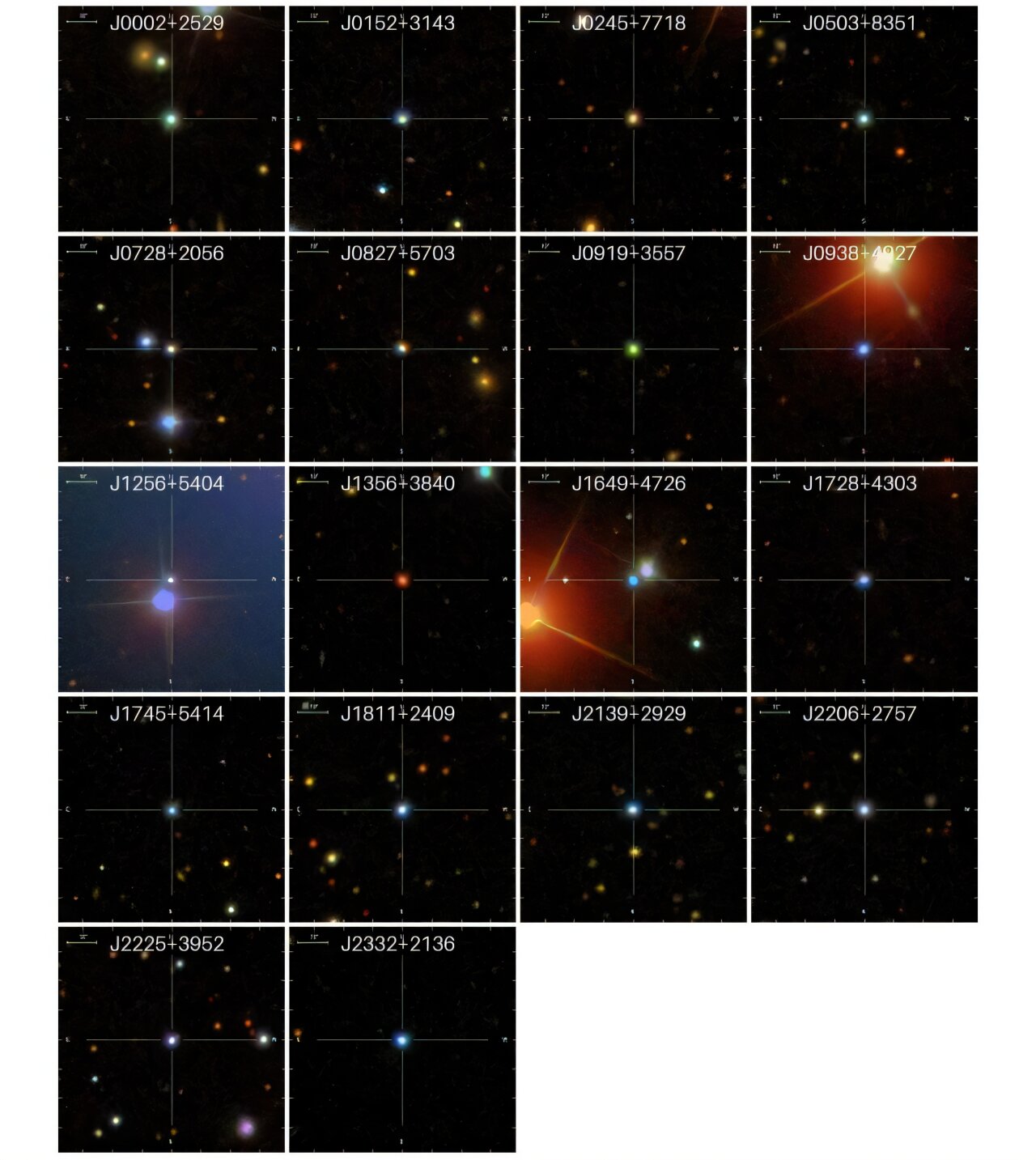
Astronomers from Seoul National University in South Korea, together with colleagues from other countries, have discovered 62 new bright quasars.
Quasars, or quasi-stellar objects, are extremely bright nuclei of distant galaxies. At their centers are supermassive black holes that absorb surrounding gas and dust. During this process, a huge amount of energy is released, which can be observed across the entire spectrum – from radio waves to X-rays. A single quasar can shine brighter than billions of stars combined, which is why they are sometimes called cosmic “superlights.”
The discovery was made as part of the AllBRICQS (All-sky BRIght, Complete Quasar Survey) project. This is a large survey of the sky that searches for the brightest quasars. To conduct their search, astronomers utilized data from modern catalogs and spacecraft: the Wide-field Infrared Survey Explorer (WISE) telescope enabled them to detect infrared radiation, while the Gaia mission provided highly accurate data on the movement of stars. First, the team identified 75 candidate quasars, then confirmed 62 of them using spectroscopic observations at telescopes in Korea and China.
The new quasars are located at different distances from Earth: some are closer, while others are billions of light-years away. These quasars turned out to be extremely bright: they shine hundreds or even thousands of times more brightly than the average quasar of this type. Among them are some truly unique objects, in particular one of the most striking known quasars of the FeLoBAL type, which has distinctive iron absorption lines.
The case of object J0919+3557 is also interesting: at first, it was considered to be an ordinary galaxy, but after refining the parameters, researchers determined that it was a quasar with weak emission lines — a rather rare variety.
Scientists explain that such discoveries help to better understand how supermassive black holes grow, how they affect their galaxies, and how quasars themselves change over time.
“These new quasars will be an important resource for future studies of the evolution of quasars, black holes, and host galaxies,” the team concludes.
An article describing the results was published on August 8 on the arXiv server.

