

Astronomers have long claimed that dark matter is the invisible framework that holds galaxies together. Without its immense gravitational pull, the rotational motion of the galaxies would simply tear them to shreds. But now scientists have discovered a chain of galaxies that appear to be completely devoid of dark matter. This lends credence to a radical theory of galaxy formation known as the “Bullet Dwarf” collision scenario, which has been a controversial idea over the past decade.
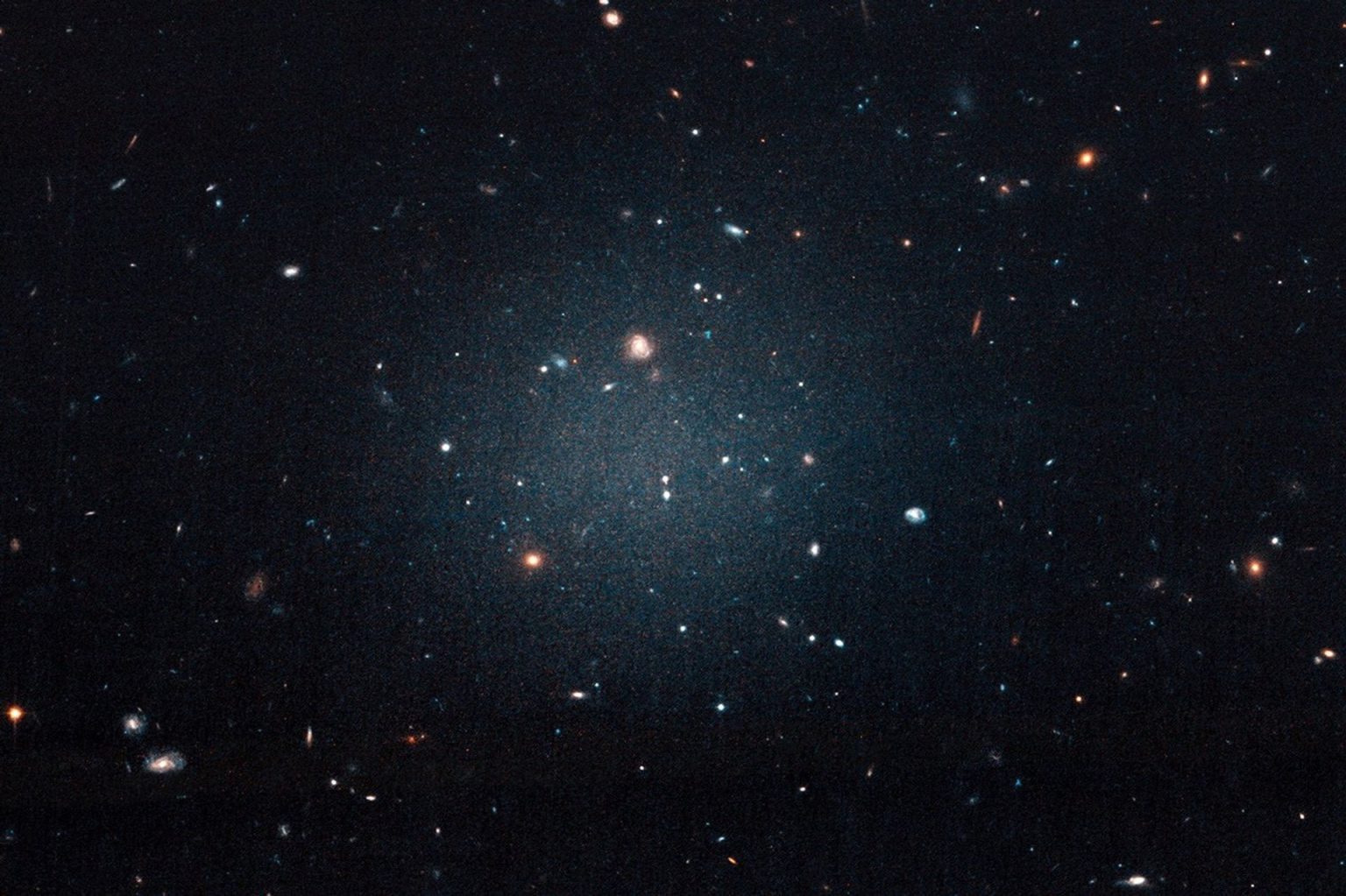
A very low-density galaxy without dark matter
Back in 2018, Dr. van Dokkum and his team published another scientific paper in which they described in detail the ultradiffuse galaxy NGC 1052-DF2 (DF2). This galaxy was the same size as the Milky Way, but contained 500 times fewer stars. It was so sparse that other ancient galaxies were literally visible through it. And this was the first indication of the possibility that galaxies could exist without the dark matter keeping them together.
The discovery of the DF2 galaxy has shown that dark matter is a distinct physical substance that can be distinguished from ordinary matter. This dealt a serious blow to Modified Newtonian Dynamics (MOND), a theory developed to explain why stars at the outer edges of galaxies move too fast. MOND suggests that at extremely low accelerations, such as those experienced by stars at the edge of a galaxy, gravity acts slightly more strongly than expected.
Discrepancy between observational data and MOND theory
MOND attempts to describe a law of nature, whereas the theory of dark matter addresses the same problem but through the use of a physical substance. The DF2 galaxy proved to be an excellent testing ground for comparing these two theories. According to MOND, a diffuse galaxy such as DF2 should exhibit the enhanced gravity that this theory predicts for environments with low internal acceleration. Consequently, if the MOND theory were correct, the DF2 stars would be moving much faster than their apparent mass would suggest.
But the researchers saw something completely different. They found that galaxies move at a slow speed, which is fully consistent with classical, unmodified Newtonian dynamics. Thus, the discovery of DF2 presented MOND with a fatal paradox. If MOND is a fundamental law of physics, it must apply to all matter—a galaxy cannot simply escape the effects of the laws of gravity. However, the “normal” gravity observed in DF2 has shown that the “extra gravity” observed in other galaxies is not a universal rule.
When new data is introduced into a scientific debate, there is usually a lot of disagreement. Several articles have been published that cast doubt on the calculations of the distance to DF2, which could explain why its stars moved in that particular way. But then the Hubble Space Telescope observed it and confirmed the distance. What’s more, Dr. van Dokkum and his team have discovered another galaxy. Known as DF4, it formed a tight linear tail together with DF2 and shares many common characteristics.
This latest article, which presents the object NGC 1052-DF9 (DF9)—located precisely in the “tail” between DF2 and DF4—confirms this pattern. The data now clearly point to a chain of ultra-diffuse galaxies that appear to simply lack dark matter. This raises the question: why don’t they have dark matter?
Alternative theory of “dwarf stars”
According to the research team, a likely explanation is the “Bullet Dwarf” collision theory. Essentially, this happens when two galaxies collide at tremendous speeds. The trace between DF2, DF4, and DF9 provides compelling evidence that they were all formed as a result of a single catastrophic event. And this event is most likely a collision between “dwarf stars.”
Imagine two dwarf galaxies rich in gas hurtling toward each other. Since dark matter interacts only through gravity, the dark matter halos holding these galaxies together simply pass right through one another, like ghosts. At the same time, ordinary matter—in this case, giant gas clouds—physically collides with one another during a violent collision. This collision separates the gas from the dark matter, triggering a powerful burst of star formation and leaving behind a chain of galaxies completely devoid of dark matter.
The absence of dark matter in DF9, as predicted by the “Bullet” theory of dwarf galaxy collisions, is a major victory for that theory. But this might not be the last one. Next, the team hopes to measure the kinematics of the fourth or fifth galaxies along this path, although the farther away they are, the fainter they become. DF9 provides evidence both of the existence of dark matter and of the extreme and violent ways in which the Universe can form galaxies.
According to phys.org

