

Galaxies are enormous structures measuring tens of thousands of light-years across. However, there are even larger objects in space, in which galaxies form giant filaments. Scientists have discovered one such filament relatively close to the Milky Way.
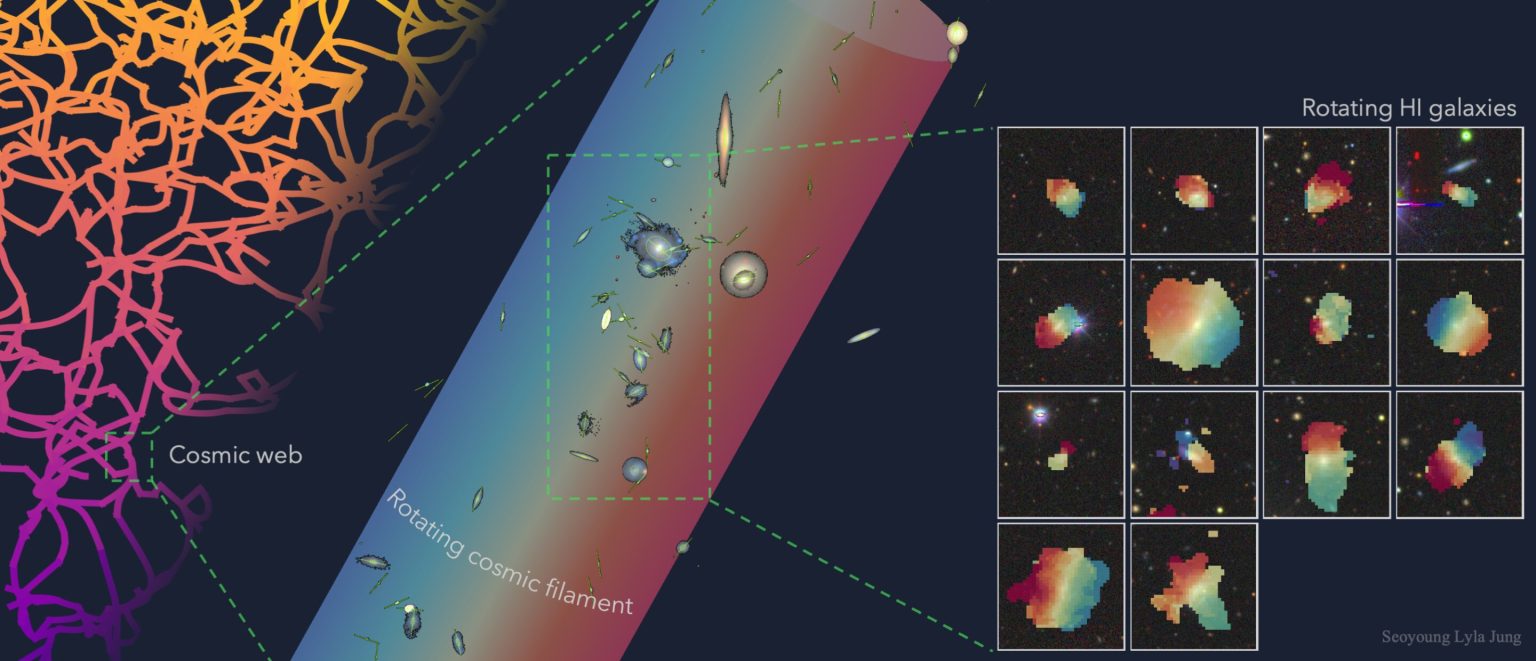
Cosmic filaments in the Universe
An international team led by scientists from Oxford University has discovered one of the largest rotating structures ever reported: a thin, blade-like filament of galaxies embedded in a giant rotating cosmic filament 140 million light-years away.
Cosmic filaments are the most famous structures in the Universe: huge formations of galaxies and dark matter that form cosmic frameworks. They also act as highways along which matter and momentum flow into galaxies.
Nearby filaments containing many galaxies rotating in the same direction—and where the entire structure appears to rotate—are ideal systems for studying how galaxies acquired the rotation and gas they have today. They also allow us to test theories about how cosmic angular momentum is formed on scales of tens of millions of light-years.
New discovery
In a new study, scientists have discovered 14 neighboring galaxies rich in hydrogen, arranged in a thin, elongated line about 5.5 million light-years long and 117,000 light-years wide. This structure is located within a much larger cosmic filament containing more than 280 other galaxies and measuring approximately 50 million light-years in length.
It is noteworthy that many of these galaxies appear to rotate in the same direction as the filament itself—far more than would be expected if the rotation of galaxies were random. This calls into question current models and suggests that cosmic structures may influence the rotation of galaxies more strongly or for longer than previously thought.
Researchers found that galaxies on both sides of the filament’s spine are moving in opposite directions, indicating that the entire structure is rotating. Using models of the filament’s dynamics, they determined a rotation speed of 110 km/s and estimated the radius of the dense central region of the filament to be approximately 50 kiloparsecs (about 163,000 light-years).
Scientists say that the structure they discovered is unique not only because of its size, but also because of the combination of alignment and rotational motion. It can be compared to a “cup” ride at an amusement park. Each galaxy is like a spinning cup, but the entire platform—the cosmic filament-is also spinning. This dual motion gives us a rare glimpse into how galaxies get their spin from the larger structures in which they exist.
Implications for galaxy formation and evolution
The filament appears to be a young, relatively undisturbed structure. The large number of gas galaxies and low internal motion—the so-called “dynamically cold” state—indicate that it is still in an early stage of development.
Since hydrogen is the raw material for star formation, galaxies containing large amounts of hydrogen are actively collecting or storing fuel for star formation. Therefore, studying these galaxies can provide insight into the early or current stages of galaxy evolution.
Hydrogen-rich galaxies are also excellent indicators of gas movement along cosmic filaments. Since atomic hydrogen is more easily disrupted by motion, its presence helps reveal how gas passes through filaments into galaxies, providing clues about how angular momentum passes through the cosmic web, affecting galaxy morphology, rotation, and star formation.
This discovery may also be useful in future attempts to model the internal alignment of galaxies, which is a potential factor that could influence the results of future weak lensing cosmology studies as part of the European Space Agency’s Euclid mission and the Vera C. Rubin Observatory in Chile.
Observation and details of cooperation
The international team used data from South Africa’s MeerKAT radio telescope, one of the most powerful telescopes in the world, consisting of an array of 64 interconnected satellite antennas.
This rotating filament was discovered through an in-depth study of the sky called MIGHTEE, led by Professor of Astrophysics Matt Jarvis ( Department of Physics, University of Oxford). It involved optical observations using the Dark Energy Spectroscopic Instrument (DESI) and the Sloan Digital Sky Survey (SDSS) to detect a cosmic filament that demonstrates both the coherent alignment of galaxy rotation and mass rotation.
According to phys.org

