

Using NASA’s Transiting Exoplanet Survey Satellite (TESS), an international team of astronomers has discovered a new exoplanet that is slightly larger and five times more massive than Jupiter. The exoplanet orbits a distant star known as TIC-65910228.
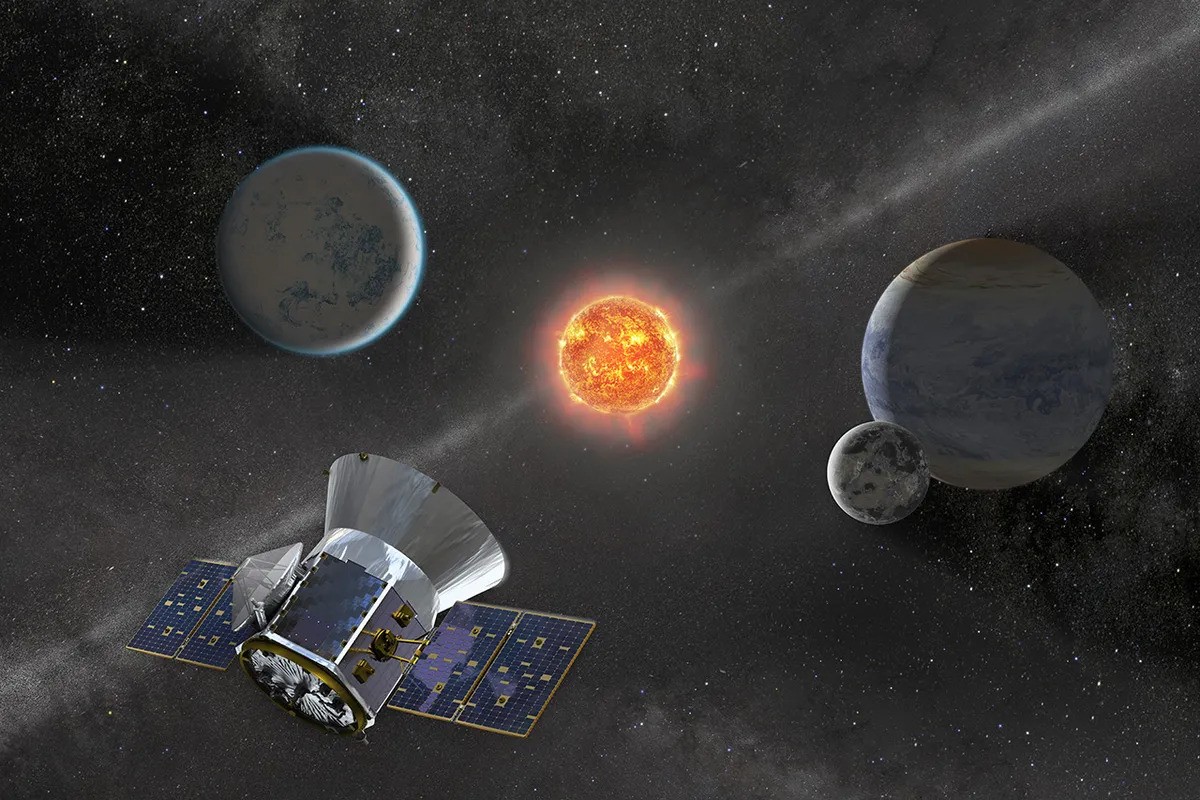
TESS identifies a distant transit signal
TIC-65910228, or NGTS-38, is a bright, metal-rich star of spectral type F6V-F7V, located about 864 light-years away. The star, estimated to be 2.2 billion years old, is almost twice the size of the Sun, has a mass of about 1.46 solar masses, and has an effective temperature of 6310 K.
TIC-65910228 has been observed several times by TESS in recent years, and one transit signal was detected in December 2020. Now, a group of astronomers led by Toby Rodel of the Queen’s University Belfast, UK, has conducted further photometric observations of TIC-65910228 using the Next Generation Transit Survey (NGTS) and spectroscopic monitoring of radial velocity using the CORALIE spectrograph and High Accuracy Radial Veloci. Their observation campaign confirmed the planetary nature of this transit signal.
Characteristics of planet TIC-65910228 b
According to the study, TIC-65910228 b has a radius of approximately 1.08 times that of Jupiter and a mass of 4.78 times that of Jupiter, giving it a density of 4.69 g/cm3. The planet orbits its star every 180.53 days at a distance of about 0.7 AU from it. The equilibrium temperature of TIC-65910228b is estimated at 458 K.
Thus, TIC-65910228b joins a small but growing group of well-characterized transiting warm Jupiters. Moreover, it turns out to be one of the longest transit periods ever discovered and one of only 13 planets with an orbital period of more than 100 days discovered by TESS.
Study of the atmosphere and additional objects in the TIC-65910228 system
As for the atmosphere, astronomers suggest that it probably contains molecular nitrogen compounds that are not found in the atmospheres of hotter giant planets. However, they noted that the planet is not suitable for further research using atmospheric transmission spectroscopy with current-generation devices.
Given that smaller inner moons have already been discovered in many transit hot Jupiter systems, the authors of the article expect to find even more planets around TIC-65910228. They note that due to the large orbital distance of TIC-65910228 b, it is quite likely that there are additional inner planets in stable orbits. Researchers also suggest that TIC-65910228b is one of the most likely transiting planets to have stable exomoon or ring systems.
According to phys.org

