

The TESS space telescope has discovered an exoplanet with a long orbital period. Its characteristics resemble those of Jupiter.
TESS was launched in 2018 with the aim of searching for exoplanets around 200,000 of the brightest stars closest to us. For this purpose, the transit method is used. TESS tracks fluctuations in the brightness of stars, indicating the presence of companions. To date, the telescope has confirmed the existence of over 700 exoplanets. Nearly 8,000 more are considered candidates.
Now this list will be expanded with another world, designated TOI-6692 b. It orbits a star located 1,012 light-years from Earth. With a mass similar to that of our Sun, it is 38% larger than our star. The age of the star is estimated at 7.8 billion years.
In 2021, TESS recorded a decrease in the brightness of the star caused by the transit of an exoplanet orbiting it. Its existence was later confirmed by ground-based observations.
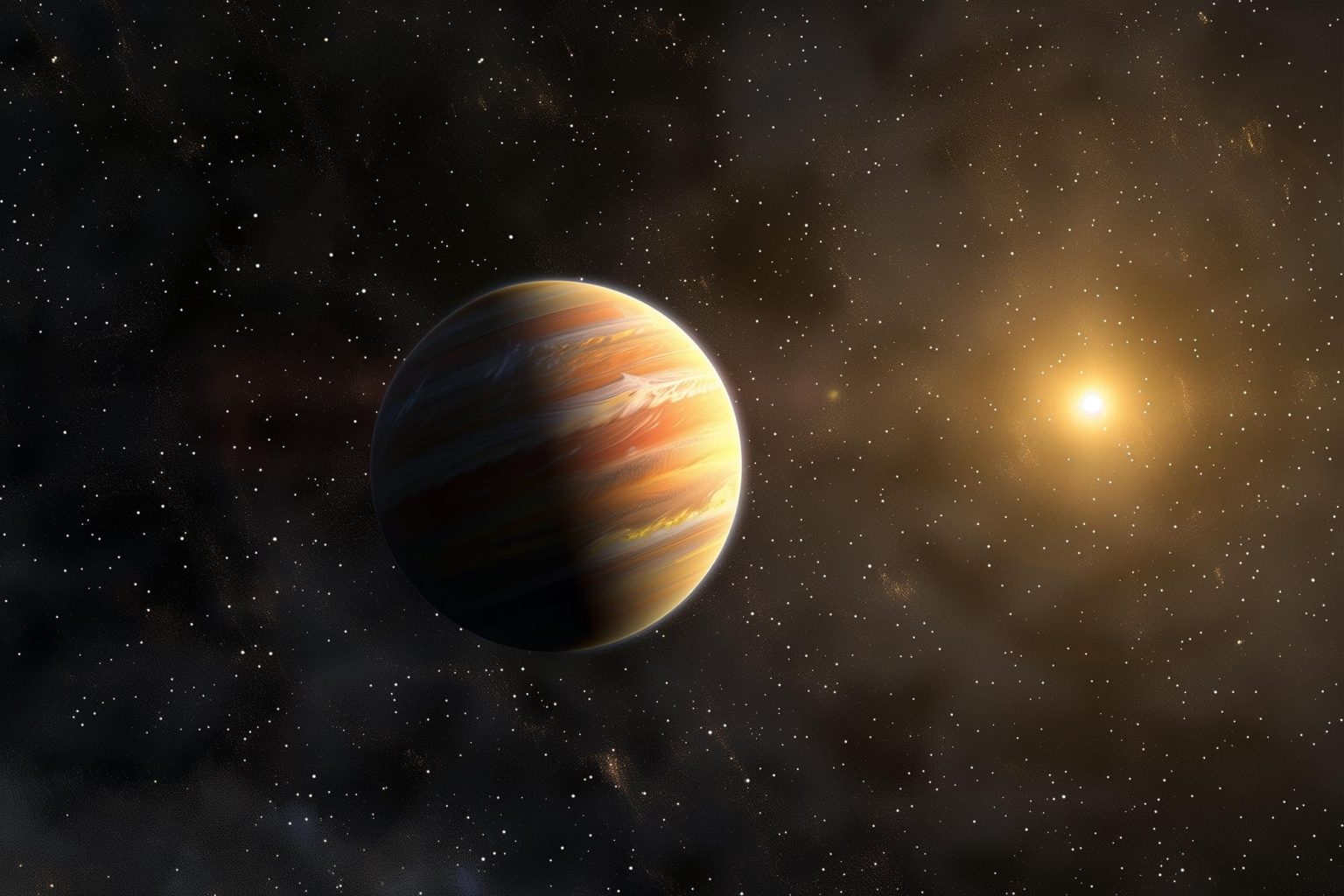
The exoplanet TOI-6692 b has a radius approximately 1.04 times that of Jupiter and a mass 0.62 times that of Jupiter. The planet orbits its star in an elongated orbit, which lies at an average distance of 0.51 AU from it. It takes 130.5 days to complete one cycle. The equilibrium temperature of the exoplanet is estimated at 194 °C.
Based on these properties, astronomers have classified TOI-6692 b as a warm Jupiter in an eccentric orbit. The discovery is interesting because it is one of the few giant planets with an orbital period of more than 100 days whose mass and radius have been measured.
Researchers have also found signs of another planet in this system located at a greater distance than TOI-6692. This is evidenced by the trend in the star’s radial velocity. However, additional observations will be needed to confirm its existence.
Earlier, we reported on how a neural network discovered 7,000 candidate exoplanets.
According to Phys.org

