

The TESS satellite helped scientists discover a new planet, TOI-5734 b. It is quite hot and twice Earth’s radius. Scientists believe that it is a sub-Neptune.
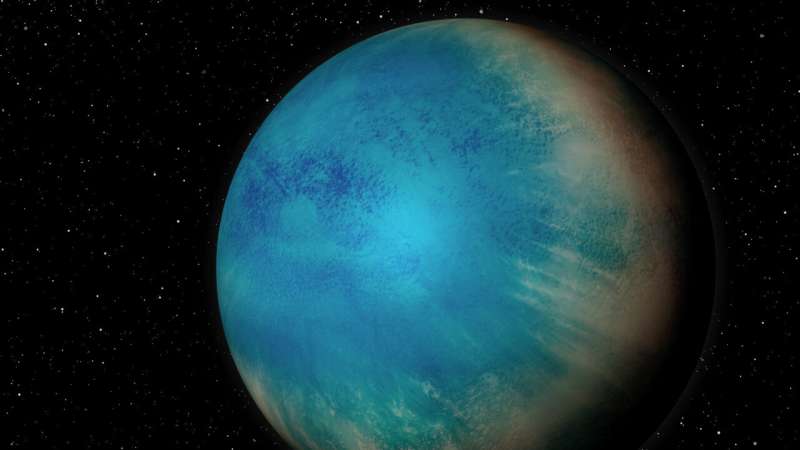
New mini-Neptune
On February 20, scientists from the Rome Astronomical Observatory announced the discovery of the exoplanet TOI-5734 b. They were assisted in this by the TESS (Transiting Exoplanet Survey Satellite) and a high-precision search device for the radial velocity of planets in the northern hemisphere (HARPS-N). The article was published on the arXiv preprint server.
Located some 106 light-years away, TOI-5734, also known as TIC 9989136, is a relatively young dwarf star of spectral type K3-K4 V. It has a radius of about 0.64 solar radii, and its mass is approximately 0.72 solar masses. The effective temperature of TOI-5734 is estimated to be 4,750 K.
The first indications that TOI-5734 may host an exoplanet came in 2022 when TESS identified a transit signal in the light curve of this star. Now, follow-up observations of TOI-5734 conducted by a group of astronomers led by Simone Filomeno of the Astronomical Observatory of Rome, Italy, confirm the planetary nature of this signal.
Parameters and composition of TOI-5734 b
According to the study, TOI-5734 b has a radius of about 2.1 Earth radii, while its mass is 9.1 Earth masses, which yields a density slightly lower than that of our home planet. The exoplanet orbits its host every 6.18 days, at a distance of some 0.06 AU from it. The equilibrium temperature of TOI-5734 b is estimated to be at a level of 688 K.
Therefore, based on the derived parameters, the astronomers classified TOI-5734 b as a hot sub-Neptune exoplanet with an Earth-like density. They noted that the properties of TOI-5734 b place it on the upper edge of the so-called “radius valley,” which is characterized by a scarcity of planets with radii between 1.5 and 2.0 Earth radii.
When it comes to the chemical composition of TOI-5734 b, the astronomers suppose that it is most likely a rocky world almost depleted of its primary atmosphere, not excluding the water-world scenario at the moment. They assume that it will completely lose its primordial envelope within 300 million years from now.
Regarding the past evolution of TOI-5734 b, the authors of the paper conclude that during its lifetime, the planet has likely moved from the region at larger radii in the mass-radius diagram to its current position near the radius gap.
Provided by: phys.org

