January will be, first and foremost, the month of the long-awaited confrontation between Jupiter and one of the most powerful meteor showers – the Quadrantids. However, the visible activity of the first notable meteor shower of 2026 will be significantly reduced due to the large phase of the Moon.
Saturn and Neptune are still visible during long winter evenings. On January 15, Saturn will move from the constellation Aquarius to Pisces, while Neptune, moving much more slowly, will remain in Pisces.
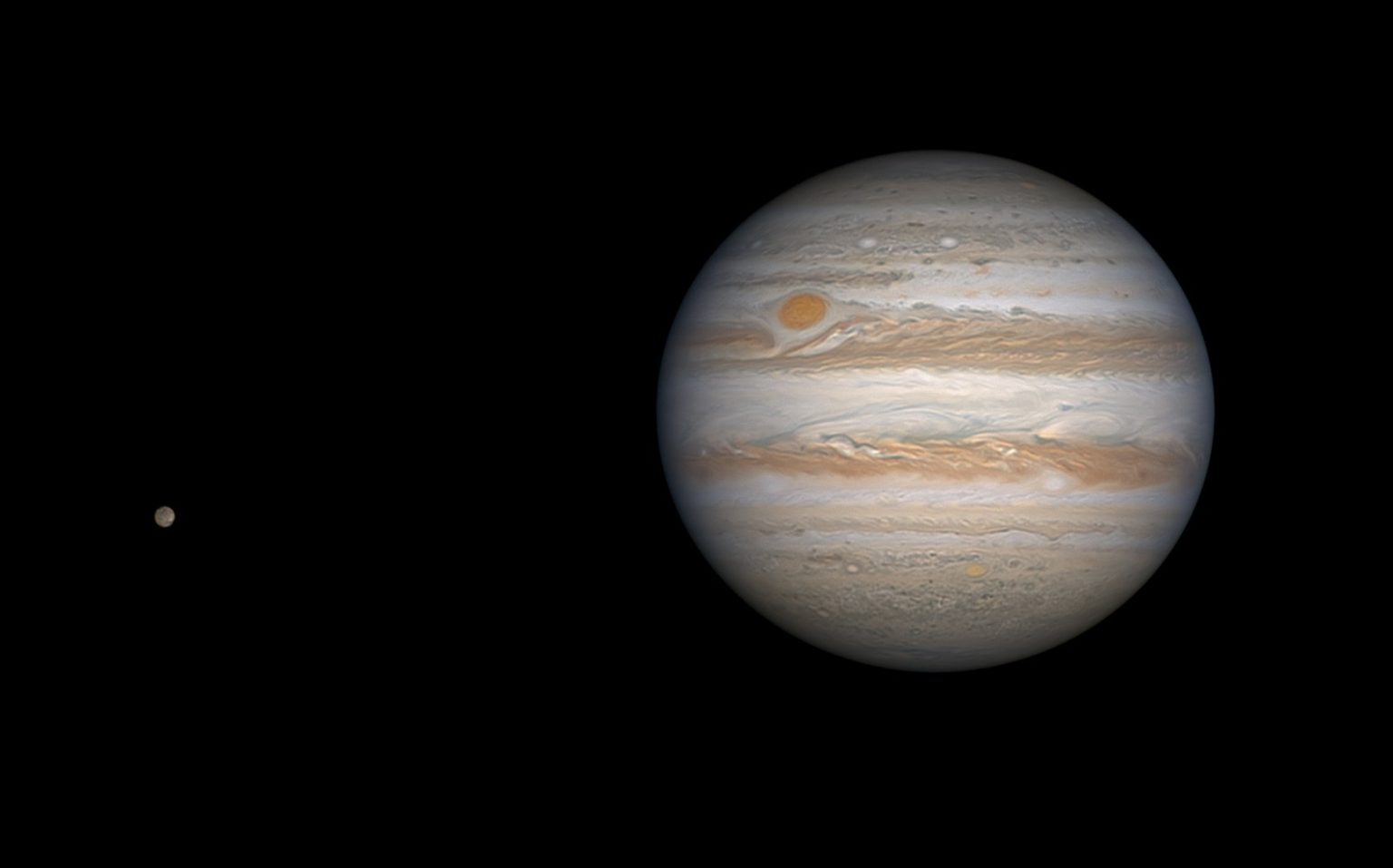
Photo: Tom Williams; 600 mm diameter reflecting telescope
This month will not offer many opportunities for planet enthusiasts. In January, Mars, Venus, and Mercury will be close to the Sun. In particular, on January 8, there will be a unique triple conjunction of the Sun, Venus, and Mars. Is it possible to observe such a rare phenomenon? With ground-based instruments, absolutely not. However, it is possible to track the movement of the planets using space coronagraphs, such as the old faithful SOHO and PUNCH, which will be launched in March 2025.
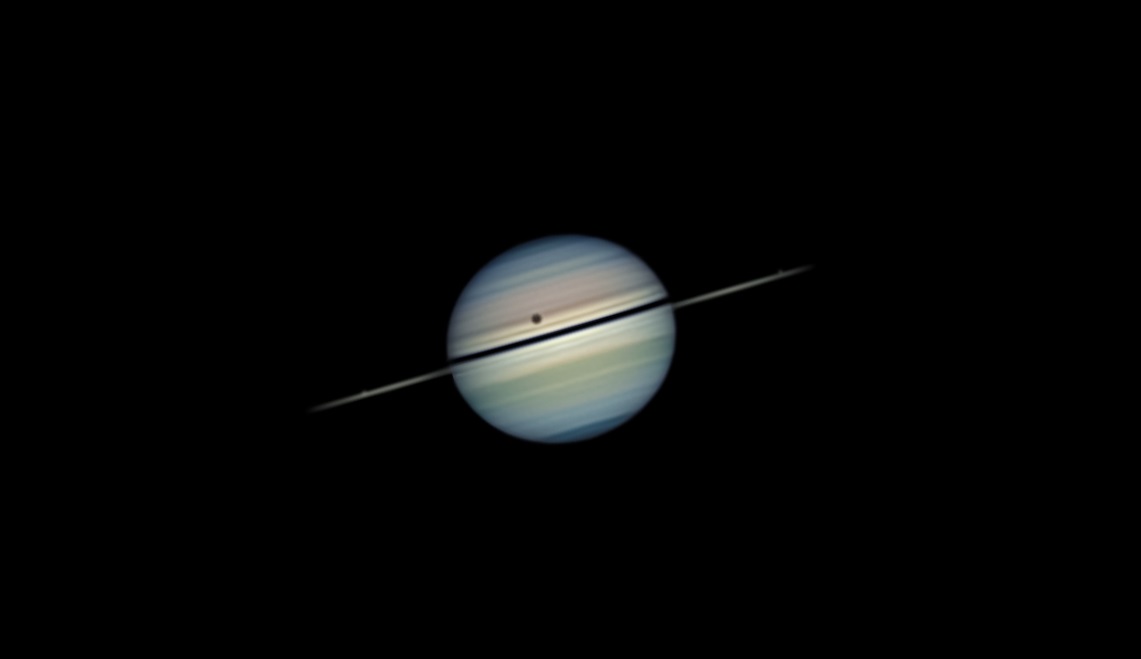
January marks the end of Titan’s transit season across Saturn’s disk. It is a rare phenomenon during which the largest moon is positioned between the planet and us for several hours. The next time we will be able to observe such events will be in 2038-2039. Similar phenomena occur only when the Earth is almost exactly in the plane of Titan’s orbit, which, in turn, practically coincides with the plane of the rings. Therefore, there is approximately 7.5 years between neighboring series – about the same as between equinoxes on Saturn, which are marked by the visibility of the rings from edge on.
Approximately 16 days pass between two consecutive transits of Titan, the period of its rotation around Saturn. The first of the two January transits will be visible on January 9 at 7:01 p.m. (5:01 p.m. UTC), and this will be the last relatively favorable transit for us. During the second transit, Saturn will be too low above the horizon for us to see – only 14°. However, you can try to see it. It will begin on January 25 at 7:45 p.m. and, like the first one, will last until Saturn disappears below the horizon.
Orion and Canis Major, Auriga, and Perseus with Cassiopeia dominate the bright constellations in the January sky, providing opportunities to admire numerous famous nebulae, clusters, and galaxies on long nights.
List of events
? ? ? January 3 – a full moon, with the exact time of the full phase at 12:03 p.m. (10:03 UTC), so for those who enjoy observing and photographing the full moon, the night of January 2 to 3 will be optimal.
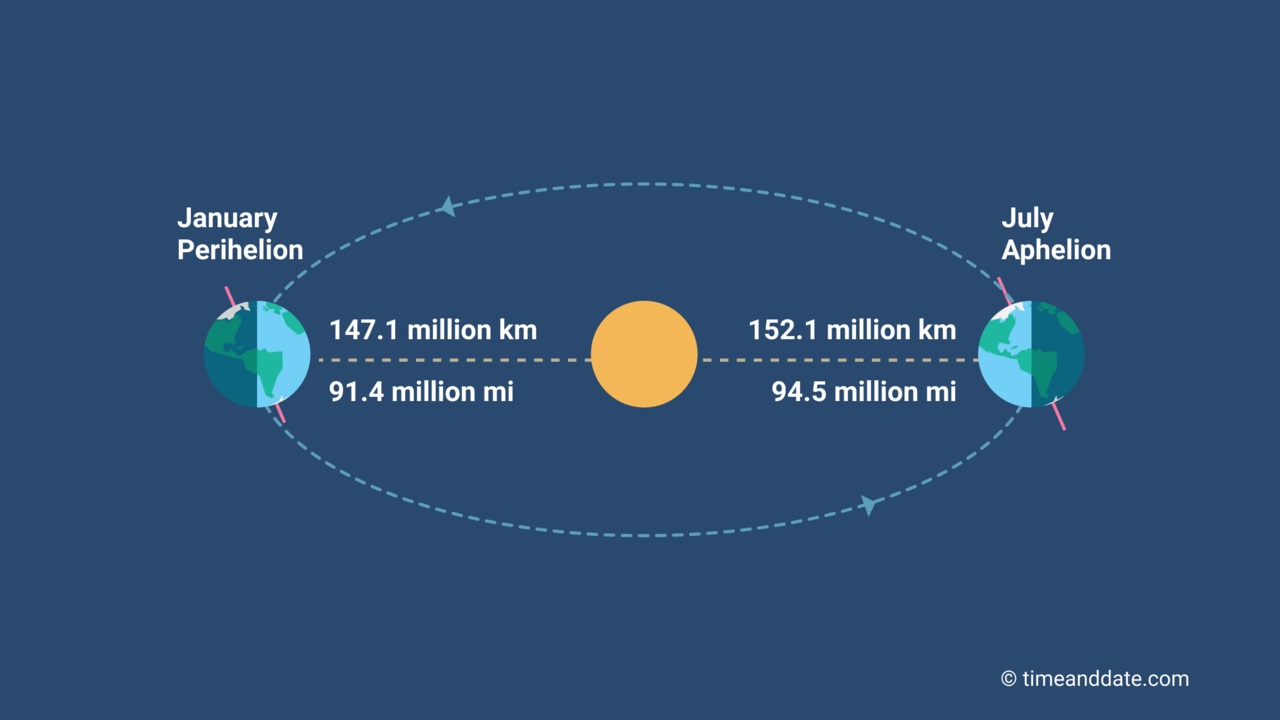
? ? ? January 3 – Earth passes perihelion (the point closest to the Sun) at a distance of 147 million km.
? ? ? January 3/4 – peak of the Quadrantid meteor shower with its radiant in the constellation Boötes. Predicted ZHR = 80, but observations under this year’s full moon conditions will only allow the brightest meteors to be seen.
? ? ? January 10 – Jupiter opposition (-2.7m). The planet is easy to find in the constellation Gemini and is visible throughout the night.
? ? ? January 18 – new moon, exact time – 9:52 p.m. (7:52 p.m. UTC).
? ? ? January 23 – conjunction of the Moon (23%) with Saturn and Neptune. The first of the two planets will be visible to the naked eye, with a brightness of +1.0m, while the second will require binoculars or, better yet, a telescope, as its brightness will only be +7.8m. At 10:30 a.m. (Kyiv time), the Moon will be 2.9° from Saturn, and at 2:23 p.m., it will be 2.4° from Neptune. However, in the evening, these celestial bodies will still be close together.
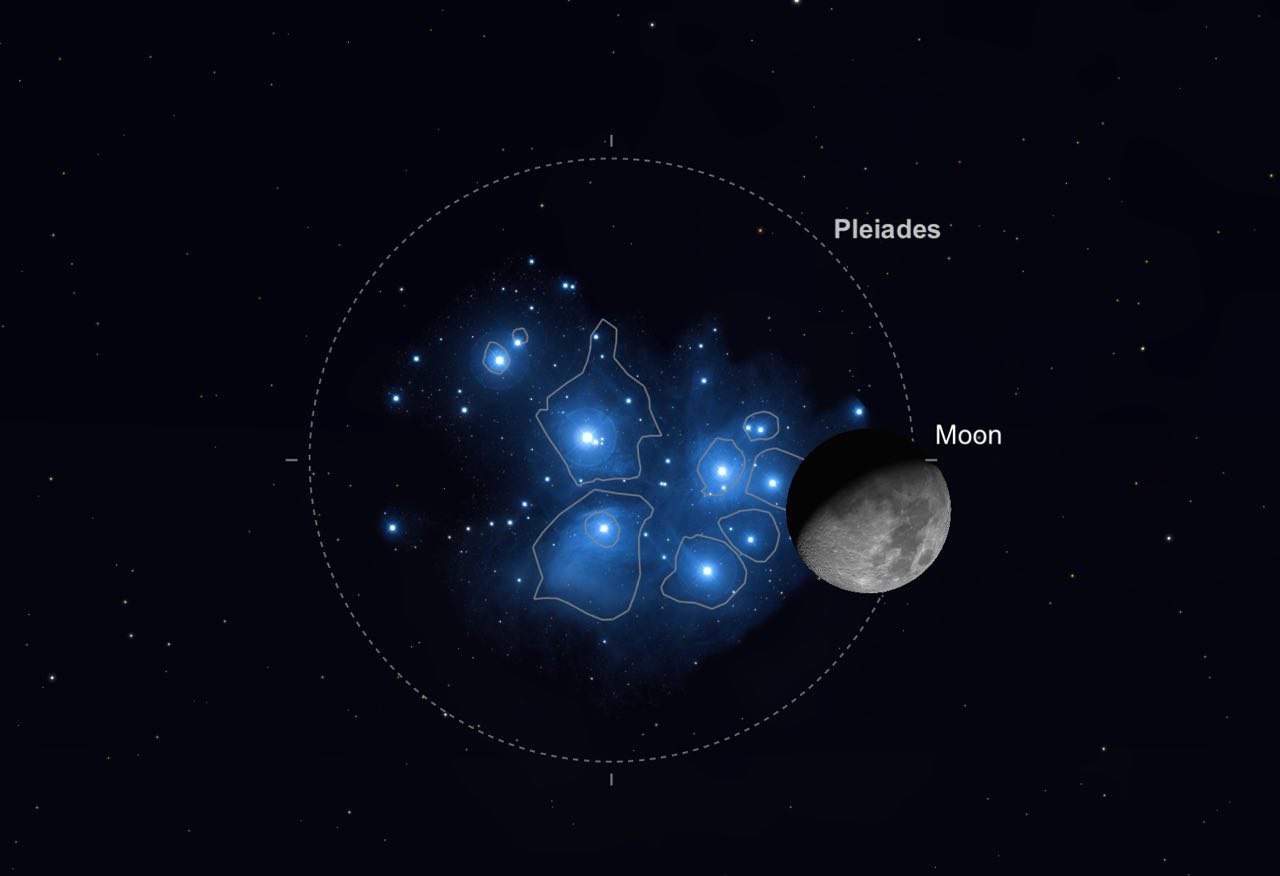
? ? ? January 27/28 – the Moon (69%) covers the Pleiades cluster. It can be observed at approximately midnight (Kyiv time), low above the western horizon.
? ? ? January 31 – conjunction of the Moon (95%) with Jupiter (-2.6m). These celestial bodies will be at their closest angular distance at 06:36 a.m., when they will be below the horizon for us. However, before dawn on January 31, they will already be quite close and will offer a magical sight against the backdrop of the pastel colors of dawn.
A detailed overview of the most interesting events
January 3: Earth at perihelion
Although our planet’s orbit is often depicted as circular, this is a simplification. Like all planets in the Solar System, Earth moves in an ellipse, sometimes approaching the Sun and sometimes moving away from it. The point in the orbit closest to the central star is called the perihelion, and the furthest point is called the aphelion.
Although it is rather counterintuitive, it is precisely when it is often coldest that the Earth passes through perihelion, reaching a distance (https://www.timeanddate.com/astronomy/perihelion-aphelion-solstice.html) of 147,099,894 km from the Sun on January 3 at 7:15 p.m. (5:15 p.m. UTC).
Is it possible to observe this phenomenon? Yes, but it is not easy and requires special equipment and patience. If you photograph the Sun for a long time using a solar filter and compare the images taken on the same scale, you will notice that at perihelion, it is 3% larger than at aphelion, which we will pass on July 6, 2026.
January 3/4: Quadrantid meteor shower at its peak
The annual Quadrantid meteor shower is active for two weeks, from December 28 to January 12, and reaches its peak on the night of January 3 to 4. It is worth noting that this shower has a fairly narrow peak, lasting only 6-8 hours. According to the American Meteor Society’s forecast, the highest activity is expected at approximately 11 p.m. on January 3 (9:00 p.m. UTC).
The radiant (the imaginary point of origin of the meteors) is located in the constellation Boötes, and in our latitudes, it never sets below the horizon. But on January 3, at approximately 8:30 p.m., it will be at its lowest point in the sky. Therefore, it is better to wait a couple of hours for observations, when the radiant has time to rise high enough, and the meteor stream reaches its maximum – this will increase the visible number of meteors.
In 2026, the full moon will significantly interfere with observations. The moonlight scatters in the atmosphere and increases the brightness of the sky, making it impossible to see faint meteors, which are abundant in the Quadrantids. The American Meteor Society estimates that observers will only be able to see about a dozen of the brightest meteors per hour. You will get the best results if you choose an observation point where the Moon is hidden behind a building. Alternatively, you can position yourself with your back to it.
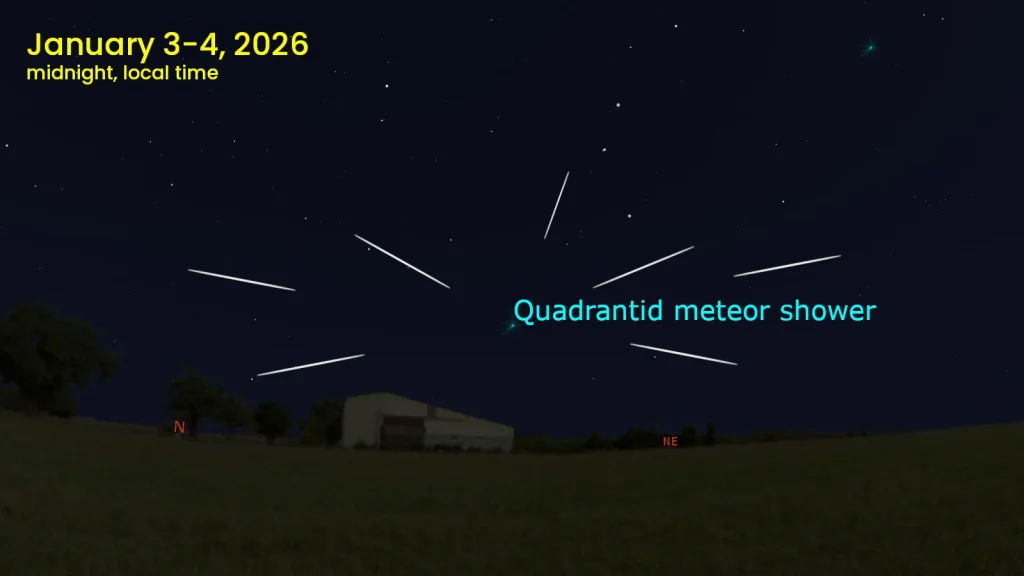
Source: Stellarium virtual planetarium
January 10: Jupiter in opposition
The opposition of an outer planet is the best time to observe it. In astronomy, opposition refers to a configuration in which a planet and the Sun are in opposite directions relative to Earth. During the days around opposition, the distance between us and the planet is the smallest, which means that it has the largest apparent size, allowing us to see it in maximum detail.
And there is plenty to see on Jupiter! The dynamic atmosphere of the Solar System’s giant planets is in constant motion. Observing through a medium or large amateur telescope, you can follow Jupiter’s rotation using the Great Red Spot as a natural marker, see the evolution of individual vortices, changes in the outlines of dark bands, and the movement of shadows of satellites across the planet’s disk. In addition, on January 27, from 03:20 a.m. to 06:56 a.m. (01:20 a.m.- 04:56 a.m. UTC), you will be able to see the rare transit of Callisto’s shadow across Jupiter.
If you are observing visually, Jupiter will remain the second-brightest object in the sky (after the Moon) throughout the night. Even in a big city, you can easily find it. In January this year, Jupiter adorned the constellation Gemini.
The opposition of the same planet varies from year to year. This is mainly due to the elliptical nature of the orbits. The current opposition will be very successful, because the day before, Jupiter will be at its perihelion, and therefore at its closest distance from the Sun. Seize the moment, because the next opposition will not occur for about 1 year and 1 month.
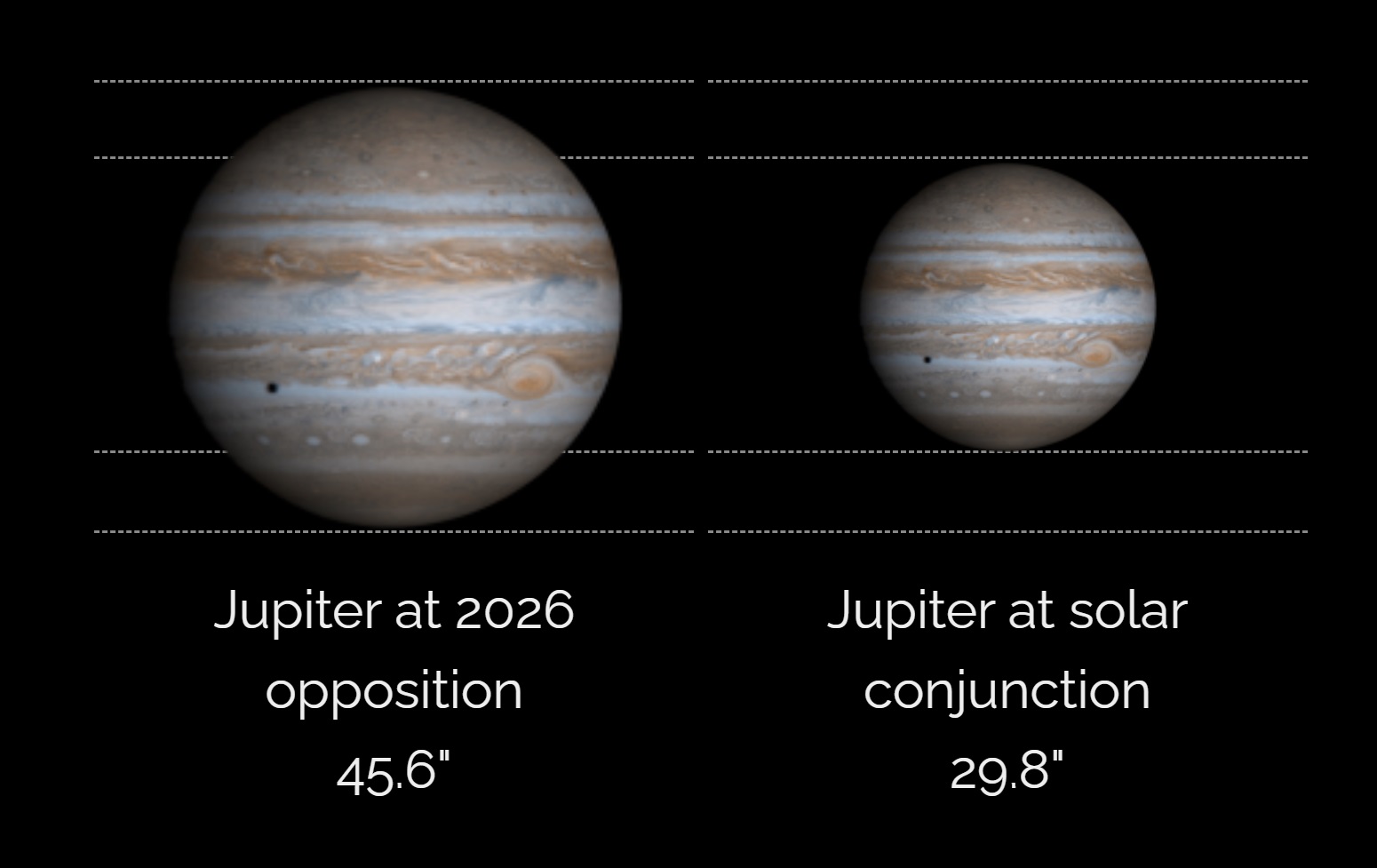
Source: in-the-sky.org
January 18: the time when the stars are brightest
January 18 – a new moon, which means we will not see the Moon all night. This is bad news for those who love to gaze at lunar craters, but it is a long-awaited time for those who enjoy observing and photographing faint celestial objects. Provided the sky is clear, long winter nights offer a wealth of opportunities for both visual observations and astrophotography, for beginners and experienced amateurs alike.
If you have not admired the Orion Nebula this winter, January is the perfect time to do so. The Pleiades (NGC 869 and NGC 884) and the Beehive Cluster (M44) are easy to find – on a clear night, they can be seen without optical instruments. And through binoculars or a small telescope, they are truly magnificent. You can walk through the star clusters along the Milky Way from the Puppis to the Auriga and arrange a mini-marathon that will include: M93, M41 (the Beehive Cluster), M46 and M47, M50, M48, the Christmas Tree cluster, M35, M37, and finally M36 and M38.
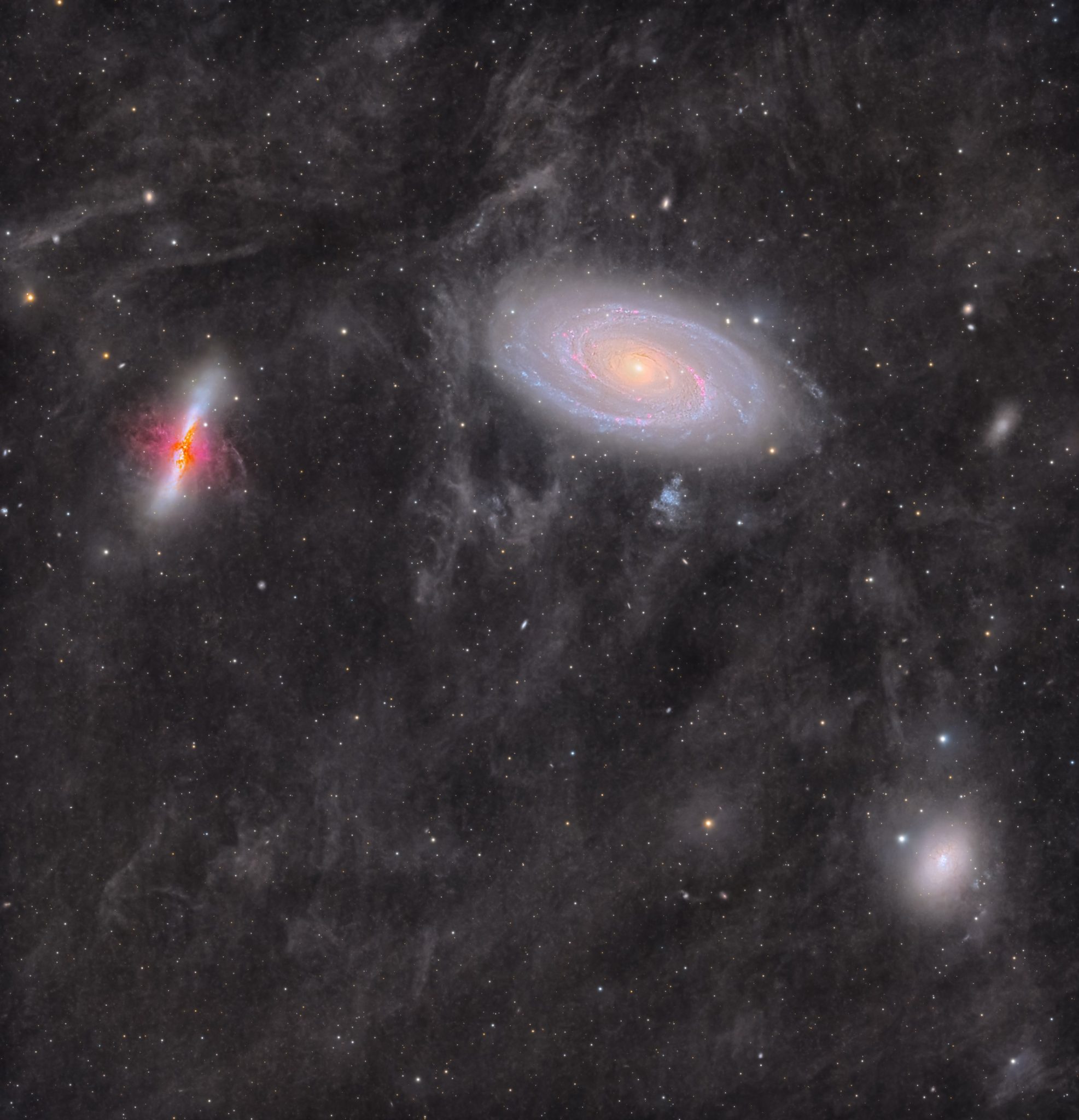
Looking for challenges for your equipment? Then try to photograph or find the trio of galaxies M81 (Bode’s Galaxy), M82 (Cigar Galaxy), and NGC 3077. Or you can focus on planetary nebulae. For example, the Owl Nebula (M97) in Ursa Major and the Eskimo Nebula (NGC 2392) in Gemini, not far from Jupiter, will be visible all night long.
January 27/28: The Moon will cover the Pleiades
The famous Pleiades cluster (M45, Seven Sisters, or Messier 45) is located in the constellation Taurus, not far from the ecliptic line. The Moon does not stray far from it either. This means that from time to time their positions in the sky coincide.
This phenomenon will be observed on the night of January 27-28. The further west and north you are, the better your viewing conditions will be. The Moon, having smaller angular dimensions than the Pleiades, does not cover them completely. Thus, in this case, residents of Ukraine will see only one of the seven bright stars in the Pleiades covered – Taygetus, which is actually a triple system.
The time and duration of coverage depend on the geographical location of the observer. For example, for Kyiv, it will take place approximately from 11:30 p.m. (January 27) to 12:20 a.m. (January 28). The Moon and the Pleiades will be in the west, at an altitude of ~35° above the horizon.
When planning your observation, keep in mind that the 69% illuminated Moon will completely obscure the Pleiades. It will be impossible to see the stars of the cluster with the naked eye, so you will need either binoculars or a small telescope with a wide field of view.