

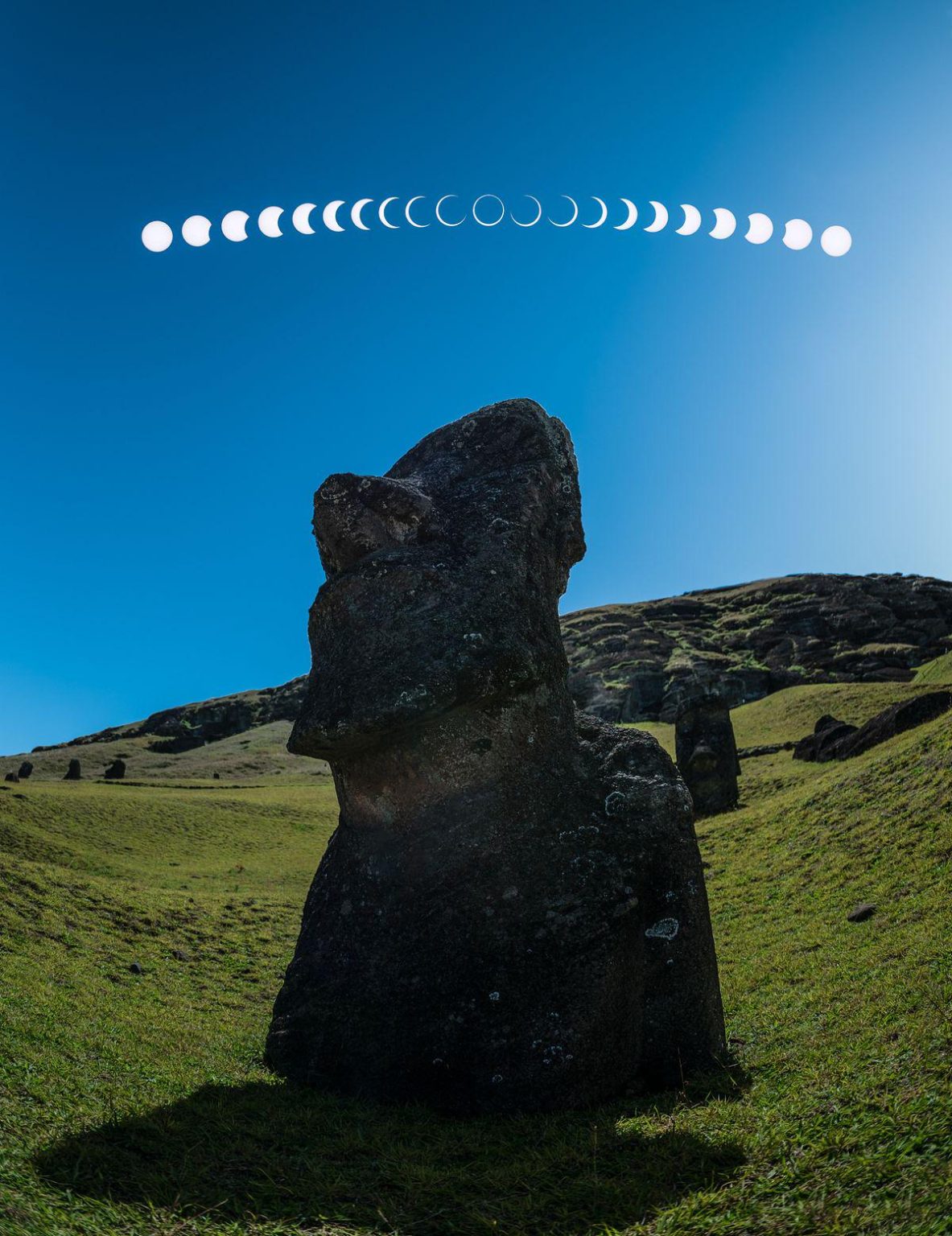
The most notable astronomical event of February 2026 could be the annular solar eclipse on the 17th. However, the only continent from which the maximum phase will be visible is Antarctica. Therefore, it is unlikely that many people will want to travel to see this phenomenon, and the number of people who live on the continent for a long time, even in the summer season (as it is now), does not exceed a few thousand. So, the eclipse on February 17 will be seen by significantly more penguins than people.
The planets of the Earth group remain mostly clustered near the Sun. It is virtually impossible to see Mars; Venus will begin to appear low above the horizon in the evening in the second half of the month, and Mercury will reach its maximum eastern elongation in February and can be seen low above the western horizon shortly after sunset.
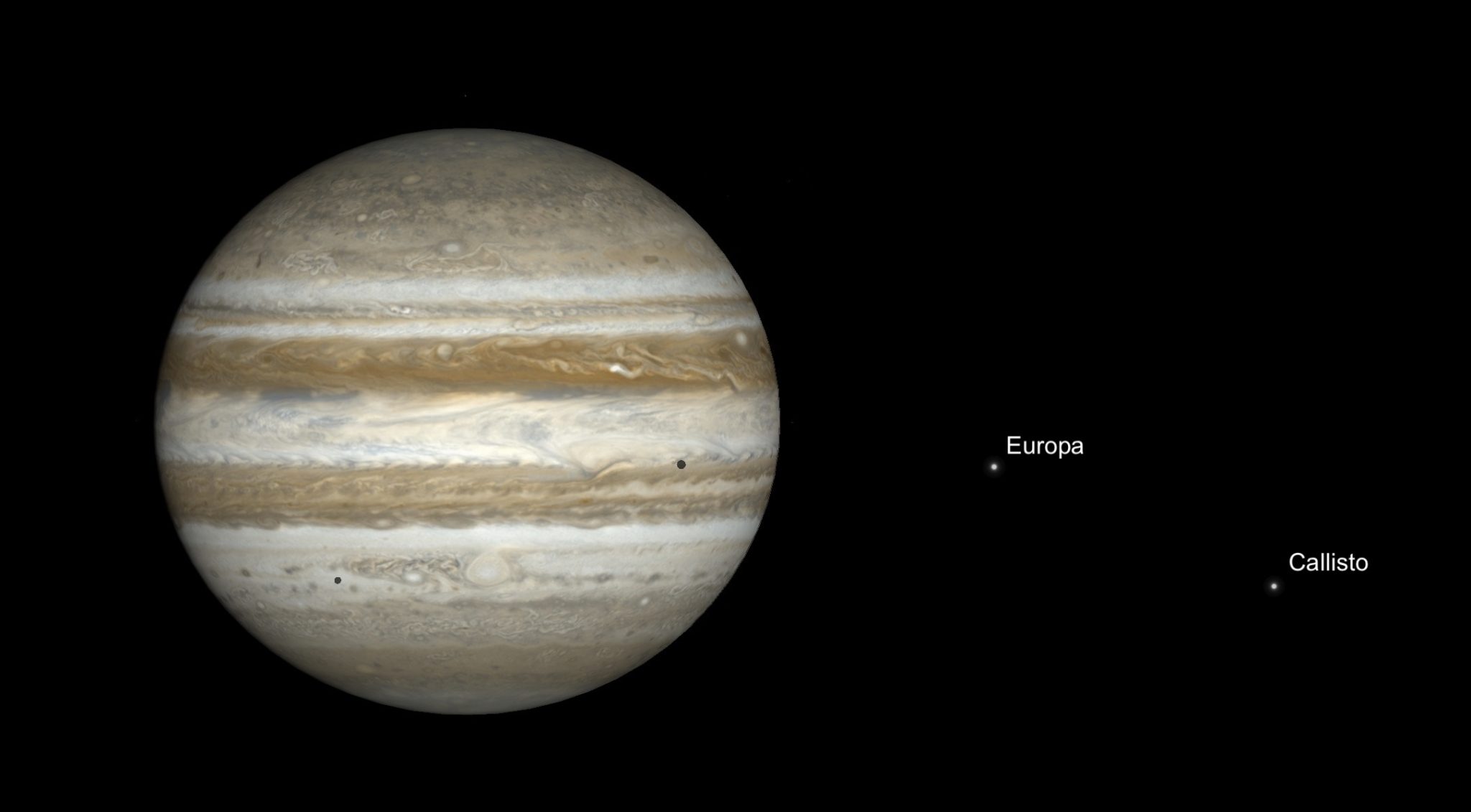
Of all the planets, Jupiter continues to be the most pleasing to observe. It moves slowly through the constellation Gemini and remains visible immediately after sunset and throughout most of the night. And that’s not the only reason to pay attention to the largest planet in our system. On the evening of February 12, the simultaneous transit of two shadows of its moons will be observed: the shadows of Europa and Callisto will appear on Jupiter’s disk. And while the first of these can be seen relatively often, the transit of the second is extremely rare.
In the evening sky, but already quite low above the western horizon, in the constellation Pisces, Saturn is still visible. And with binoculars or a telescope, you can see Neptune next to it. Pay special attention to this pair on February 20 – the planets will be less than 1° apart.
Another planet that can be observed is Uranus – it is quite easy to find with binoculars or a telescope in the constellation Taurus, not far from the scattered cluster of the Pleiades. In February, its retrograde motion against the background of the stars ends, and a period of prograde motion begins, which will last until mid-September.
List of events
? ? ? February 1/2 – full moon, exact time of full phase 12:09 a.m. (10:09 p.m. UTC 01.02.2026).
? ? ? February 4 – Uranus changes its direction of movement across the sky from retrograde to prograde.
? ? ?February 12 – Transit of the shadows of Europa and Callisto across Jupiter’s disk (double transit lasts from 09:04 p.m. to 10:25 p.m. Kyiv time).
? ? ? February 17 – new moon, exact time 02:01 p.m. Kyiv time (12:01 p.m. UTC).
? ? ? February 17 – annular solar eclipse. The maximum eclipse magnitude will reach 0.963, meaning that the Moon will cover up to 96.3% of the visible diameter of the Sun. The eclipse will be visible mainly in Antarctica; it will not be visible in Ukraine.
February 19 – Mercury (-0.6m) at its greatest eastern elongation (18.1°); visible shortly after sunset, low above the western horizon.
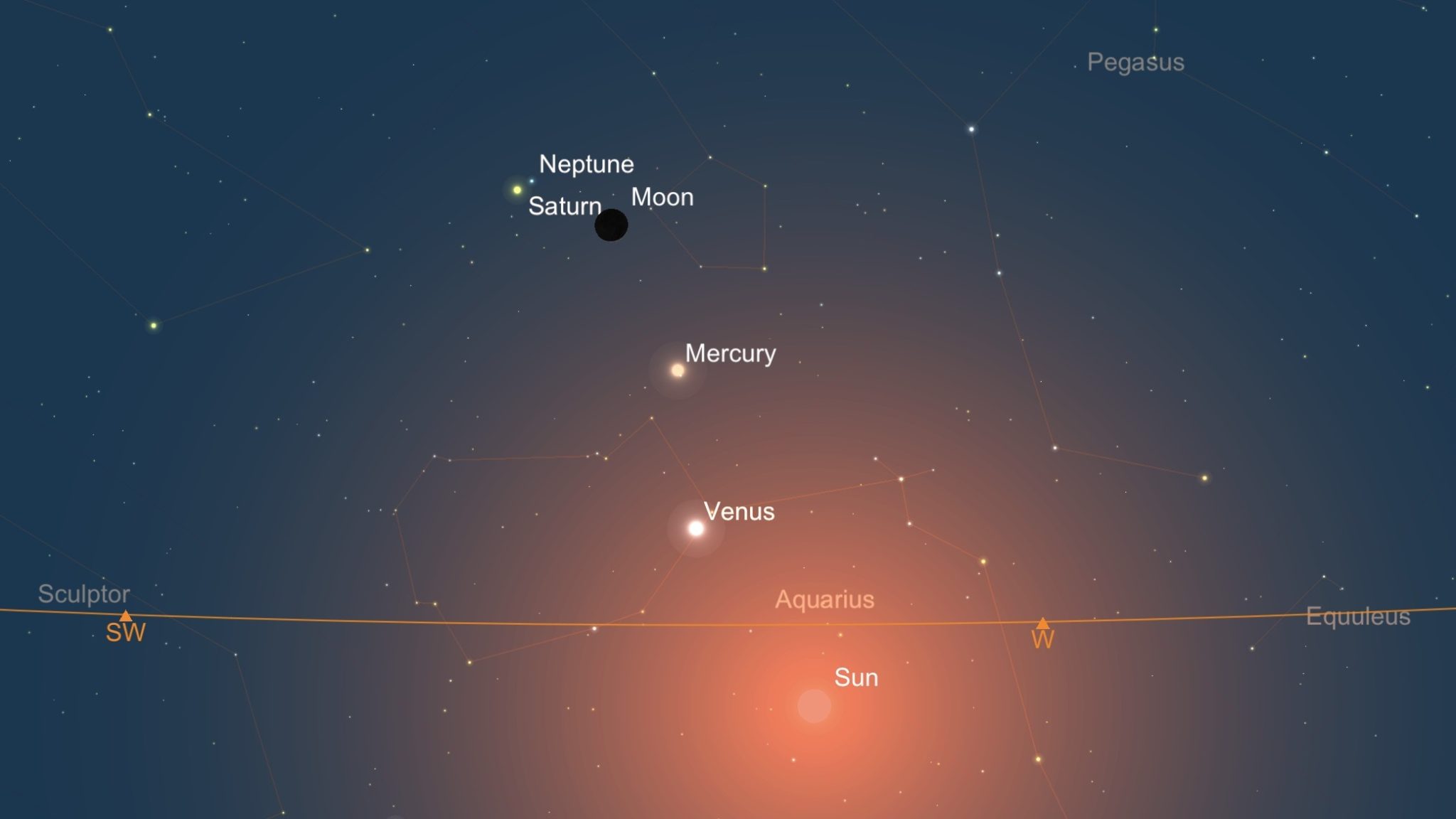
? ? ? February 19 – a beautiful configuration in the evening sky in the west, including Venus, Mercury, the crescent of the new Moon, and Saturn with Neptune.
? ? ? February 20 – Saturn (+1.0m) and Neptune (+7.8m) will be in conjunction. The angular distance between the planets will decrease to 0°50′ so that they will be visible in the same field of view of binoculars or a small telescope.
? ? ? February 26/27 – conjunction of the Moon (77%) with Jupiter (-2.5m). The celestial bodies will be closest (2.5° apart) at approximately 08:58 a.m., when they will be below the horizon for us.
A detailed overview of the most interesting events
February 12: Double transit of the shadows of Jupiter’s moons – Europa and Callisto
If we could conduct astronomical observations from Jupiter, then, given a favorable location, we would regularly witness eclipses caused by one of its four large moons. From outside the Jupiter system, this looks like the slow movement of a moon’s shadow across the planet’s disk – a so-called transit.
In February, Jupiter still attracts attention with its high brightness, as it was in opposition in January. Its angular dimensions remain large enough to allow us to see details of its changing atmosphere and the shadows of its Galilean moons.
The transits of the shadows of Io, Europa, and Ganymede occur quite regularly: these satellites orbit in the equatorial plane close enough to the planet. Callisto, however, is more distant, and therefore its shadow most often “misses,” passing south or north of Jupiter. Only around the time of the Jovian equinox is it possible to observe the transit of Callisto’s shadow. The next equinox will be in December 2026, so the season of Callisto’s shadow transits has already begun.
Double transits, during which two shadows appear on Jupiter’s disk at once, are usually observable in a given location no more than a couple of times a year. And between double transits involving Callisto’s shadow, several years may pass, i.e., from one equinox to the next.
Source: SkySafari virtual planetarium
The closest visible transit of Callisto and Europa’s shadows will take place on February 12 and will last from 09:04 p.m. to 10:25 p.m. (07:04 p.m. – 08:25 p.m. UTC). For observations, it is advisable to use a telescope with a diameter of at least 150 mm. Success largely depends on the weather – ideally, you should have a cloudless sky, dry air, and a stable atmosphere. Keep in mind that Callisto’s shadow will appear much more blurred than Europa’s shadow.
February 17: Annular solar eclipse
Solar eclipses occur when the Moon is between the Earth and the Sun. Depending on the accuracy of this alignment, a total, partial, or annular eclipse can be observed. A necessary condition for a total eclipse is not only the precise alignment of the celestial bodies, but also that the apparent angular size of the Moon must exceed the apparent size of the Sun. A partial eclipse occurs when the alignment is not precise enough. An annular eclipse occurs when the angular size of the Moon is smaller than that of the Sun, so that only the central part of the solar disk is covered, and a “ring of fire” can be seen around the edge. In turn, the change in the apparent size of our satellite is due to the elliptical shape of its orbit – it sometimes approaches the Earth and sometimes moves away.
The eclipse on February 17 is quite interesting. Usually, this occurs when the Moon passes near its apogee, the point in its orbit furthest from Earth. However, in this case, there are approximately seven days between the apogee and the perigee. Why, then, is the eclipse not total, but annular? The reason is that the Earth recently (on January 3) passed the point in its orbit closest to the Sun, so the angular size of the Sun is still larger than average and, more importantly, larger than the apparent size of the Moon.
Source: www.timeanddate.com
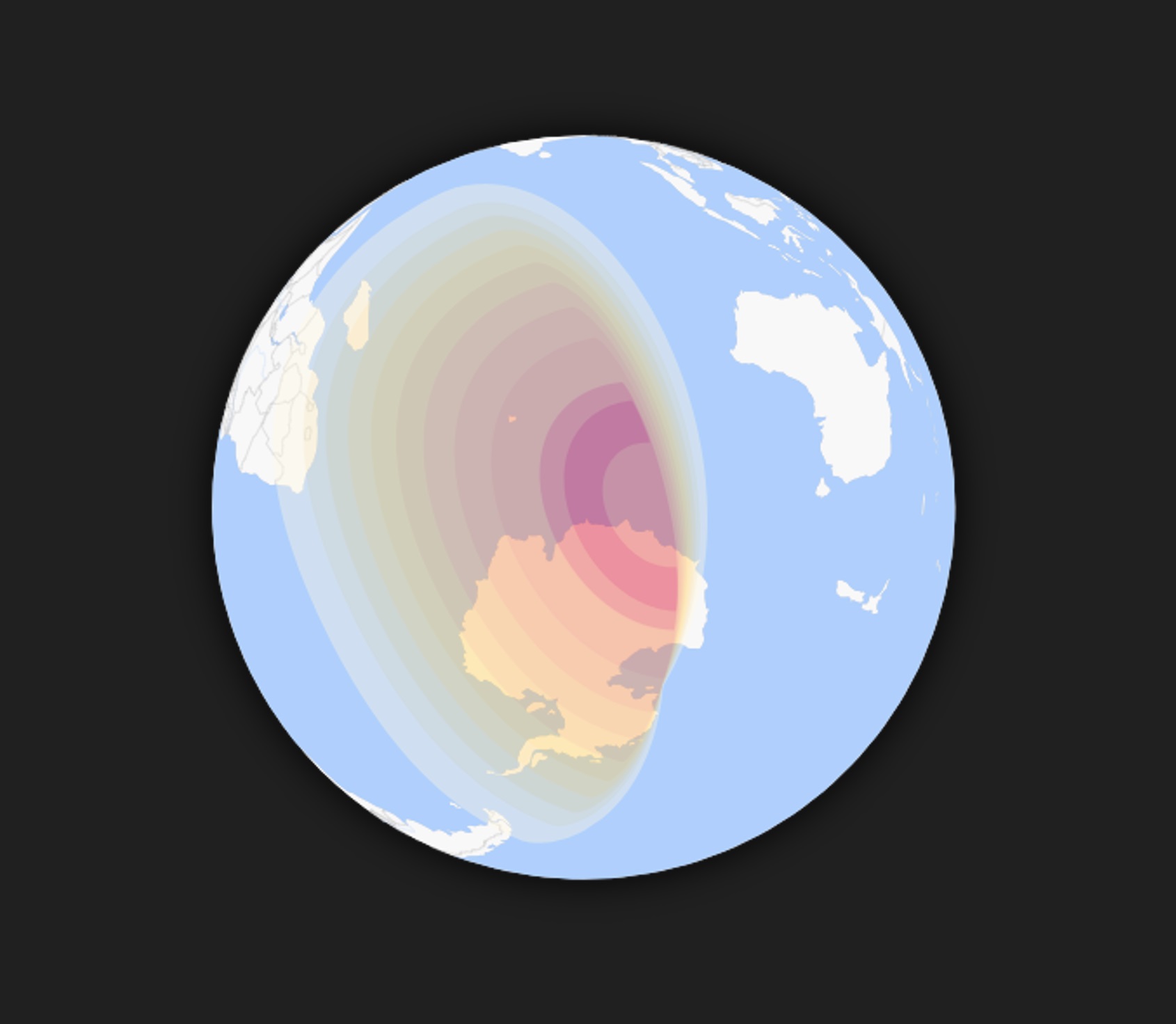
Of all the continents, Antarctica will have the best viewing conditions. The residents of the French-Italian Concordia Station will be the luckiest, as they will be able to see the deep annular phase of the eclipse, when the Sun will be 92.5% hidden behind the Moon. However, the Sun will be literally 5° above the horizon. Conditions will be only slightly worse at Casey Station, Australia’s research station. Here, it will be possible to see a partial phase close to the maximum, reaching 91.3%. The partial phase can also be observed from the Ukrainian Antarctic station Akademik Vernadsky. However, the conditions are significantly worse – only 21.7% of the solar disk will be covered, and the Sun itself will be only 12° above the horizon.
Partial phases will also be visible in southern South America (up to 5%), southern Africa (up to 16%), and Madagascar (up to 28.7%).
February 17: New moon – the best time to observe galaxies and star clusters
We may not have been lucky with the solar eclipse, but we can devote this time to deep space objects. With no Moon in the night sky, it is much easier to see faint galaxies, nebulae, and star clusters.
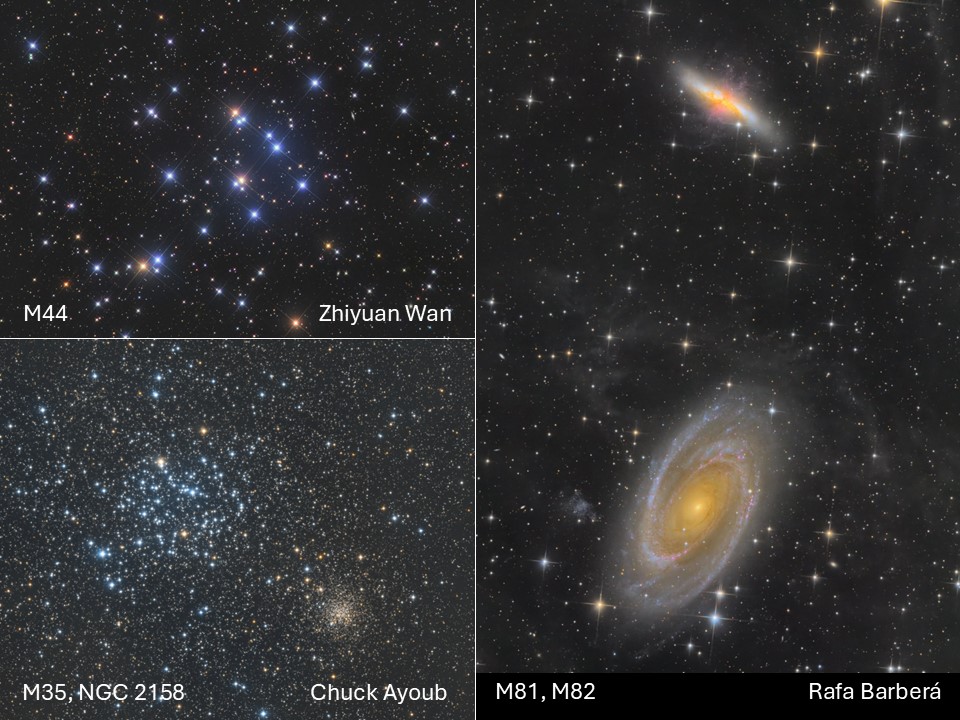
If you are just beginning to explore the gems of the night sky, a good place to start in the first half of the night would be the Pleiades (M45), the Orion Nebula (M42), and a little later, the open cluster Beehive Cluster (M44, constellation Cancer). Other open clusters that abound in the winter sky will also be attractive even in small instruments: M35, M36, M37, and M38.
For more experienced observers and photographers, February is the best time for the Bode (M81) and Cigar (M82) galaxies, and if the sky is really dark, you can try to find the M108 galaxy and the Owl planetary nebula (M97).
February 19: Mercury’s greatest elongation and mini “parade”
On the evening of February 19, almost immediately after the Sun sets below the horizon, a very aesthetic configuration will be visible. Bright Venus will be located lowest, above it will be the much less distinct Mercury, higher still will be the thin crescent of the young Moon, and next to it will be Saturn and Neptune.
Please note that almost all of these objects can be seen with the naked eye, and only Neptune requires optical instruments and a slightly darker sky.
For observations, choose a location with an open view to the west-southwest. You can start right after sunset, which is approximately 05:25 – 05:30 p.m. in Kyiv. Keep in mind that the window of opportunity will be very short – only about 50 minutes between sunset and Venus.
The first ones you will see are the Moon and Venus, as they are the brightest in the visual quartet. With the onset of twilight, Mercury will appear – on this day, it will have its maximum elongation, that is, it will move away from the Sun to the greatest distance, which this time will be 18.1°. Saturn will be the last to be seen. And if you plan to look at Neptune, do not forget to bring your binoculars, or better yet, a telescope.
Source: SkySafari virtual planetarium.

