

The Zwan-Wolf effect has been observed on Mars. This effect occurs when particles in the ionosphere are pushed into specific regions by the solar wind. The MAVEN spacecraft helped us observe this phenomenon.
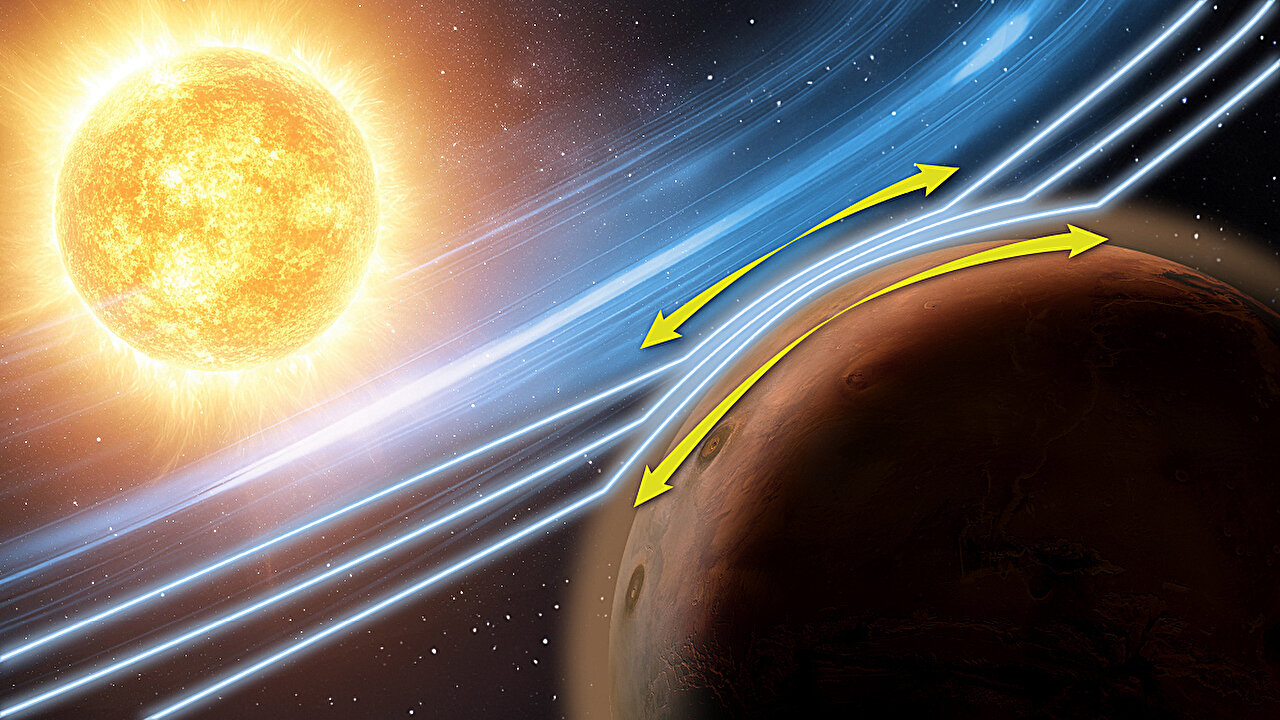
Zwan-Wolf effect
A study recently published in the journal Nature Communications describes an intriguing phenomenon that scientists observed on Mars in 2023. It is known as the Zwan-Wolf effect, and until now it had only been observed by researchers studying Earth’s magnetosphere. The MAVEN spacecraft played a key role in this discovery.
Usually, the Earth’s magnetic field acts as a reliable shield, protecting the planet from dangerous radiation and high-energy particles coming from the Sun. However, sometimes the solar wind becomes so powerful that its energy displaces the plasma in the ionosphere, which is normally held in place by the magnetic field.
This phenomenon was first described on Earth in 1976. Due to the Earth’s strong magnetic field, it manifests itself in a unique way here: charged particles in the ionosphere align themselves along the magnetic field lines, which extend from one pole to the other.
Mars’ magnetic field
Mars simply does not have a global magnetic field. Therefore, it cannot have magnetic field lines that emerge from one pole and enter the other. The planet’s ionosphere is already under constant intense bombardment. So if the solar wind intensifies and the field lines shift, they do so only in a very chaotic manner deep into the atmosphere.
Therefore, scientists believed that it was simply impossible to observe the Zwan-Wolf effect on Mars. And even if it exists, it is too weak for a spacecraft like MAVEN to detect it. It was launched into the Red Planet’s orbit back in September 2014 specifically to study the atmosphere and its interaction with the solar wind, which it did for many years without detecting anything resembling the Zwan-Wolf effect.
However, in 2013, while flying through the outer layers of Mars’ atmosphere, the MAVEN spacecraft first detected fluctuations in the magnetic field and then observed ionospheric particles penetrating into denser layers to a depth of more than 200 km. Analysis showed that this was indeed the Zwan-Wolf effect.
The fact that this phenomenon is observed on a planet lacking a normal dipole magnetosphere actually has practical significance. It means that the local magnetic fields on Mars are strong enough to provide at least some protection for its atmosphere against destruction caused by solar radiation.
According to phys.org

