

The middle and second half of August 2025 will be favorable for observing almost all planets at the same time. Six planets will appear in the predawn sky, four of which will be visible to the naked eye. Such configurations are often referred to as an “appulse”. And although, from a scientific point of view, they are not unique, they are still a wonderful reason to enjoy the warm summer sky, colored in the pastel tones of the morning dawn.
What to expect from the “appulse”?
Have you seen the movie Family Switch? No, it is not about astronomy; it is about the relationship between parents and teenage children. However, the magic of body swapping among family members occurs during the “appulse” they observe at the Griffith Observatory. According to the filmmakers, the appulse through a telescope should resemble the screenshot below. That is, all the planets of the Solar System that are outside the Earth, from Mars to Neptune, should line up in a row.
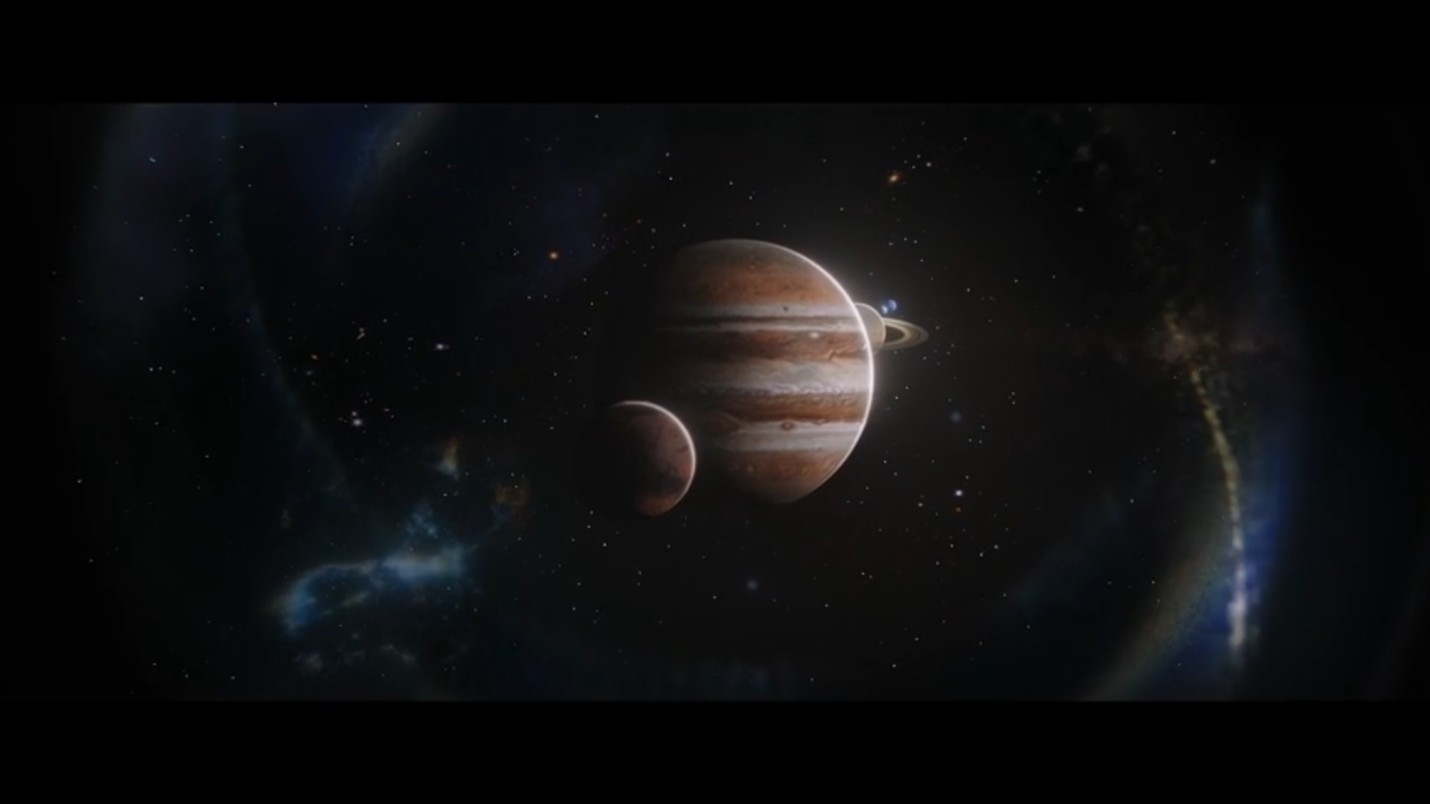
Let’s leave aside the fact that no telescope can see the planets exactly as they are shown in the film. After all, this is just a family comedy designed to entertain, make you think, or even change something in your behavior. But from an astronomical point of view, Mars, Jupiter, Saturn, Uranus, and Neptune are never that close together in the sky. This is primarily due to the orientation of their orbits in space.
If all planets revolved strictly in one plane, alignment would be potentially possible, albeit a fantastically rare phenomenon. For example, the Sun, Uranus, and Neptune can be aligned approximately once every 171 years. Adding other planets to this, we get a gigantic time interval. Continuing this imaginary exercise, we find that during such an “ideal appulse”, Mercury and Venus would appear against the background of the Sun to an observer on Earth, while all the other planets, from Mars to Neptune, would line up-just like in the movie. However, in the real Solar System, the orbits of the planets are slightly tilted relative to each other, which completely rules out such a scenario.
Instead, the “appulse” usually refers to the alignment of several planets in the sky in a relatively narrow sector. There is a rather interesting story behind the origin of this term, which we told in this article. Nowadays, this concept is used in even “softer” conditions than those mentioned above – to describe a configuration in which several planets are visible in the sky simultaneously. For example, during the current “appulse”, this sector will exceed 120 degrees.
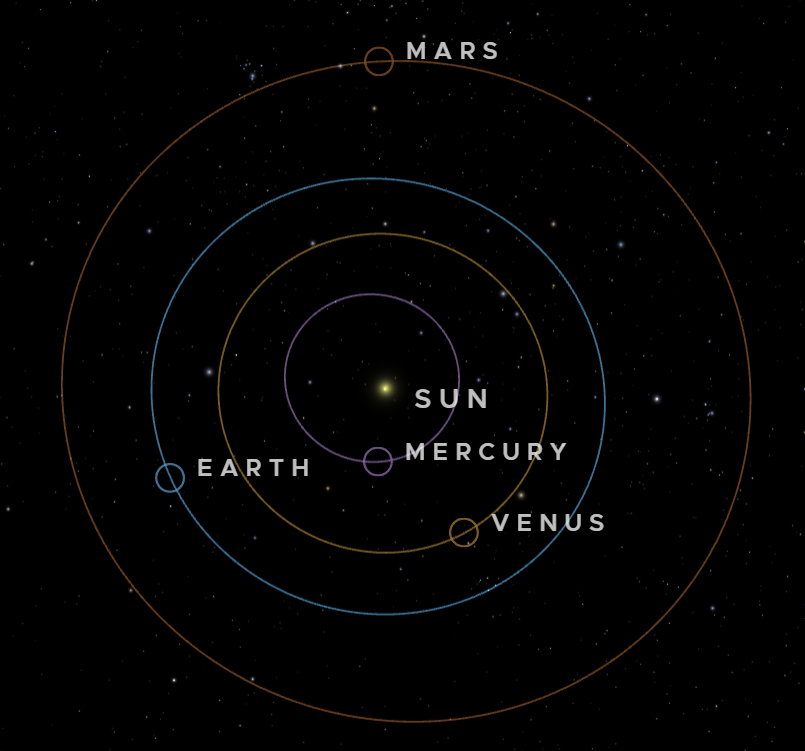
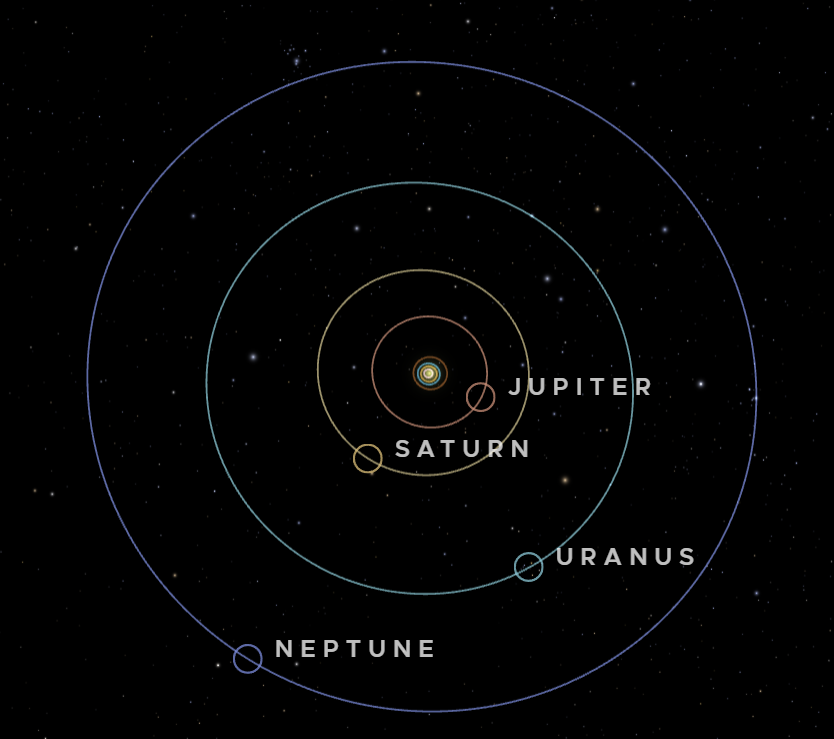
Source: Eyes on the Solar System (NASA).
It should be noted that this arrangement does not necessarily mean that the planets are physically aligned. The angles between the vectors pointing from the Sun to the planets can be quite large. In the sky, however, the planets are always located along the ecliptic – the apparent path of the Sun against the background of the stars. You can easily trace it when several planets are visible in the sky at the same time. Just mentally draw a wide arc through them, from horizon to horizon.
In the second half of August, shortly before dawn, Mercury, Venus, Jupiter, Uranus, Neptune, and Saturn will be visible. From August 15 to 22, the old Moon will join them. Some sources (e.g., Star Walk) indicate the specific date of the “appulse” as August 10. This is probably because on that day, the angular distance between the westernmost planet (Saturn) and the easternmost planet (Mercury) will be the smallest. But in reality, this is not the best time for observation. On the contrary, on this date it will be almost impossible to see Mercury – it will be too low above the horizon and will fade into the predawn.
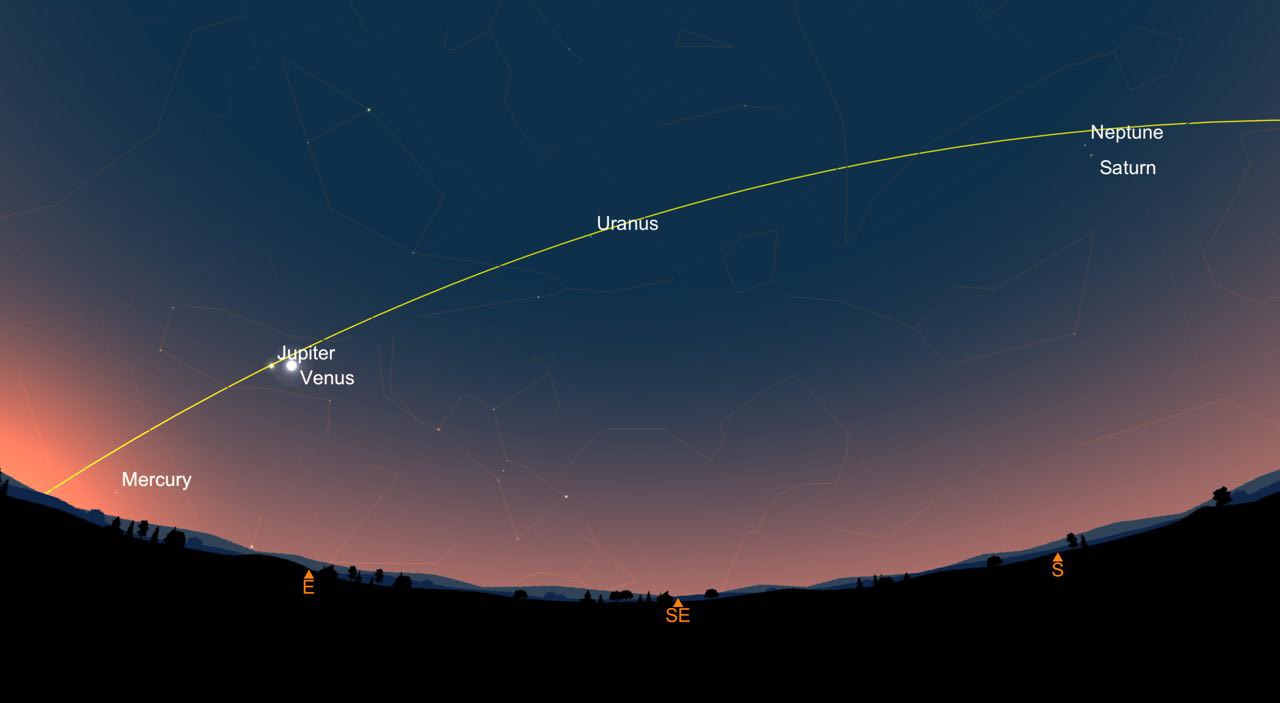
In general, when it comes to an “appulse”, it is usually impossible to specify a specific date, since the movement of the planets is not fast enough to see significant changes on consecutive days. In this case, we recommend observing the phenomenon between August 15 and 26, with the most favorable configuration occurring between August 19 and 21. However, there are dates soon that we recommend paying special attention to.
Venus + Jupiter = an amazing sight!
The closest event that is truly worth getting up early for is the conjunction of Venus and Jupiter, which will take place before dawn on August 12 – the same day that the Perseid meteor shower is predicted to peak. The smallest distance between the planets will be 0.86° at 09:39 Kyiv time (06:39 UTC) – Jupiter will be less than two lunar discs north of Venus. But a few hours before that, the difference will not be noticeable. If you want to track the moment of the closest conjunction, you can try daytime observations with a telescope or binoculars. With a brightness of -4m, Venus will be easy to find in the bright sky, and it will help you find Jupiter, whose brightness will be -2m.
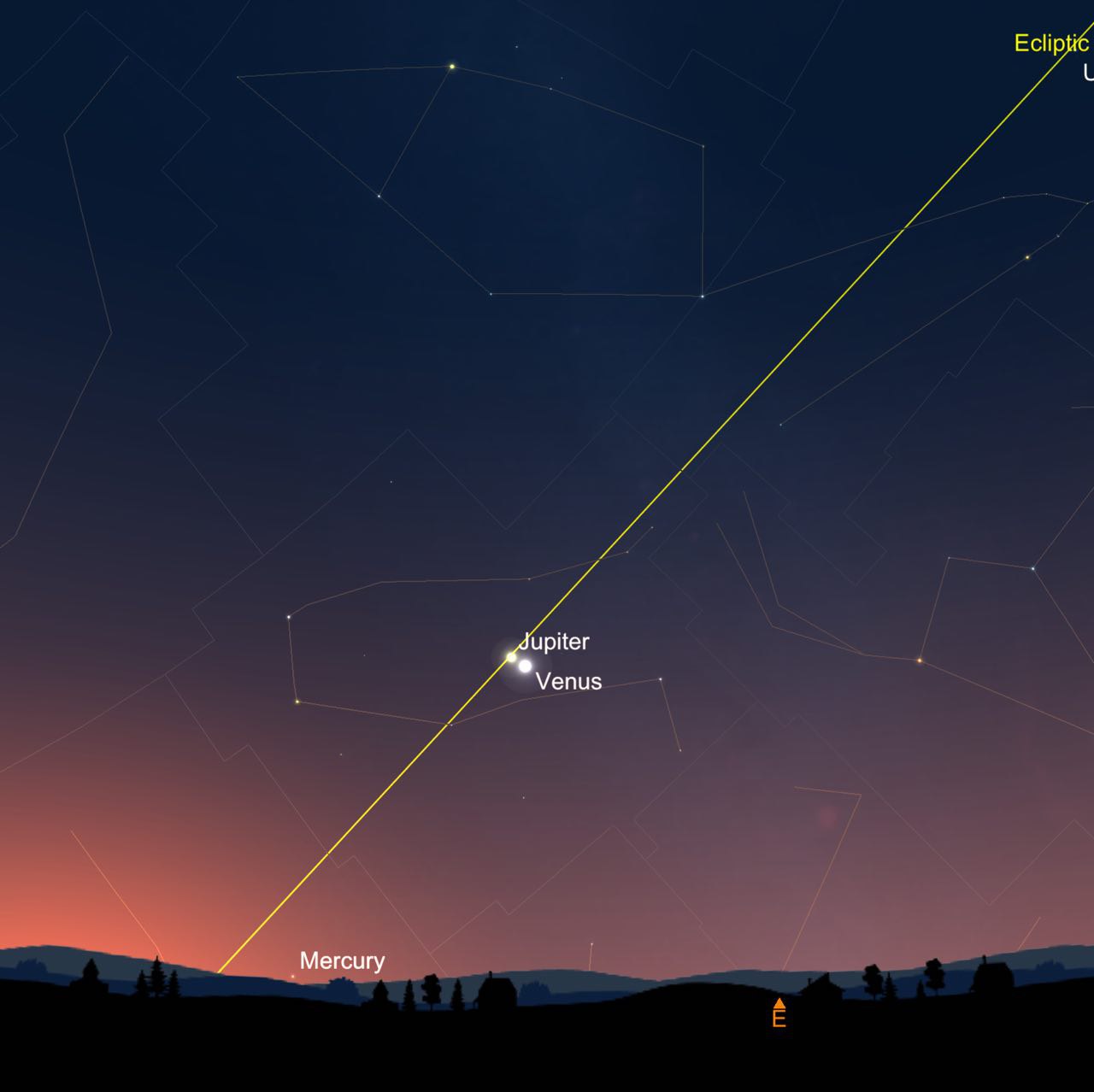
Source: SkySafari virtual planetarium.
Although, as mentioned above, planets move across the sky rather slowly, the case of Venus and Jupiter is special in a certain sense. In general, both planets move westward against the backdrop of the stars, but the former is currently moving away from the Sun, while the latter is approaching it. Therefore, if you observe their relative positions the day before or after the event itself, the difference will be noticeable.
Another experiment that can be conducted while observing this striking pair is to attempt to observe them for as long as possible. Will you still be able to see Venus after the edge of the Sun has disappeared below the horizon? What about Jupiter – when will this massive giant fade into the blue sky?
August 19 – the best time for Mercury
Of all the planets visible to the naked eye, Mercury is the most difficult target. The best time to observe Mercury is during its greatest western or eastern elongation, when the planet is at its greatest angular distance from the Sun. In the case of greatest eastern elongation, Mercury can be observed in the evening, almost immediately after sunset, while greatest western elongation means that the planet can be seen just before dawn.
On August 19, at 11:59 a.m. Kyiv time, Mercury will be 18.6° from the Sun. The angle between the ecliptic (near which the planet is located) and the horizon in our latitudes will be quite large. Thanks to this, the dates around August 19 can be considered the most attractive for observing the fastest planet in the Solar System. For Kyiv, the best time will be between 05:00 a.m. and 05:15 a.m., when Mercury is already relatively high above the horizon and the Sun is still low enough below it.
This planet is not as bright as Venus or Jupiter. In addition, due to the scattering of the blue part of the spectrum in the atmosphere, Mercury will have a slightly reddish color. You can use a telescope to make sure that the relatively bright object low above the horizon is Mercury. The planet will look like a tiny moon, illuminated by 42%.
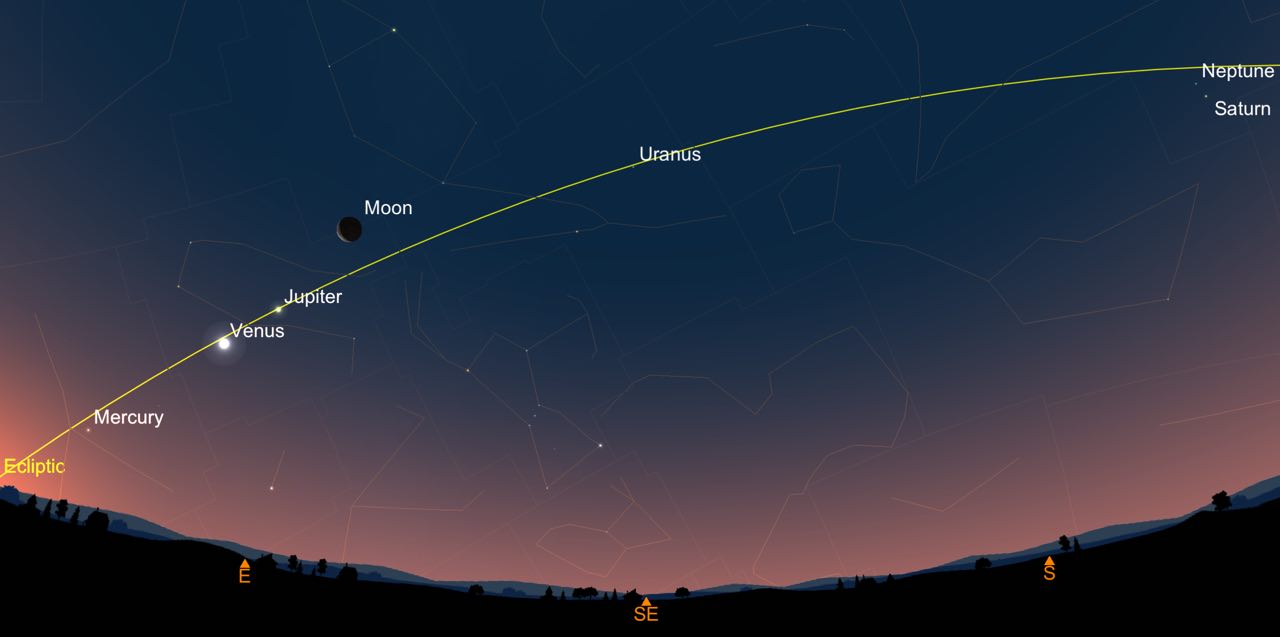
Source: SkySafari virtual planetarium.
Choosing a place, time, and strategy
If you want to see all six planets in the second half of the night, you will need to plan. First of all, it is recommended to choose an observation site with a completely open northeast view. This will allow you to fully enjoy Mercury, Venus, and Jupiter before dawn.
However, it is advisable to start observing a little earlier – at around 4 a.m. local time. Saturn and Neptune in the constellation Pisces may be the first objects to observe: after their conjunction on August 6, the planets are still located close enough to each other. In addition, Neptune, with a brightness of 7.7m, is the faintest of the planets, so it is best observed in a dark sky, and you will need binoculars or a telescope for this. Saturn, on the other hand, can be seen with the naked eye. And if your eyes are equipped with a telescope, pay attention to the angle of inclination and brightness of the planet’s rings. Medium and large instruments will allow you to see the Cassini Division in the structure of the rings.
The next target is Uranus. Theoretically, it can be seen with the naked eye. But in the early morning hours, the sky is not dark enough, so binoculars or a telescope will come in handy. You will find the light blue planet in the constellation Taurus, slightly below the famous Pleiades cluster. If you are observing on August 16 or 17, the Moon will be located near Uranus.
Now it is time for a truly “stellar couple” – Venus and Jupiter will be high enough at approximately 4:30 a.m. – 4:40 a.m. local time to fully enjoy the amazing spectacle. When observing with optical instruments, pay attention to the phase of Venus. Depending on which day between August 15 and 26 you are observing, the planet will be illuminated by the Sun by 80–83%. As for Jupiter, on August 19, a pleasant bonus may be the transit of Europa’s shadow across its disk, which will last from 03:32 a.m. to 06:18 a.m. Kyiv time (00:32 a.m. – 03:18 a.m. UTC). And on August 21, the transit of Io’s shadow will be observed from 04:00 a.m. to 6:16 a.m. (01:00 a.m. to 03:16 a.m. UTC).
The final planet will be Mercury, which rises above the horizon last, shortly before sunrise. Even at maximum elongation, the window of opportunity is very narrow. Due to the elliptical orbit of the planet, at maximum elongation, the angular distance to the Sun can range from 18° to 18.6 ° on August 19. Therefore, when choosing the optimal time for observations, it is advisable to use a virtual planetarium, which will display the location of celestial bodies specifically for your location. Experience shows that Mercury’s altitude above the horizon should be at least 6°, and at the same time, the Sun should be at least 7° below the horizon. This leaves a small window of literally 10-15 minutes, between 05:00 a.m. and 05:15 a.m., although the exact time depends on both your geographical location and the specific date of observation.

