

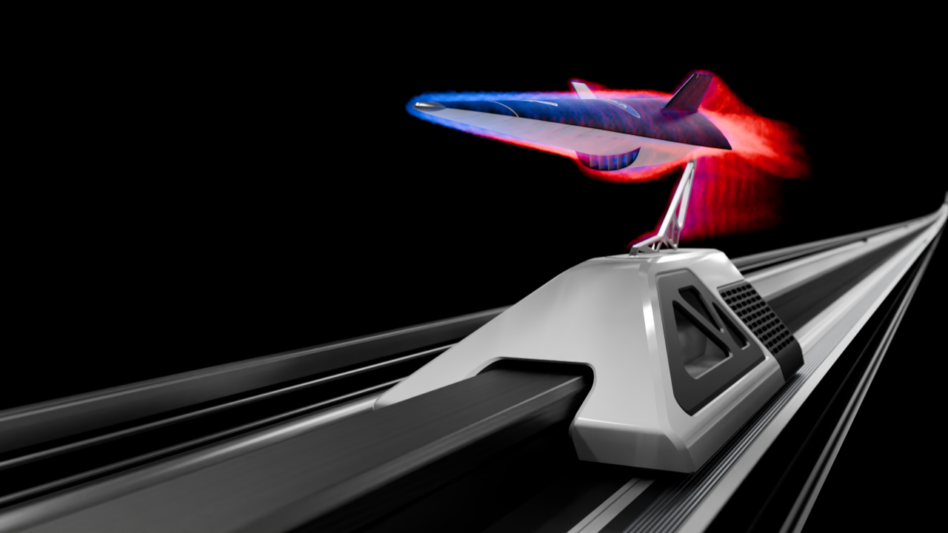
Auriga Space, a young California-based company, has announced that it has raised $6 million in investments and government contracts to build an electromagnetic “maglev ramp” that will accelerate small rockets to 6 Mach (≈ 4570 mph, or ≈ 7350 km/h) and then “throw” them into the upper layers of the atmosphere. The carrier engine will only be fired for the final maneuver into orbit, so most of the mass of a traditional first stage, i.e., fuel, will be superfluous.
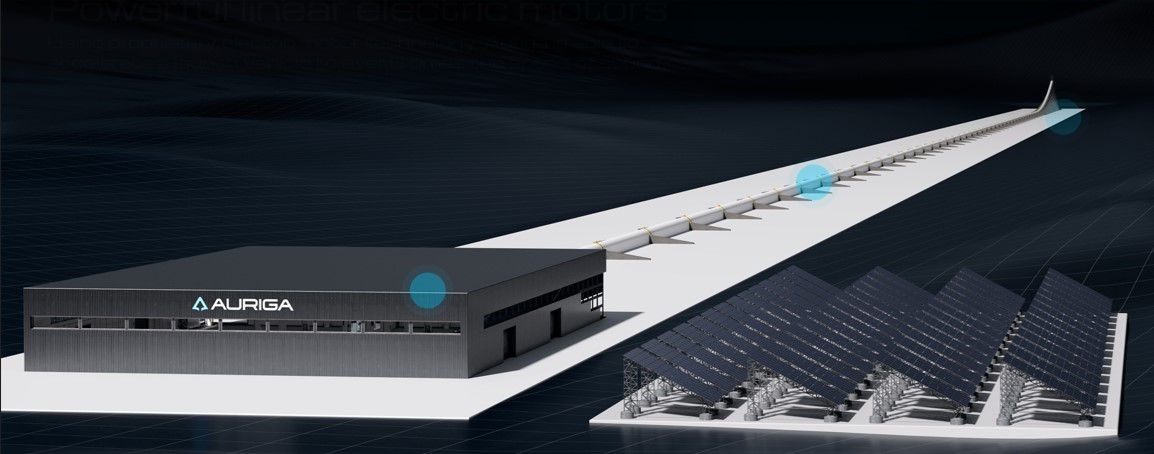
The key element of the system is a reusable linear track with powerful superconducting magnets (similar to the Maglev Track used in high-speed trains). The last few meters are laid at an angle, forming a ramp that ensures a quick exit from the acceleration tube and minimizes aerodynamic drag. The company claims that modern power electronics allow megawatt-level pulses to be delivered without significant energy losses.
Auriga is already planning two smaller-scale installations: the Prometheus laboratory track and the Thor field track for hypersonic testing in 2026, with the full-scale Zeus orbital complex to follow as the next stage. Unlike the SpinLaunch centrifuge, where excessive overload remains the main problem, Auriga engineers optimize the length of the path to reduce the G-load to levels acceptable for satellite electronics. The project has already been supported by venture capital funds OTB Ventures, Trucks VC, and government programs AFWERX / SpaceWERX.
Reducing fuel consumption and making ground infrastructure fully reusable could radically reduce the cost of launching small satellites. This will pave the way for spontaneous scientific missions: the rapid deployment of telescopes to observe fleeting astronomical phenomena (gamma-ray bursts or novas), the rapid replenishment of microsatellite networks for radio or gravitational astronomy, and the launch of combined groups of CubeSats that will operate as an interferometer. Reducing the cost and preparation time will facilitate a greater number of experiments on the ISS, increasing the scientific return from the orbital infrastructure.
Interested in learning about the physical principles behind this “electromagnetic springboard” and how much fuel can actually be saved thanks to the magnetic catapult? Read our detailed article, “Magnetic catapult: How to save tons of fuel for launching rockets into space,” where we examine the details of various projects, compare their energy balances, and show how new technologies can reduce fuel consumption by tens of tons per launch. Get ready for an even deeper dive into mathematical calculations and real-life cases!
According to interestingengineering; techcrunch; payloadspace

