

Dust storms regularly occur on the surface of Mars. Static discharges constantly occur between particles within these storms. In a recently published paper, scientists suggested that these discharges may not only create light effects, but also influence global chemical processes on the planet.
Dust storms on Mars
Mars is considered a dead planet, where nothing has changed for hundreds of millions of years. However, an article was recently published in Earth and Planetary Science Letters. The authors claim that chemical processes on this planet are much more intense than previously thought.
Specifically, we are talking about dust storms, which occur regularly on Mars and sometimes reach significant scales. From a physics point of view, they represent the chaotic movement of small particles in rarefied air. This means friction between them, which creates the possibility of static discharges.
Statistical discharges do occur in Martian storms and manifest themselves as a faint glow similar to the aurora borealis. Scientists now believe that this may not only be a bright light effect, but may also influence chemical processes on the planet’s surface.
Chlorates on Mars
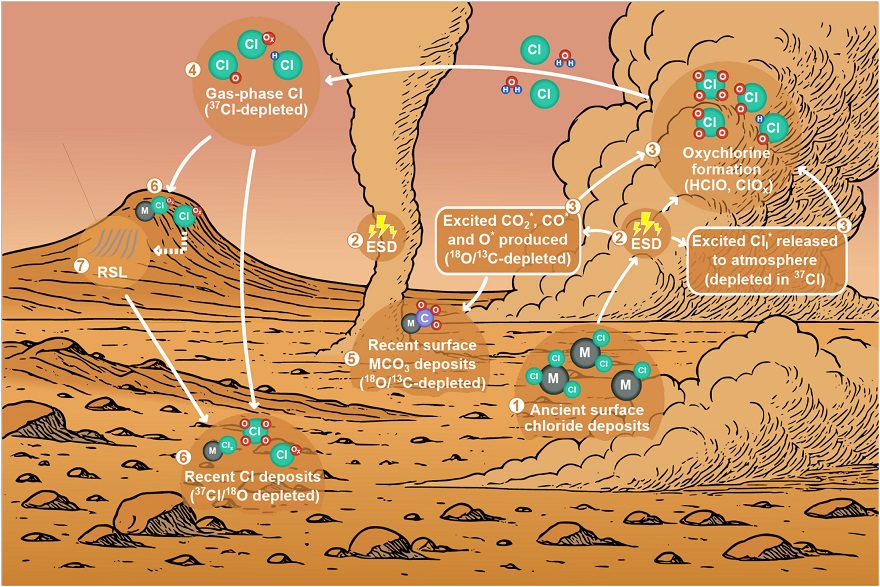
Scientists built two chambers to simulate what happens on the Red Planet during dust storms: PEACh (Planetary Environment and Analysis Chamber) and SCHILGAR (Simulation Chamber with InLine Gas AnalyzeR). Experiments inside them showed that electrical discharges between solid particles can affect the chemicals they are made of: carbonates, chlorates, and active oxides.
These substances were formed during the Amazonian period several billion years ago. Scientists suggest that even then, the “auroras” of Martian storms significantly influenced the formation of the chemical composition of the planet’s surface. And these processes did not stop even when Mars became colder and drier.
Measuring isotopic composition, along with preliminary quantitative determinations, is part of a larger puzzle. This comprehensive view shows that electrochemistry induced by Martian dust activity has shaped the planet’s chemical landscape. These findings support the hypothesis that Martian dust activity has played a crucial role in shaping the modern geochemistry of both the surface and the atmosphere.
In particular, Mars is full of chloride salt deposits, and perchlorates—supersaturated aqueous salt solutions that can exist in liquid form—are found on its surface. It is now clear that static discharges were the cause of their formation.
It turns out that Mars is not so dead after all. For millions of years, chemical processes have been transforming its surface. And it is quite possible that this is not only happening on Mars. The same thing may be happening on Venus and other bodies with atmospheres.
According to phys.org

