

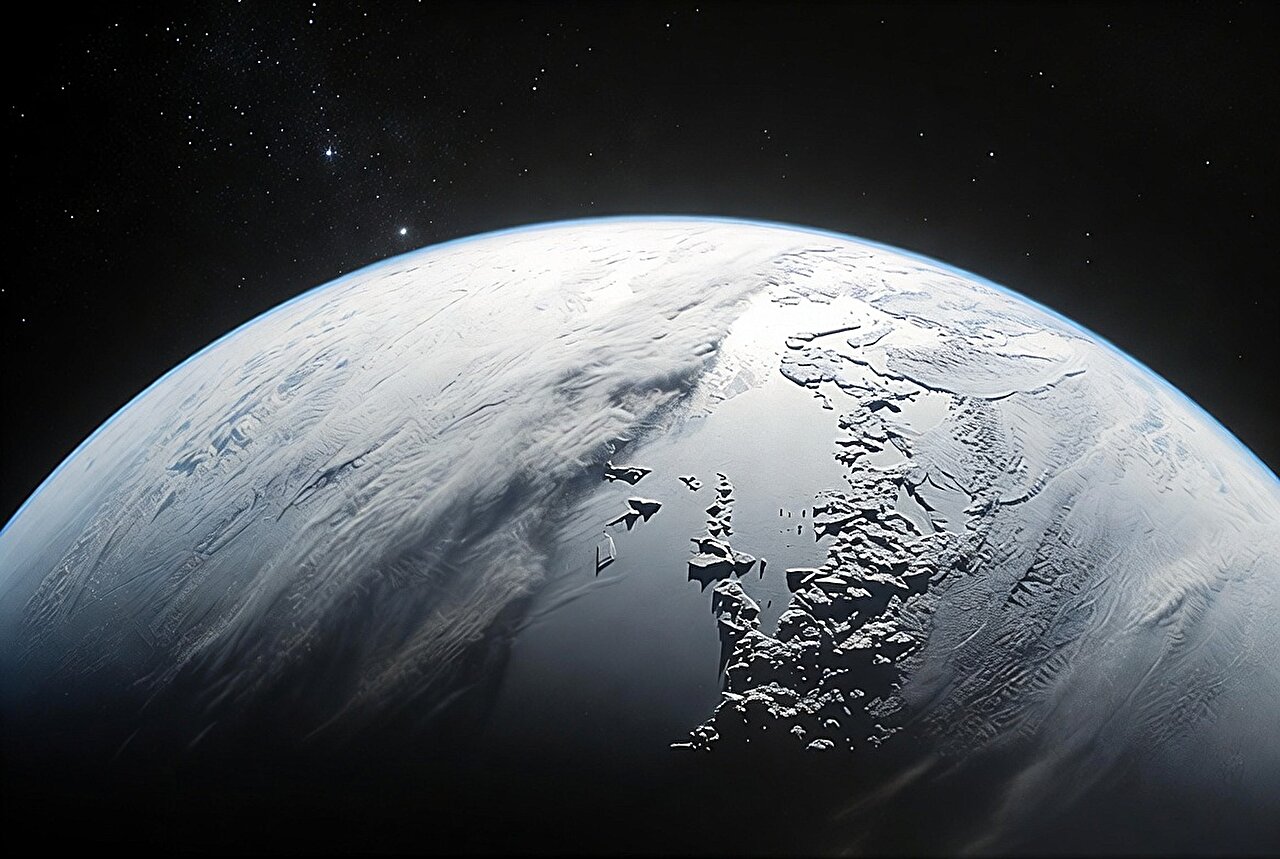
Scientists continue to unravel the mystery surrounding the transformation of Earth into a snowball approximately 600–700 million years ago. A new theory suggests that this may have been caused by the fact that the Rodinia supercontinent, which at that time comprised all of the planet’s landmass, remained almost barren—a solid rocky surface devoid of vegetation and even of formed soil.
Snowball Earth
Scientists from the Trieste Astronomical History Institute recently published a study in which they sought to determine what caused our planet to turn into an almost entirely frozen sphere several hundred million years ago. The article on this topic was published in the International Journal of Astrobiology.
The Neoproterozoic Era, which began about a billion years ago, remains one of the greatest mysteries for scientists. After all, even at its beginning, there were single-celled eukaryotic organisms and cyanobacteria that enriched the atmosphere with oxygen. However, true plants and animals did not appear until 541 million years ago—at the end of this era.
The main reason cited for this phenomenon is the series of ice ages that occurred during this period, including the most extensive in the history of our planet, which took place between 600 and 700 million years ago. At that time, the moving polar ice sheets effectively converged at the equator. Scientists have named this period “Snowball Earth,” and it is precisely this period that they are unable to adequately explain.
In other words, the mechanism by which a significant portion of the planet’s surface began to freeze over—thereby accelerating the process—is quite clear: an increase in albedo. But what served as the initial trigger at that particular time? It is known that the Sun’s luminosity at that time was only 95% compared to today. It has been gradually increasing since the moment of its birth. But this does not explain what prevented an ice age from occurring even earlier, when the Sun was even weaker.
Rodinia
At this point, the scientists recalled another distinctive feature of the Neoproterozoic era. Throughout this period, all of Earth’s landmasses were united into a single supercontinent—Rodinia. Researchers noted that its surface should have been almost barren: nothing but granite and basalt, since neither vegetation nor developed soil existed at that time. At the same time, granite can reflect up to 35% of solar radiation back into space.
And once this massive mass of granite had been brought together, conditions formed at its center that allowed ice to accumulate even in the summer. In addition, the slow weathering of silicate rocks exposed those that had never before come into contact with the atmosphere, causing them to react with the carbon dioxide it contained.
Carbon dioxide, in turn, is the primary greenhouse gas responsible for trapping heat in the atmosphere. Theoretically, all of this together could have led to the initial accumulation of ice in the center of Rodinia, which, in turn, would have triggered the mechanism of ice ages. However, scientists were not certain of this and therefore resorted to mathematical modeling.
The conclusion drawn from this was quite interesting. None of the factors listed could, on its own, have triggered such a catastrophic ice age. In particular, if the entire Earth were to merge into a single supercontinent today, this would not happen. However, back then, during the Neoproterozoic, the combination of a concentrated, plant-free landmass and a sun with low luminosity could indeed have turned the Earth into a snowball.
According to phys.org

