

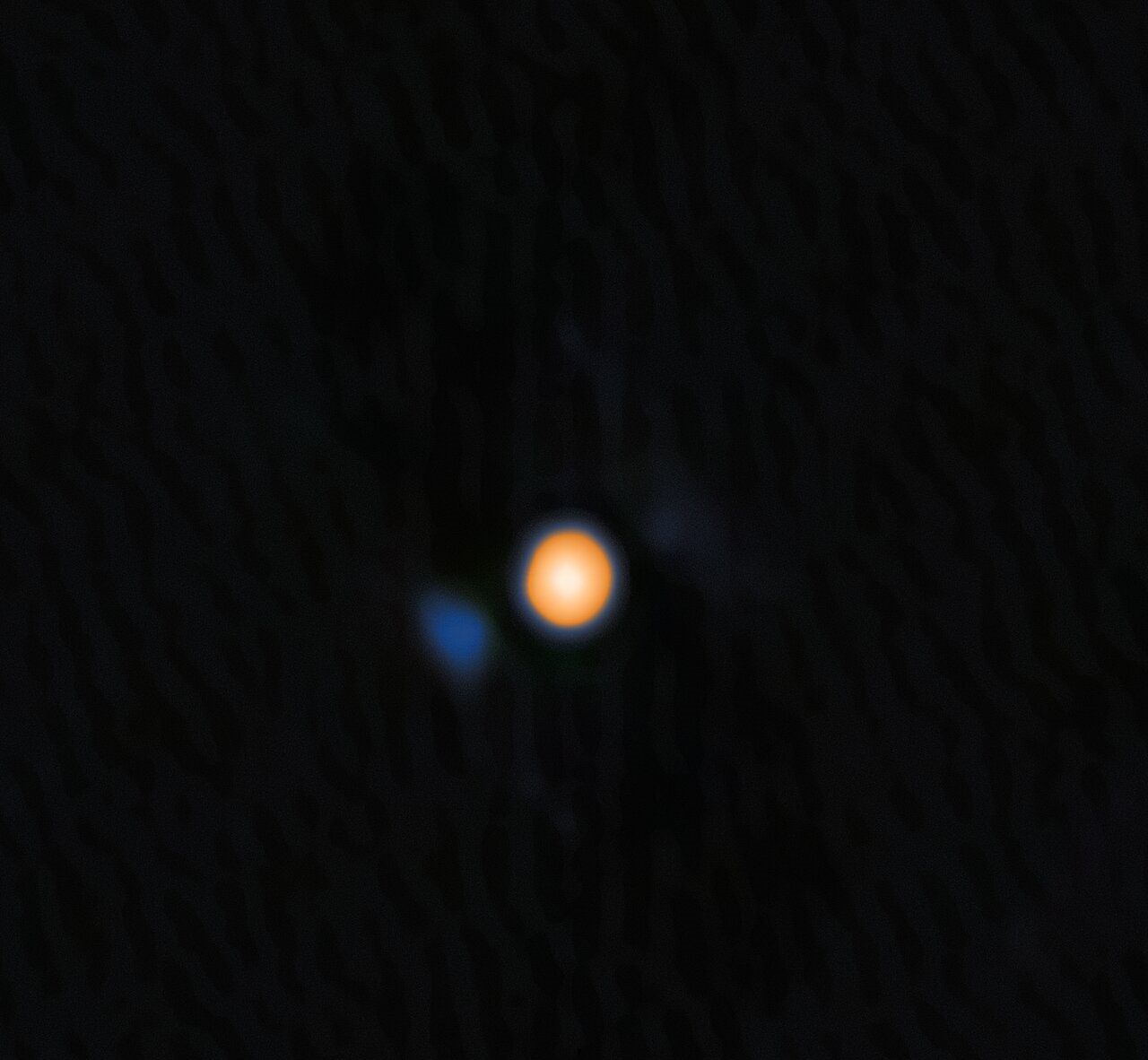
For quite some time, astronomers have suspected that one of the reasons for the mysterious behavior of the giant star Betelgeuse is the presence of a companion star, whose light is simply lost among the dust filling the system. And now its existence has been conclusively proven.
Complicated discovery
Betelgeuse, the red star marking Orion’s shoulder, has long been suspected of hiding a secret, namely a companion star. However, to prove this, it was necessary to quickly capture the fleeting alignment and deploy some of the most powerful space telescopes in a race against time. Now, researchers at Carnegie Mellon University have finally confirmed what many suspected: Betelgeuse really has a companion star, although not quite the type they expected.
The difficulty of detecting anything near Betelgeuse cannot be overstated. This star is approximately 700 times larger than our Sun and thousands of times brighter, which makes it extremely difficult to detect nearby objects. It’s like trying to photograph a firefly flying next to car headlights, or maybe even worse! The difference in brightness between Betelgeuse and its tiny companion is, as Anna O’Grady, a McWilliams Postdoctoral Fellow at Carnegie Mellon, put it, “absolutely insane.”
The breakthrough occurred during a critical observation period around December 6, when the companion, affectionately named Betelbuddy, reached its maximum distance from the supergiant before disappearing behind it for the next two years. The situation required immediate action. O’Grady and her team secured discretionary time as director at both NASA’s Chandra X-ray Observatory and the Hubble Space Telescope, which is usually reserved for only the most exceptional scientific research. The simultaneous adoption of two similar proposals demonstrates the importance of the discovery.
Betelbuddy — Betelgeuse’s companion star
Using Chandra X-ray observations, the deepest ever made of Betelgeuse, O’Grady’s team looked for evidence of accretion, a characteristic feature of compact objects such as neutron stars or white dwarfs that extract matter from their surroundings. They found nothing. The data showed no signs of accretion, ruling out these possibilities. The results, published in the Astrophysical Journal, point to something more familiar, but no less exciting — a young stellar object, roughly the size of our Sun.
In addition to confirming the existence of Betelbuddy, these discoveries help explain the mysterious six-year cycle of Betelgeuse’s brightness and dimming. A previous study in 2024 suggested that a satellite orbiting the star clears it of dust that blocks light, making Betelgeuse appear brighter from Earth. Now this theory has finally been confirmed by observations. However, it questions current models of the formation process of binary stars.
Usually, binary pairs are formed with similar masses, but Betelgeuse weighs 16 or 17 solar masses, while its companion barely reaches one solar mass. This huge mass ratio opens up new possibilities for binary stars with extreme mass ratios, an area that remains largely unexplored just because such systems are very difficult to detect.
According to phys.org

