

Astronomers working with the James Webb Space Telescope (JWST) have published a new, striking image. It shows a protoplanetary disk surrounding a newborn star.
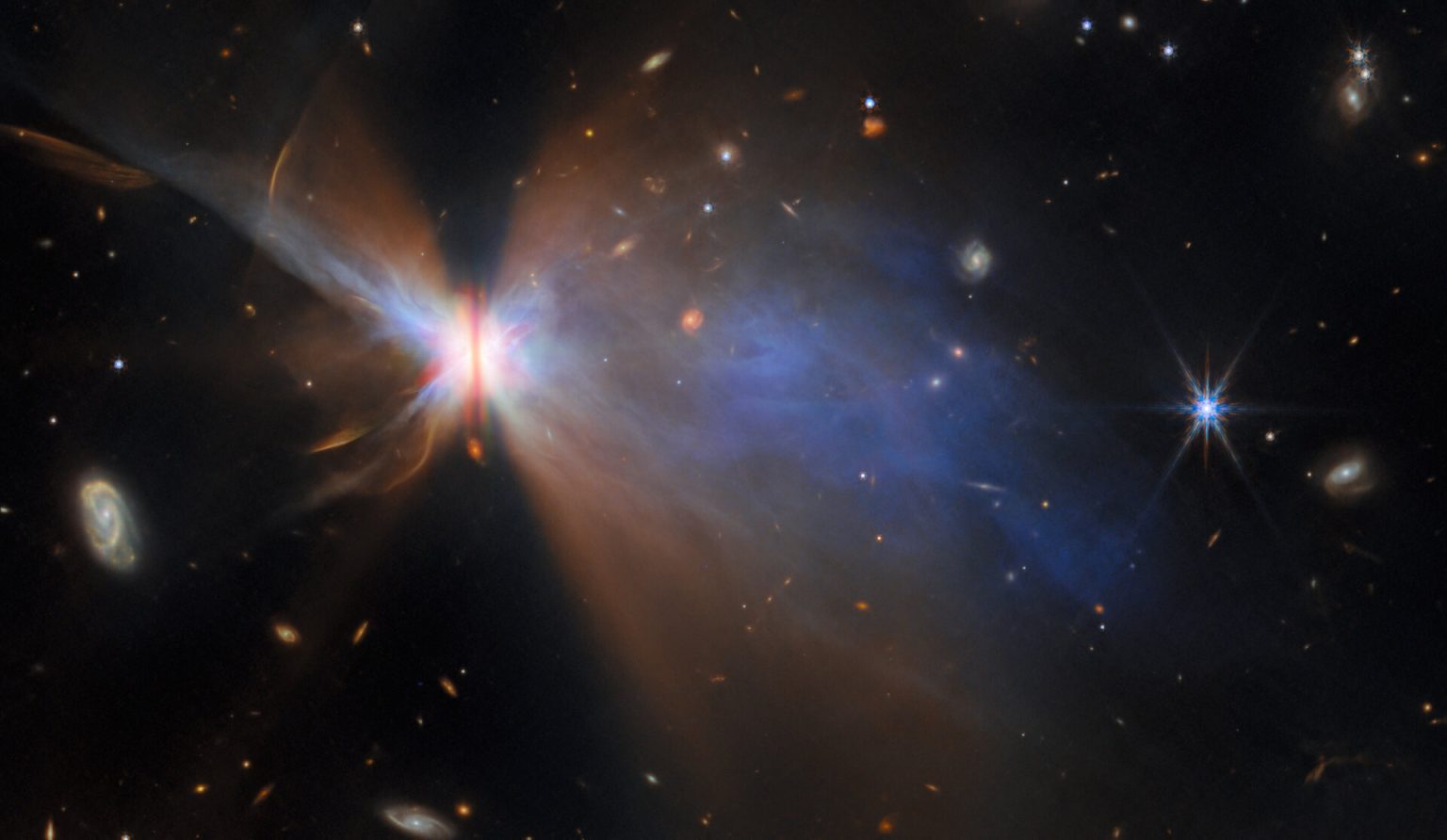
New stars form in giant clouds of cold gas. As they grow, the gas and dust surrounding them gather into narrow protoplanetary disks. They are planetary cradles. Studying protoplanetary disks provides insight into understanding the formation of the Sun, Earth, and other planets.
The protostar IRAS 04302+2247 is a good example of what the Sun might have looked like 4.5 billion years ago. It is located 525 light-years from Earth in the Taurus star-forming region and is still actively growing, gaining mass from its surroundings. It is surrounded by a protoplanetary disk with a diameter of 65 billion kilometers. This is approximately 14 times greater than the distance from the Sun to Neptune.
To better understand the structure of the protoplanetary disk IRAS 04302, astronomers used JWST and the Hubble telescope. The data they collected in the infrared and visible ranges allowed astronomers to study its structure and dust distribution.
Since the protoplanetary disk IRAS 04302 is turned edge-on to us, it appears in the photo as a dark narrow line that blocks the light of the protostar in the center. Dust grains migrate to the midplane of the disk, settle there, and form a thin, dense layer that promotes planet formation: the thickness of the disk is a measure of the efficiency of this process.
Because dust blocks much of the star’s bright light, JWST was able to see the transparent nebulae surrounding it on both sides of the disk. They are so-called reflecting nebulae. Such structures shine with light reflected from other stars. Due to their characteristic appearance, scientists have even given IRAS 04302 the nickname “Butterfly Star.”
Earlier, we talked about another “butterfly” studied by the James Webb Telescope — the planetary nebula NGC 6302.
According to Esawebb

