

Scientists investigated the source of radiation Sh 2-283-1a SMM1. It is a stream of matter emitted by a newborn star located at the very edge of the Galaxy. Its chemical composition shows that it contains far fewer heavy elements than similar objects observed to date, but the general patterns of physical processes remain the same.
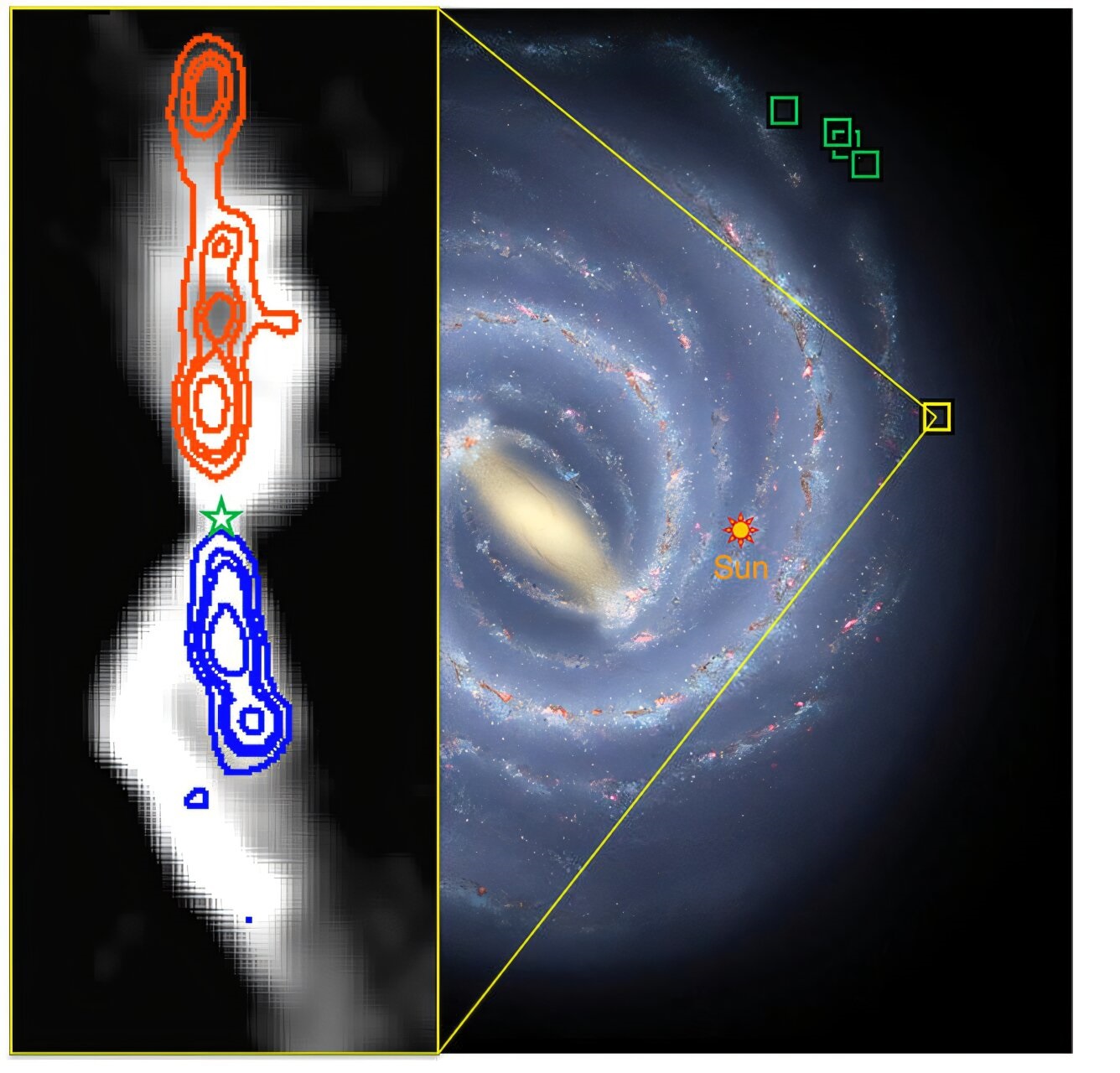
Jets from a newborn star
Research conducted using the Atacama Large Millimeter/submillimeter Array (ALMA) may help us better understand the processes of star formation. This giant radio telescope observed the radiation source Sh2-283-1a SMM1. It is located 26,000 light-years away from us and 51,000 light-years from the center of the Galaxy.
In fact, it consists of jets of matter emitted by a newborn star. This phenomenon is not new and has been observed more than once. A large amount of matter falls onto the newly formed star, and part of it is ejected back into space due to the large angular momentum.
What makes Sh 2-283-1a SMM1 unusual is the star’s location. Not only is it far away from us, but it is also at the very edge of the Galaxy. Scientists have not yet observed such a phenomenon so far from the center of the Galaxy, and this should be an interesting region, because even compared to the vicinity of the Sun, it is poor in metals, i.e., elements heavier than hydrogen and helium.
Research results
Observations made with ALMA have provided insight into the chemical composition of the jets. It has been confirmed that it is much poorer in heavy elements than similar structures that have been observed previously. In particular, the ratio of silicon oxide to carbon oxide was significantly lower than in jets emanating from young stars near the Sun.
At the same time, this object is a “hot core” — a hot structure rich in chemical elements. They are quite common in star-forming regions closer to the center of the galaxy, but this is only the second time such an object has been observed at its edge.
The luminosity of the core is 6,700 times greater than that of the Sun, which suggests that the star, when fully formed, will be of average or large mass. The jets are not emitted continuously, but at intervals of 900–1400 years.
ALMA also detected increased activity in four other young stars on the outskirts of the Galaxy. This indicates that the processes of star formation here are quite intense and, in general, follow the same patterns as in the center of the Galaxy.
According to phys.org

