

An international group of astronomers observed a sudden ejection of matter near a supermassive black hole. The speed of the ejected matter reached 20% of the speed of light.

The black hole responsible for the ejections is located at the center of the galaxy NGC 3783, 135 million light-years from Earth. Its mass is 2.8 million times greater than that of the Sun. It has an accretion disk, part of which is absorbed by the black hole, while the rest is ejected in the form of jets.
The black hole at the center of NGC 3783 has long attracted attention due to its activity. During 10 days of observations, conducted mainly with the XRISM space telescope, researchers witnessed the formation and acceleration of matter ejection. Such ejections are often fueled by strong radiation, but this time the most likely cause is a sudden change in the magnetic field, similar to the bursts on the Sun that cause solar flares.
Although it is known that supermassive black holes flicker in X-rays, astronomers have clearly seen for the first time a high-speed ejection accelerated during an X-ray burst. Over a 10-day period, they observed changes in the brightness of the X-rays, especially in the softer X-ray range. These changes, including a three-day-long surge, are not unusual for supermassive black holes.
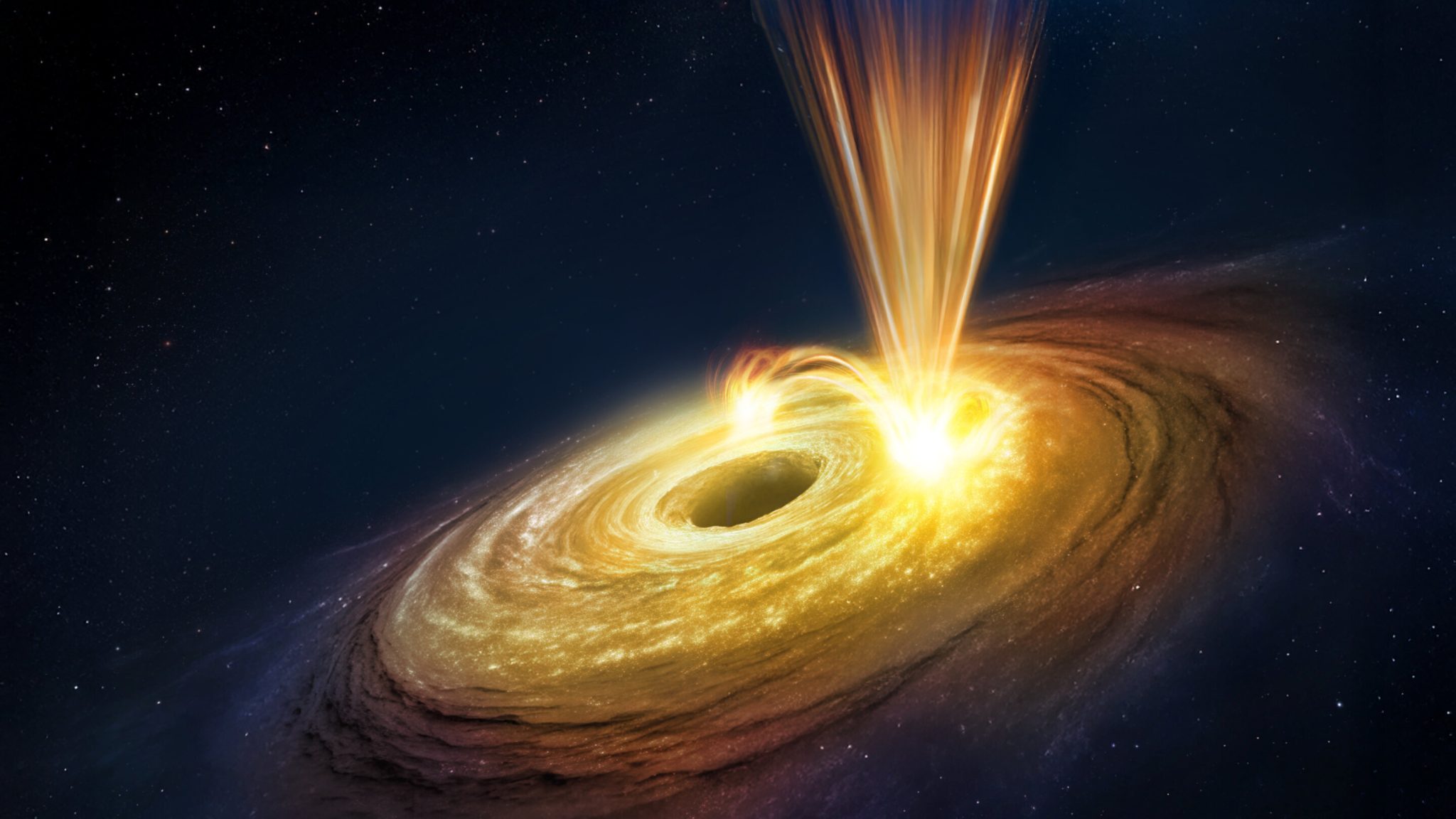
However, what makes this burst unique is the simultaneous ejection of gas from the black hole’s accretion disk—a swirling disk of matter orbiting the black hole. This gas was ejected at an incredibly high speed, reaching 60,000 kilometers per second, or 20% of the speed of light.
The gas apparently came from a region about 50 times farther away from the black hole. In this turbulent region, gravitational and magnetic forces interact extremely intensely. The authors of the study believe that the ejection was caused by a process called magnetic reconnection — a sudden reconfiguration of magnetic fields that releases enormous amounts of energy.
“This is a unique opportunity to study the mechanism behind ultra-fast ejections,” said Liyi Gu, lead author of the study published in the journal Astronomy & Astrophysics. “The data show that the acceleration of the ejection is caused by magnetic forces similar to coronal mass ejections from the Sun.”
A coronal mass ejection occurs when large drops of hot solar plasma are ejected into space. A supermassive black hole can do the same thing, only these eruptions are ten billion times more powerful, eclipsing anything we have ever seen on our Sun. Scientists suggest that the observed black hole phenomenon, like its solar counterpart, is fueled by sudden bursts of magnetic energy. This contrasts with common theories suggesting that black holes eject matter through intense radiation or extreme heat.
Earlier, we reported on what would happen if a person encountered a microscopic black hole.
According to SRON

