

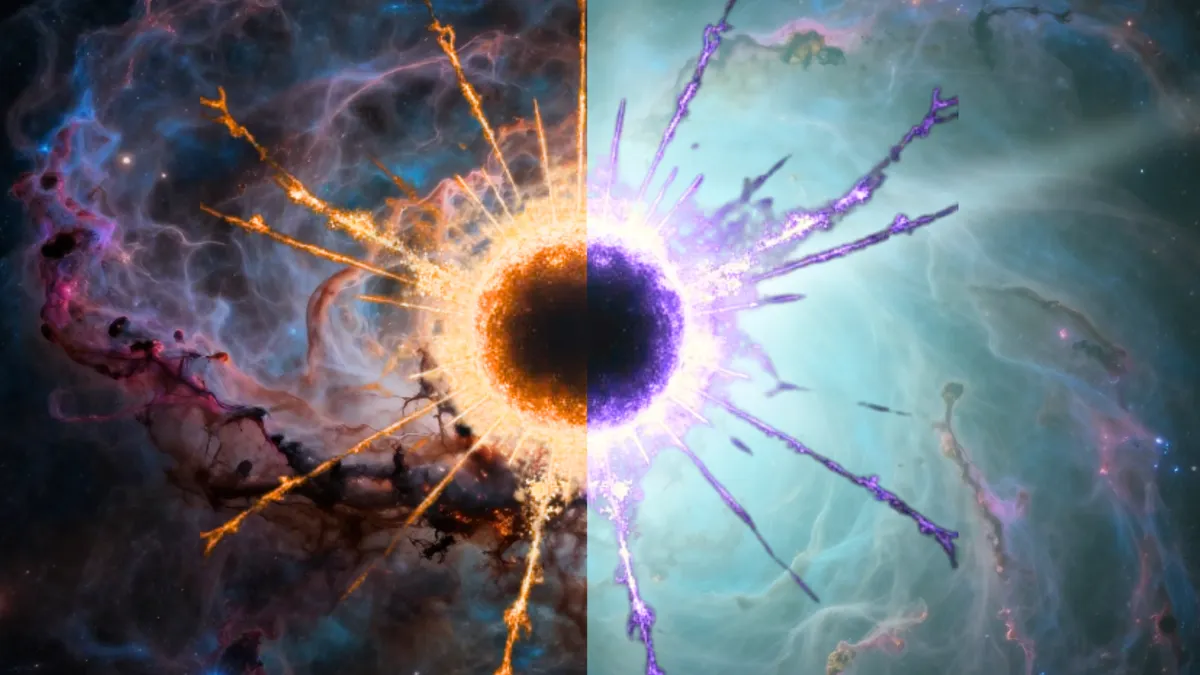
Hypothetically existing black holes that formed immediately after the Big Bang can exist for much longer than previously thought. What’s more, some of them may not vanish without a trace, but instead transform into so-called white holes, which, instead of absorbing matter and radiation, repel everything from themselves.
Radiation mechanism
Scientists have long suspected that black holes gradually lose mass through a specific mechanism. In the 1970s, physicist Stephen Hawking predicted that black holes slowly lose energy by emitting thermal radiation. The smaller the mass of the black hole, the more intense this process is. This means that small black holes “evaporate” faster, while massive ones could outlive the universe many times over.
It is believed that first black holes did not form from the collapse of massive stars, but rather from fluctuations in superheated and superdense matter in the first moments after the Big Bang. They have not yet been detected and remain hypothetical objects, but they are being actively sought as possible candidates for dark matter.
What’s happening on the border?
Daniel Paraizo, a researcher at Eberly College of Natural Sciences, and his colleagues focused on the so-called Planck mass—0.00000002176 kg, or approximately 21.76 micrograms, which is roughly equal to the mass of a human eyebrow hair. This is a fundamental unit in physics, where the laws of quantum mechanics and general relativity become equally important. Previous calculations showed that once this threshold is reached, the remaining 20 micrograms of the black hole should be emitted in less than a second.
The team’s new mathematical calculations yield a different result. According to Daniel Paraizo, once a black hole reaches Planck mass, it becomes practically stable and begins to emit what is known as cleansing radiation. This radiation “cleanses” the quantum state of the universe and is a sign of behavior characteristic of a white hole.
It is important to understand this is only a theoretical model, not an observed physical process. To date, there is no experimental evidence for the existence of such remnants or white holes. This is merely one of several possible approaches to resolving the black hole information paradox.
Primordial black hole
A primordial black hole formed from the mass of a medium-sized asteroid—that is, about a billion tons—disintegrates over approximately a billion years, gradually losing mass through Hawking radiation until it reaches the Planck limit. An object born with only a ton of matter, on the other hand, explodes almost instantly, immediately reaching the threshold value.
According to the team’s predictions, after this threshold, the object’s behavior takes on the properties of a white hole—the hypothetical opposite of a black hole, which repels rather than absorbs matter and radiation. To describe this transition more precisely, a theory of quantum gravity is needed that would unify quantum mechanics and general relativity. Physicists have been searching for it since the early 20th century. A preprint of the study has been published in the arXiv repository and has not yet undergone peer review.
According to space.com

