

Radioastronomy studies show that after black holes tear stars apart, certain processes take place within them. These processes generate powerful radio bursts, and scientists even know why this happens.
Tearing stars apart
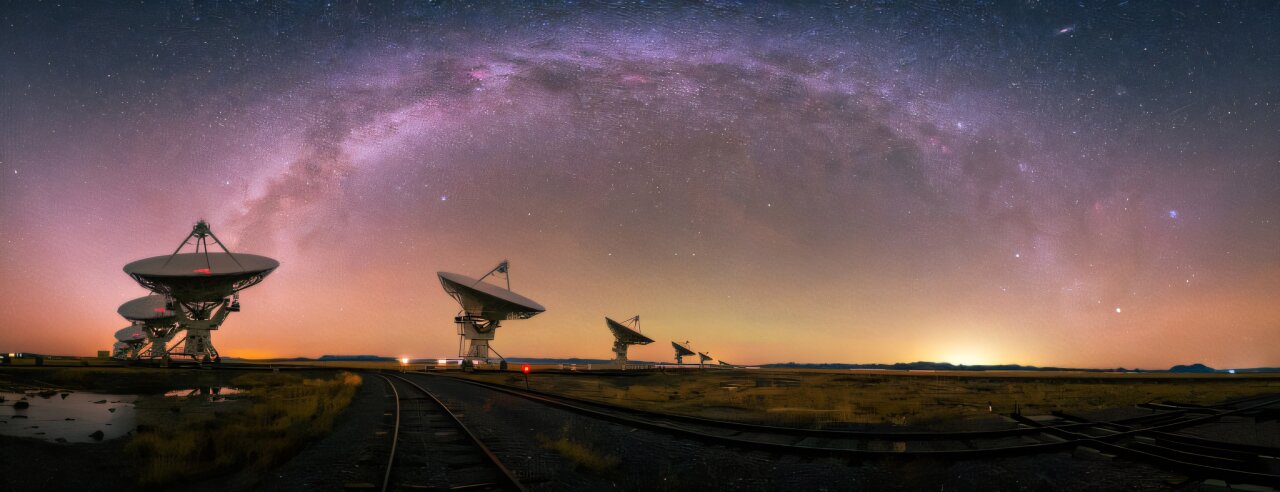
Scientists working with the NSF VLA, a large array of antennas, recently made a discovery related to the processes by which black holes destroy stars. This radio telescope recently detected signals from some of them that arrive days after the visible light has faded.
Black holes are usually formed as a result of supernova explosions—some of the most massive phenomena in the universe, marking the end of massive stars’ lives. However, sometimes, after their formation, they become the source of events that are no less dramatic. This happens when another star, usually one of lesser mass, approaches a black hole.
At this point, gravity begins to play a decisive role, because despite its size—measured in kilometers—stellar-mass black holes weigh as much as dozens of stars like the Sun. And supermassive ones weigh as much as several million. This means that its gravitational pull is so strong that it can tear a nearby star to pieces.
Such catastrophes usually occur in several stages and are called tidal disruption events. And they can end with the luminary, which is collapsing, eventually flaring up in such a way that it becomes visible over vast distances. Afterward, a black hole quietly devours what remains.
Radiation from a black hole
At least, that’s what scientists had thought until now. But then a new study showed that black holes, which cause tidal disruption events, generate radio bursts. And if this were happening during the event itself, there would be nothing surprising about it. However, these signals appear many days or even months after the light from the torn-apart star has completely faded.
In fact, scientists observed two different scenarios for such flares. In the first scenario, flares in the ultraviolet and radio bands occurred during the first few hundred days after the event took place. In the second scenario, they occurred even later, when the black hole’s consumption of parts of the star should have already ended.
In any case, we’re not talking about something created by a dead star. The reason is a black hole. And in fact, there is nothing particularly mysterious about these events. The models clearly show what is happening. When a black hole absorbs matter, a process called accretion occurs: first, material from the component star forms a disk around the black hole, called the accretion disk. Then, matter falls onto the black hole from the inside of this disk.
However, it still cannot swallow all the material. Some of it is converted into radiation, which often makes it very difficult for black holes to conceal their existence. All of this was already known before the new discovery. Now, scientists have determined that tidal disruption events also give rise to a similar phenomenon, and that it is quite widespread.
According to phys.org

