

Scientists used the IXPE satellite to measure the polarization of X-rays coming from the black hole IGR J17091-3624. It turned out to be 9.1% higher than expected, and astronomers have put forward a number of interesting theories that could explain this phenomenon.
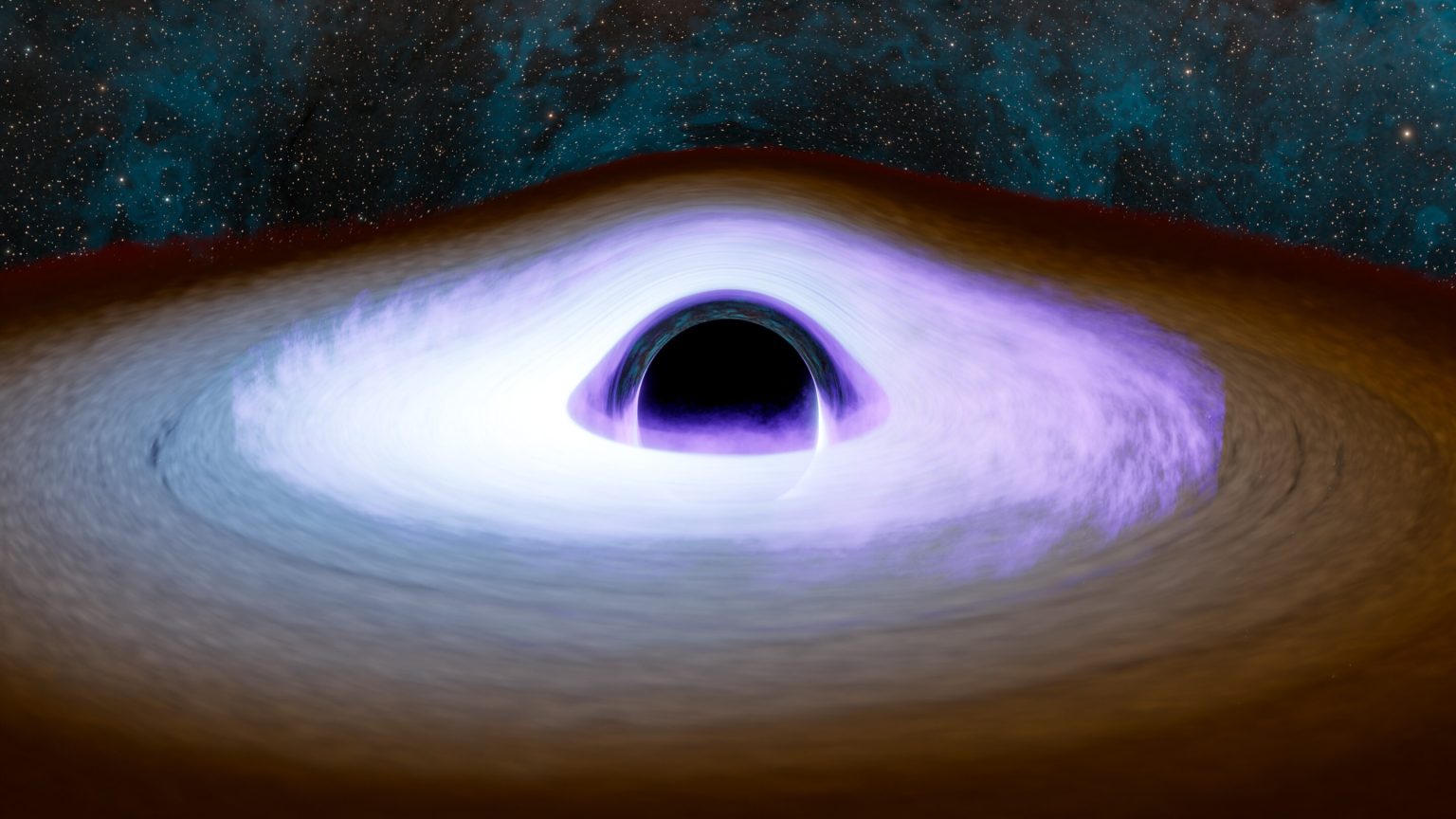
X-ray satellite and black hole
Black holes do not emit anything, hence their name. However, the substance in the space directly around them may well glow at different wavelengths, including in the X-ray range. And an international team of scientists studied one of these remarkable objects with it.
The main instrument used in the study is the IXPE space telescope. This unique device is capable of measuring the polarization of X-rays, i.e., the extent to which the oscillations occur in a single plane.
The black hole, which has become the subject of research, is called IGR J17091-3624 and is located 28,000 light years away from us. It is part of a close binary system and exhibits periodic fluctuations in brightness similar to a heartbeat.
A mysterious discrepancy
The main result of the study of IGR J17091-3624 was that the degree of polarization of X-ray radiation from it was 9.1% higher than expected. Here, it is necessary to explain what exactly is emitted in such a binary system.
The gravitational pull of the black star tears matter away from its companion star and flows toward it across a peculiar bridge, forming an accretion disk. The substance inside it is super hot, spins fast, and gives off radiation.
However, in the X-ray range, it is not the disk itself that glows, but the “corona” — the area inside it where the plasma is heated to billions of degrees. Its orientation relative to the direction toward Earth determines the polarization of the radiation.
Unfortunately, due to the enormous distance, scientists cannot see either the corona or even the companion star to verify how the accretion disk is oriented. However, according to some data, we see that it is not quite from the edge, which would ensure the maximum level of polarization.
Possible explanations
Scientists have explored various ways of explaining the high degree of polarization. In one model, astronomers included the “wind” of matter lifted from the accretion disk and ejected from the system, which is a rare phenomenon. If X-rays from the corona encountered this matter on their way to IXPE, Compton scattering would occur, leading to these measurements.
Another model suggested that plasma in the corona could exhibit very rapid outflow. If plasma were flowing outward at up to 20% of the speed of light, or approximately 124 million miles per hour, relativistic effects could amplify the observed polarization.
In both cases, simulations could reproduce the observed polarization without a very specific ridge. Researchers will continue to model and test their predictions to better understand the high degree of polarization for future research efforts.
According to phys.org

