

Blue Origin successfully conducted a firing of its New Glenn rocket. This was the final test before its second flight, which will take place in November.
Technical design of New Glenn
New Glenn has a two-stage design. It is 98 meters high and seven meters in diameter. The first stage of the rocket is equipped with seven BE-4 engines. They use methane as fuel and liquid oxygen as an oxidizer. The second stage is equipped with two BE-3U engines that run on a mixture of liquid hydrogen and oxygen.
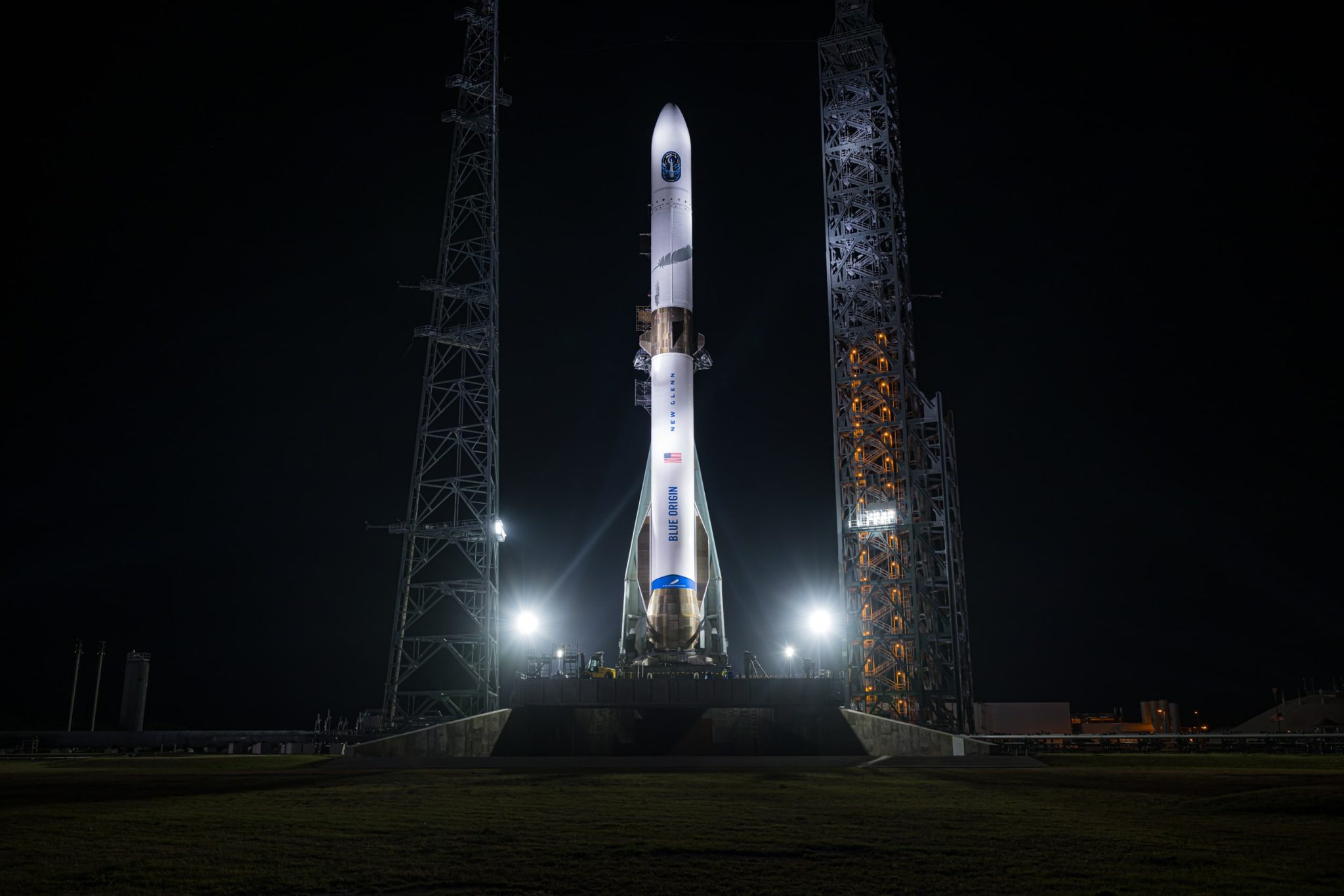
The first stage of New Glenn is reusable. After separation, it lands on a barge in the ocean, similar to the first stage of Falcon 9. According to the designers, the stage can be used up to 25 times. New Glenn can deliver up to 45 tons of cargo to low Earth orbit and 13 tons to geostationary transfer orbit.
The first flight of New Glenn took place in January 2025. The rocket successfully launched the Blue Ring satellite platform prototype into orbit. However, Blue Origin specialists were unable to solve the problem of returning its stage. It was lost shortly after entering the atmosphere.
Firing of New Glenn
After the first flight, Blue Origin engineers made a number of changes to the rocket’s design. The company has high hopes for its second flight and expects to successfully recover its second stage — this task is now a key priority.
In October, a new New Glenn rocket arrived at Cape Canaveral. At the end of the month, the rocket was installed on the launch pad, after which engineers conducted a fire test. It lasted 38 seconds, including 22 seconds during which seven BE-4 engines operated at full power. The test was successful.
We completed a successful hotfire of our fully integrated New Glenn launch vehicle at LC-36! All seven engines performed nominally with a 38 second duration test including all seven engines operating at 100% thrust for 22 seconds. pic.twitter.com/jHAoNpIC0A
— Blue Origin (@blueorigin) October 31, 2025
In the near future, specialists will install a payload consisting of two ESCAPADE probes on the rocket. After that, New Glenn will be prepared for launch. The exact date has not yet been announced, but it is expected to take place in November.
After launch, the ESCAPADE probes will head for the Lagrange point L2. They will spend about a year in its vicinity studying space weather, after which they will head for Mars. You can find out more about the technical design and main objectives of this mission in our article.

