

The New Year is approaching, and we are looking at the calendar of astronomical events for 2026. The sky will offer something interesting for everyone: the opposition of Jupiter and rare transits of satellites across its disk, the greatest elongations of Venus and Mercury, spectacular meteor showers and various conjunctions, and May will see two full moons – at the beginning and end of the month. In some parts of the world, it will be possible to observe lunar and solar eclipses. We are also eagerly awaiting the explosion of a bright new star – T Corona Borealis. Will 2026 be the year that astrophysicists and the world’s largest telescopes have been preparing for?
Meteor showers
Throughout the year, we will witness a series of fairly powerful and reliable “shooting stars.” Although they are observed annually, the specific conditions vary from year to year. The decisive factor is the Moon, whose large phase significantly reduces the number of meteors you can see at night.
Quadrantids – December 28 to January 12, peak on January 3, ZHR = 80, but the full moon will significantly reduce the number of meteors that can be seen per hour.
Lyrids – April 14 to 30, peak on the evening of April 22, ZHR = 18, the waxing Moon will be 34% illuminated, so it will not greatly interfere with observations.
Eta Aquariids – from April 19 to May 28, peak on May 6, ZHR = 50. The stream is observed closer to dawn, and at this time, the 84% illuminated Moon will be above the horizon.
Southern Delta Aquariids – July 12 to August 23, peak on July 31, ZHR = 25. The Moon in its 98% phase will be near the radiant and will remain in the sky throughout the night.
Perseids – July 17 to August 24, peak on August 12/13, ZHR = 100. The peak of activity is expected just a few hours after the solar eclipse, so the Moon will remain in its new phase, and therefore, observations promise to be very fruitful.
Orionids – from October 2 to November 7, peak on October 21, ZHR = 20+; the waxing Moon, illuminated at 71%, will set below the horizon at approximately 01:30 a.m., leaving the most favorable pre-dawn hours for observation.
Leonids – from November 6 to November 30, peak on November 17, ZHR = 15, the shower is visible in the second half of the night, when the waxing Moon has already set below the horizon.
Geminids – December 4 to 20, peak on December 14, ZHR = 150. The new moon will set below the horizon in the evening and will not interfere with enjoying this meteor shower.
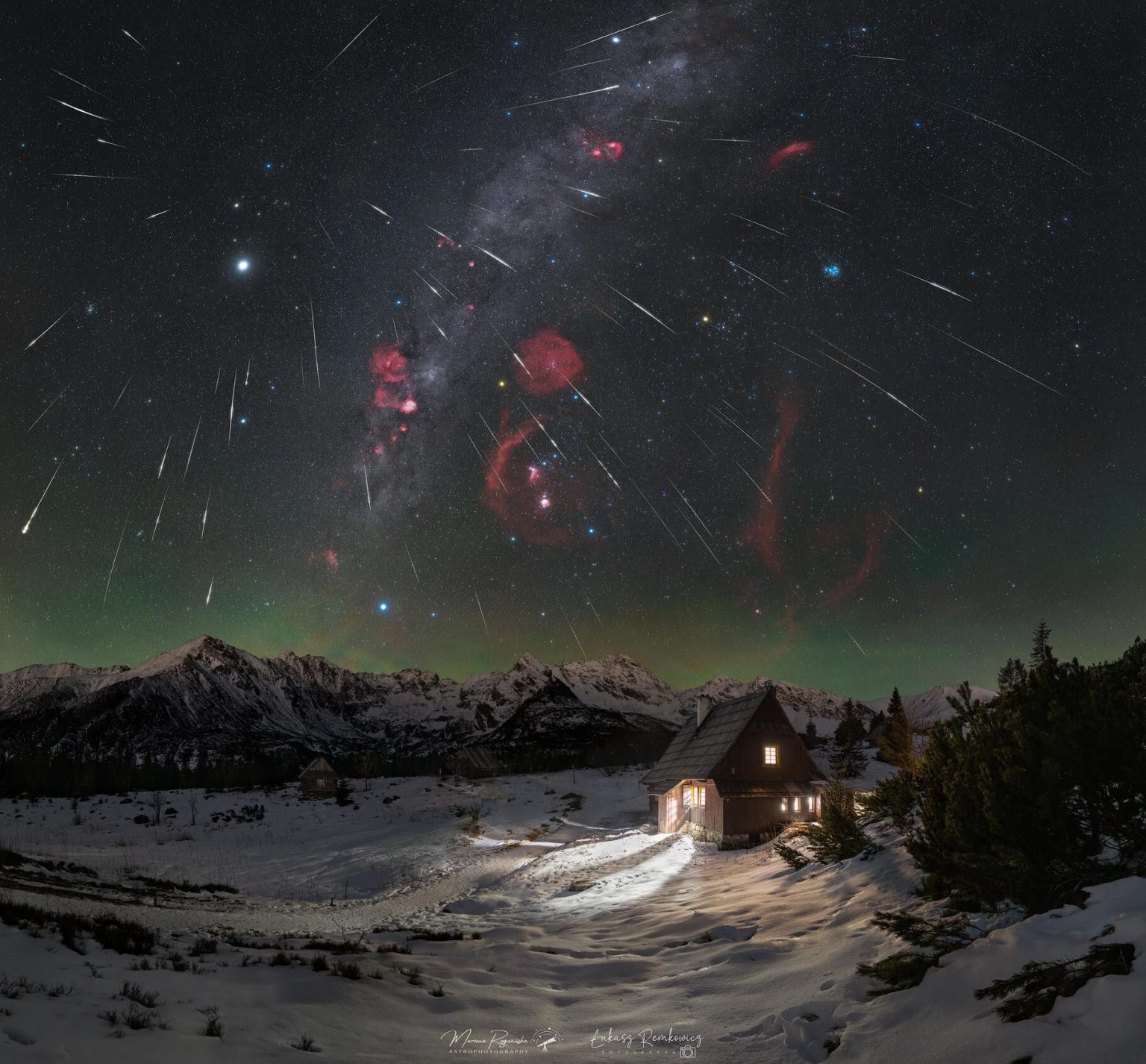
Photo: Marzena Rogozińska and Lukasz Remkowicz.
Lunar and solar eclipses
In 2026, there will be a total of four eclipses: two solar and two lunar. However, none of them will be truly favorable for observation in Ukraine.
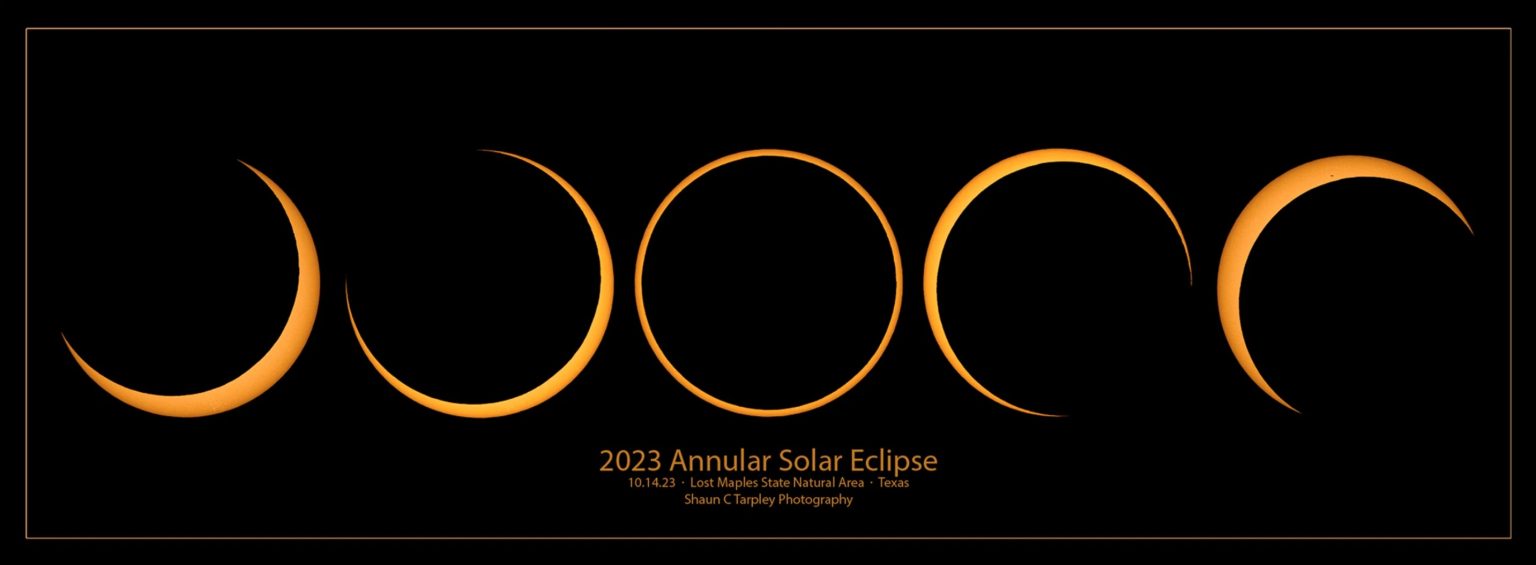
The first eclipse of the year will be an annular solar eclipse on February 17. Such eclipses occur when the Moon is near its apogee – the point in its orbit furthest from Earth. During the maximum phase, the Sun is not completely hidden behind the Moon – a thin, dazzlingly bright rim remains. However, the eclipse on February 17 will be visible to a very limited number of people, as it will be best observed in Antarctica and, perhaps, partially on the southern coast of Africa and South America (Chile and Argentina).
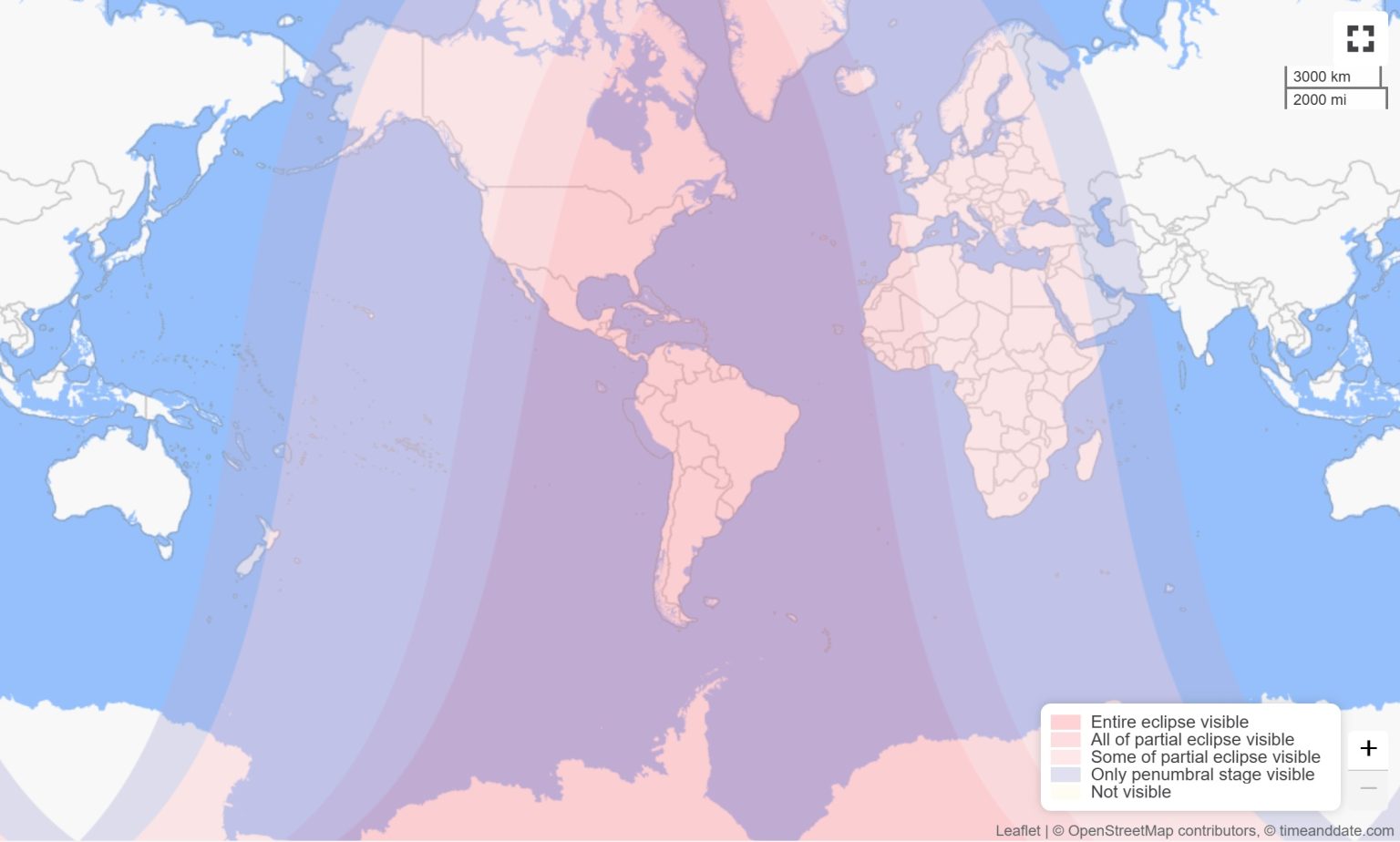
Solar and lunar eclipses occur in pairs (much less frequently in trios), separated by approximately two weeks. The eclipse on February 17 will be paired with a total lunar eclipse on March 3. Lunar eclipses are less “sensitive” to the geographical location of the observer: they can be observed from anywhere where the Moon is visible at that time. However, there will not be many witnesses to the eclipse on March 3 either. The best place for observation is the Pacific Ocean, so the Hawaiian Islands, Fiji, New Zealand, and others will be the luckiest. All phases of the eclipse will be visible to residents of East Asia and western North America, as well as the east coast of Australia. For Ukraine, the eclipse will occur during the daytime, when the Moon will be below the horizon.
The third eclipse of the year will be a total solar eclipse on August 12. Unlike the first one, residents of the northern hemisphere will be able to enjoy it. The best conditions will be in Greenland, Iceland, Portugal, and Spain. A large partial phase will be observed in northern Canada and Europe. In Ukraine, less than 60% will be visible in the west of the country before sunset.
The final partial lunar eclipse of the year will occur on the night of August 27/28. A lunar eclipse is called partial if our natural satellite does not completely submerge into the Earth’s shadow. In this case, up to 93% of the Moon will be in shadow. The most favorable conditions for observation will be in South America, but the maximum phase will also be visible from the eastern part of North America. Certain phases will also be visible throughout the rest of the continent, as well as in Greenland, Africa, and Europe. In Ukraine, it will not be possible to observe the maximum phase, but partial phases will be visible almost everywhere. The further west the observer is, the greater the percentage of the Moon that will be hidden in the Earth’s shadow before the satellite descends below the horizon.
Oppositions and greatest elongations of planets
The best time to observe the inner planets – Venus and especially Mercury – is traditionally considered to be during periods of their greatest elongations. That is, configurations in which they move as far as possible from the Sun in the sky. However, not all maximum elongations of Mercury are equally favorable for observation, since during some of them the fastest planet rises or sets almost simultaneously with the Sun.
The most favorable periods for observing Mercury from the northern hemisphere in 2026 will be the greatest eastern elongation on February 19 (in the west, shortly after sunset) and the greatest western elongation on November 21 (southeast, before dawn).
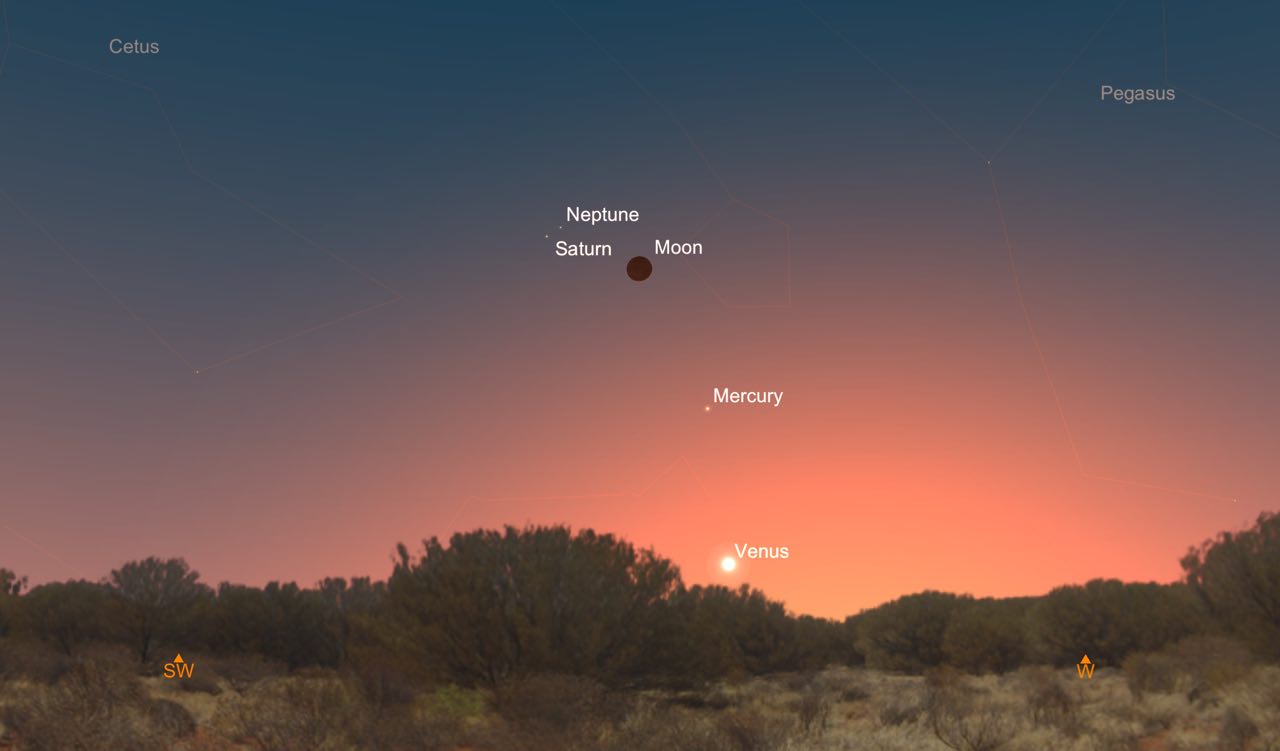
Source: SkySafari virtual planetarium.
As for Venus, the best opportunity for evening observations is late spring. However, during its greatest eastern elongation on August 15, the planet will not be as easy to observe, as it will set below the horizon shortly after the Sun. The next comfortable window will open in mid-November: every day, the brightest planet will rise earlier than the Sun. And at the beginning of 2027, it will reach its greatest western elongation.
Planets that are external to Earth – from Mars to Neptune – are best observed in opposition, when the planet and the Sun are in opposite directions relative to Earth, and at almost the minimum possible distances. The rarest are the oppositions of Mars – we are expecting the next one as late as February 2027.
Giant planets move much more slowly, so oppositions occur less frequently than once a year. Jupiter’s opposition will take place on January 10, followed by Neptune (September 26), Saturn (October 4), and Uranus (November 26).
Interesting configurations of planets and the Moon
Do you remember how incredible the conjunction of Venus and Jupiter looked at dawn on August 12, 2025? No photograph can convey what the human eye sees live. A similar configuration awaits us on the evening of March 8. However, this time Venus’s “celestial partner” will not be Jupiter, but Saturn. The planets will be less than 1° apart, so they can be seen simultaneously through the eyepiece of a small telescope or binoculars. They will be accompanied by Neptune, but it will be difficult to see it in the bright sky, even with a telescope.
From April 17 to 21, four planets will gather in a close cluster: Saturn, Mercury, Mars, and Neptune. Unfortunately, it will be almost impossible to observe this phenomenon, as the planets will rise almost immediately before sunrise.
On June 17 and 18, look to the western sky shortly after the evening star disappears below the horizon. There you will see a spectacular configuration: Mercury, Jupiter, Venus, and a thin crescent moon will be arranged almost in a row.
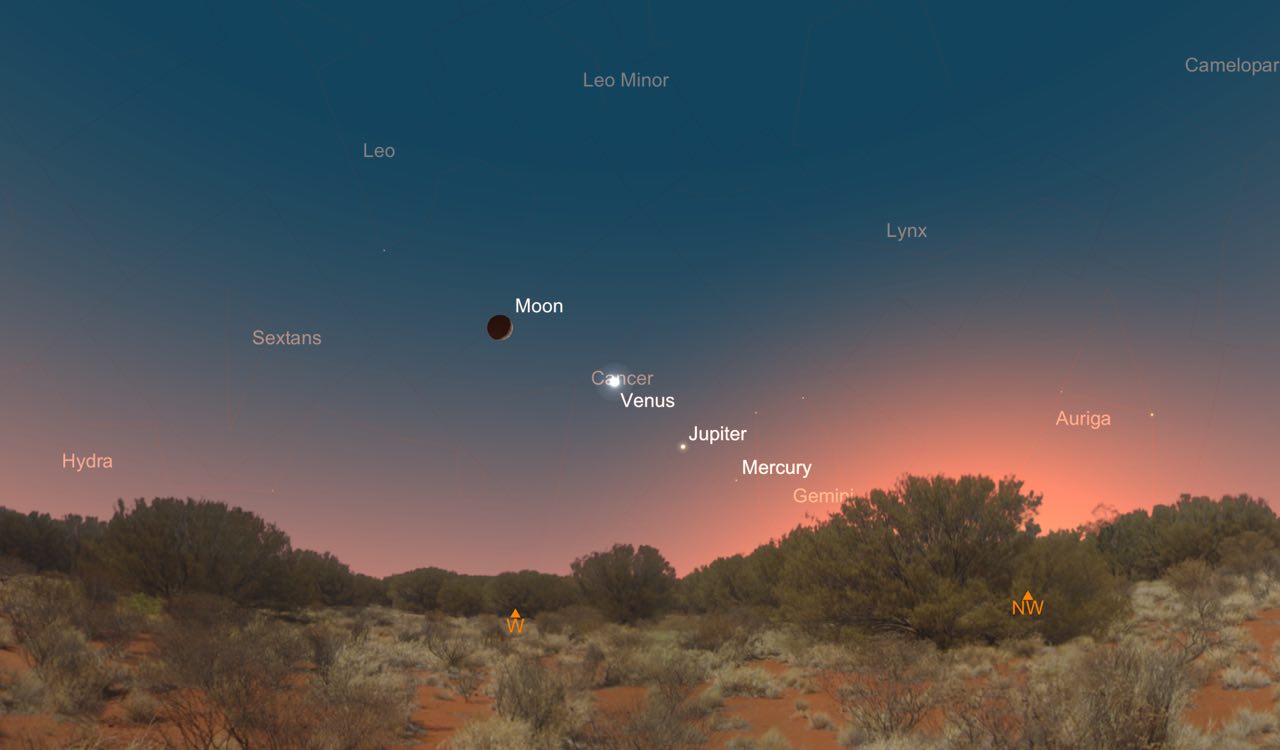
Source: SkySafari virtual planetarium
Before dawn on August 15, Jupiter and Mercury will be less than 1° apart. Although the planets are bright, it will be very difficult to observe this phenomenon because they are too low above the eastern horizon.
A rare event, the Moon covering Venus, will occur during the day on September 14. The moon, which will be 12% full, will be easy to find in the sky. This event will also help you see Venus in the daytime sky – a difficult task that becomes realistic even for beginners. Of course, for full observation, it is advisable to “arm” yourself with binoculars on a tripod or a telescope.
On October 5, also in the daytime sky, at approximately 09:10 (06:10 UTC), the Moon will pass literally 0.3° from Mars. The celestial bodies will be only slightly further apart before dawn. However, for experienced observers, observing them in the daytime sky is a great opportunity to gain new experience. (Yes, it is quite possible to find Mars in the daytime with a telescope, and it looks quite unusual!)
On November 3, in the second half of the night, Mars, Jupiter, and the old Moon will be closely aligned above the eastern horizon.
Jupiter under the steadfast gaze
A series of interesting, rare, and little-known events in the Jupiter system will mark the year 2026. This is because at the end of the year, the orbital planes of the planet’s four large Galilean moons will be oriented edge-on to the center of the Solar System.
This configuration allows us to observe extremely interesting phenomena – mutual “eclipses” of one satellite by another. Sometimes we see how one satellite hides behind another, and sometimes how one of them enters the shadow of the other. For detailed observations, you will need a telescope with a diameter of 200 mm or more. But even with a smaller aperture, you can see how two satellites “merge” into one.
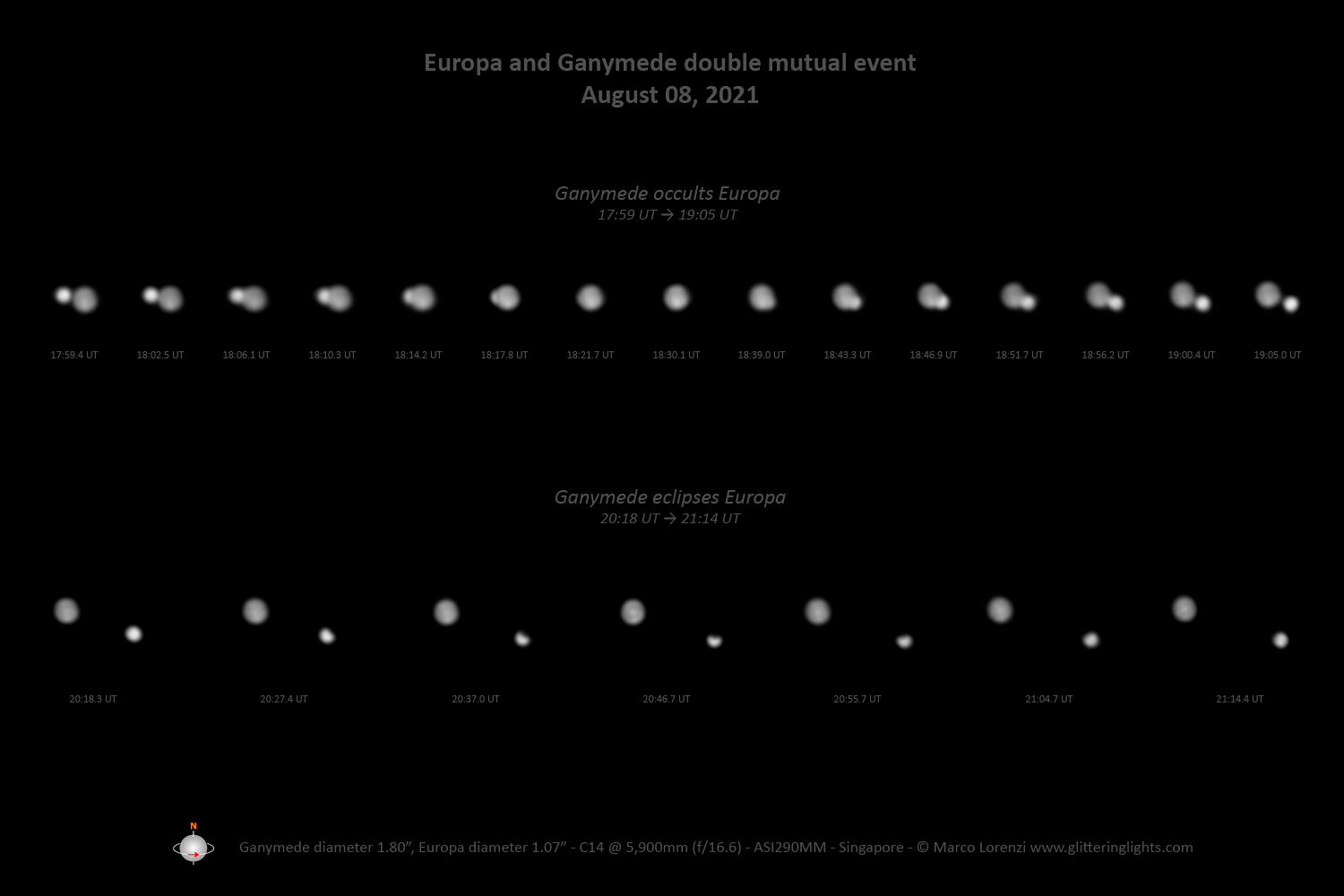
For example, before dawn on September 9, Ganymede will partially cover Callisto. This peculiar “eclipse” will last approximately from 05:30 to 05:39 (02:30 – 02:39 UTC). A complete list of events can be calculated using a special service.
In addition, on the night of December 18-19, as well as before dawn on December 26, there will be quadruple transits: Io, Europa, and their shadows will simultaneously appear on Jupiter’s disk.
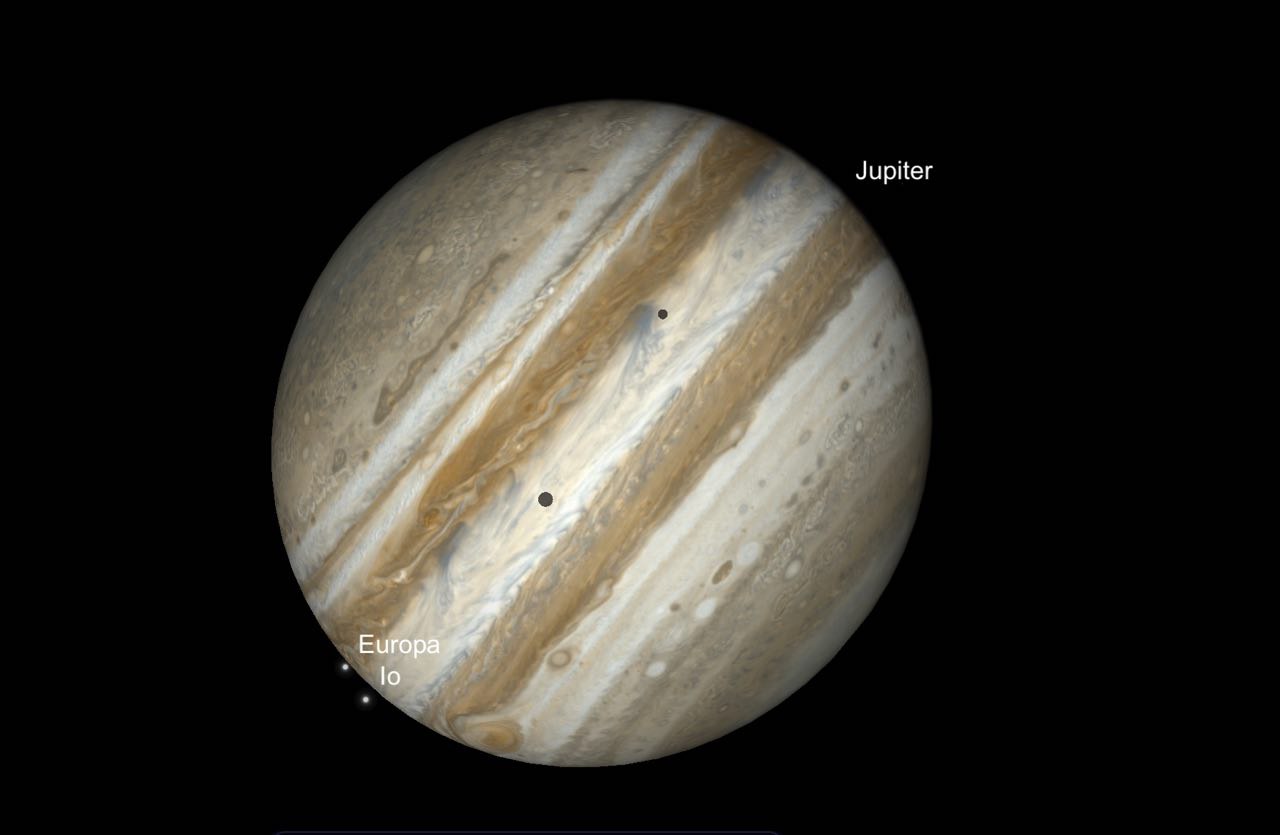
Source: SkySafari virtual planetarium
Comets
Of all celestial phenomena, comets are the most unpredictable. In this respect, they can only be rivaled by supernovae and novae. As of the end of 2025, astronomers are not aware of any comets that will be truly bright and easily visible to the naked eye. However, there are a couple that can be seen with binoculars.
The second ten days of April promise to be favorable for observing comet C/2025 R3 (PANSTARRS) shortly before dawn. On April 19, it will pass perihelion and reach a brightness of +6.7m. On April 26, it will be at its closest distance from Earth and may appear relatively bright at +3.2m (according to optimistic forecasts, even brighter). However, at this time, the comet will be inaccessible to Earth-based observers due to its apparent proximity to the Sun. Later, it will finally move into the southern hemisphere.
Another “tailed” object that amateur astronomers should pay attention to is the periodic comet 10P/Tempel 2. In early August, it will pass its perihelion and be closest to Earth, almost in opposition to the Sun. However, on August 2-3, when this happens, the bright Moon will interfere with observations. So it is better to try to catch it around July 26-27. With a brightness of +6.9m, the comet should be visible with binoculars and small telescopes, but in our latitudes at this time, it will remain quite low above the horizon.
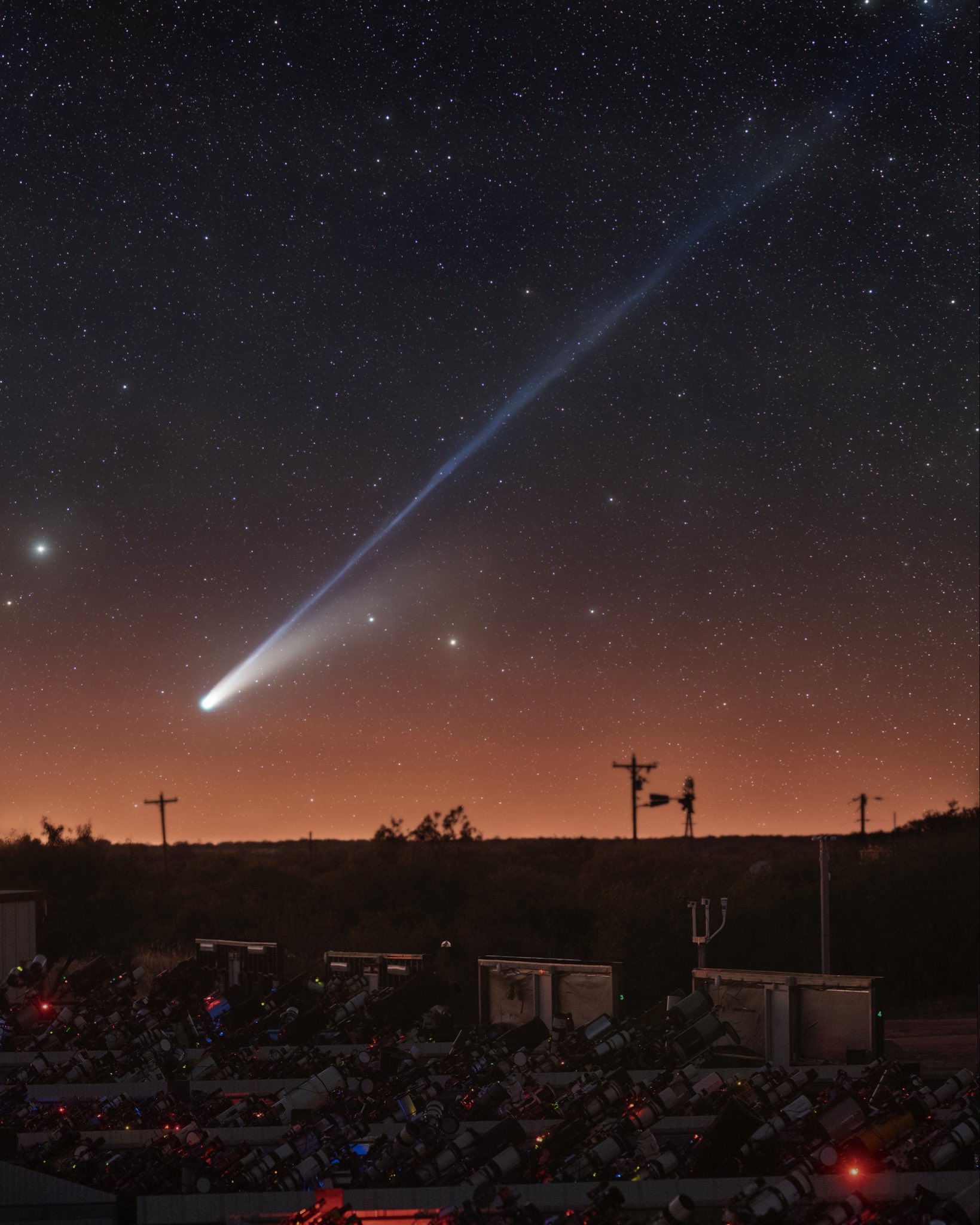
Nevertheless, it is quite possible that in 2026, a new comet will be discovered, which by the end of the year will become bright and visible to the naked eye.
Will a new star light up the sky?
Astrophysicists studying variable stars in general and cataclysmic star systems in particular have been expecting the explosion of T Coronae Borealis since 2024. It belongs to a rare type of so-called repeat novae, which flare up approximately once every few decades. Moreover, of the dozen such systems in the Milky Way, T Coronae Borealis is the only one that can be observed with the naked eye during an outburst – it becomes almost as bright as the North Star.
Physically, a nova is a system of two stars, one of which is a white dwarf. It gradually pulls matter from its companion (in this case, a red giant), accumulating it on its surface. When fresh hydrogen reaches critical conditions, a thermonuclear reaction occurs, covering the entire surface of the white dwarf. And we observe a sharp increase in brightness, thousands of times greater, over the course of several hours.
The last two T-type flares in the northern corona in 1866 and 1946 were reliably recorded and studied as thoroughly as possible by astronomers of that time. There is also evidence of flares in 1217 and 1787, although they cannot be considered completely reliable. In any case, scientists who have studied this star system suggest a periodicity of approximately 80 years. And it is precisely this period of time since the last flare that is coming to an end.
Signs of the approaching next flare appeared as early as 2018-2023. Therefore, amateur astronomers from all over the northern hemisphere are closely monitoring this star, and professional astronomers are ready to involve the largest ground-based and space observatories in the observations.
List of major astronomical events in chronological order
January 3 – peak of the Quadrantid meteor shower (radiant in the constellation Boötes, ZHR = 80, variable activity).
January 3 – Earth at perihelion (closest point to the Sun in its orbit).
January 9 – Titan transits Saturn’s disk (transit begins at 7:01 p.m.).
January 10 – Jupiter in opposition (in the constellation Gemini, magnitude -2.7m).
February 12 – transit of the shadows of Europa and Callisto across Jupiter’s disk (double transit lasts from 9:04 p.m. to 10:25 p.m.).
February 17 – annular solar eclipse (not visible in Ukraine).
February 19 – Mercury at its greatest eastern elongation (low in the west in the evening, magnitude -0.4m).
March 3 – total lunar eclipse (not visible in Ukraine).
March 8 – Venus, Saturn, and Neptune come really close (low in the west in the evening; magnitude of Venus -3.9 m; Saturn +1.0m; Neptune +7.8m).
March 20 – Spring Equinox (exact time – at 4:48 p.m.).
April 3 – Mercury at its greatest western elongation (very low in the east before dawn, magnitude +0.4m).
April 22 – peak of the Lyrid meteor shower (radiant at the border of Lyra and Hercules, ZHR = 18).
May 6 – peak of the Eta Aquariid meteor shower (radiant in the constellation Aquarius, ZHR = 50).
May 29 – Venus at its highest point in the evening sky (magnitude -3.9m).
June 9 – Venus and Jupiter conjunction (low in the west in the evening; Venus magnitude -4.0m; Jupiter magnitude -1.9m).
June 15 – Mercury at its greatest eastern elongation (low in the northwest in the evening, magnitude +0.6m).
June 17 – close conjunction of the Moon and Venus (in the evening at sunset, Venus magnitude -4.0m).
June 21 – summer solstice (exact time – 11:27 a.m.).
July 6 – Earth is at aphelion (the point in its orbit furthest from the Sun).
July 11 – Moon conjunction with the Pleiades (low in the northeast before dawn).
July 31 – peak of the Southern Delta Aquariids meteor shower (radiant in the constellation Aquarius, ZHR = 25).
August 2 – Mercury at greatest western elongation (low in the northeast before dawn).
August 12 – total solar eclipse (partial phase visible in western Ukraine).
August 12/13 – peak of the Perseid meteor shower (radiant in the constellation Perseus, ZHR = 100).
August 15 – Mercury and Jupiter in conjunction (low in the east before dawn, Mercury magnitude -1.2m; Jupiter magnitude -1.8m).
August 15 – Venus at its greatest eastern elongation (low in the west in the evening, magnitude -4.4m).
August 28 – partial lunar eclipse (in Ukraine, the partial phase will be visible before dawn).
September 14 – Venus occultation by the Moon (in the daytime sky, approximate time 12:53 p.m. – 1:52 p.m.).
September 23 – Autumn equinox (exact time – 03:08 a.m.).
September 26 – Neptune in opposition (in the constellation Pisces, magnitude +7.8m).
October 4 – Saturn in opposition (in the constellation Cetus, magnitude +0.3m).
October 5 – close conjunction of the Moon and Mars (before dawn; Mars magnitude +1.0m).
October 12 – Mercury at its greatest eastern elongation (very low in the southwest in the evening).
October 13 – Asteroid Vesta in opposition (in the constellation Cetus, magnitude +6.1m).
October 21 – peak of the Orionid meteor shower (radiant in the constellation Orion, ZHR up to 30).
November 3 – close conjunction of the Moon and Jupiter (in the second half of the night of November 2/3, Jupiter magnitude -2.0m).
November 15/16 – Mars and Jupiter conjunction (Mars magnitude +0.6m; Jupiter magnitude -2.1m).
November 17/18 – peak of the Leonid meteor shower (radiant in the constellation Leo, ZHR = 15).
November 21 – Mercury at its greatest western elongation (low in the southeast before dawn, magnitude -0.6m).
November 26 – Uranus in opposition (in the constellation Taurus; magnitude +5.6m).
December 9 – Venus at its highest point in the morning sky (before dawn in the southeast, magnitude -4.8m).
December 14 – peak of the Geminid meteor shower (radiant in the constellation Gemini, ZHR = 150).
December 18/19 – Io, Europa, and their shadows simultaneously on Jupiter’s disk (quadruple transit from 02:22 a.m. to 03:01 a.m., double transit of shadows from 01:18 a.m. to 03:01 a.m.).
December 21 – winter solstice (exact time – 10:53 p.m.).
December 26 – Io, Europa, and their shadows simultaneously on Jupiter’s disk (quadruple transit from 04:46 a.m. to 05:26 a.m., double transit of shadows from 03:13 a.m. to 05:26 a.m.).
The UST editorial team sincerely wishes you happy holidays and a successful New Year 2026! May the sky above you be peaceful, clear, and starry, and bring you many unforgettable pleasant moments!

