

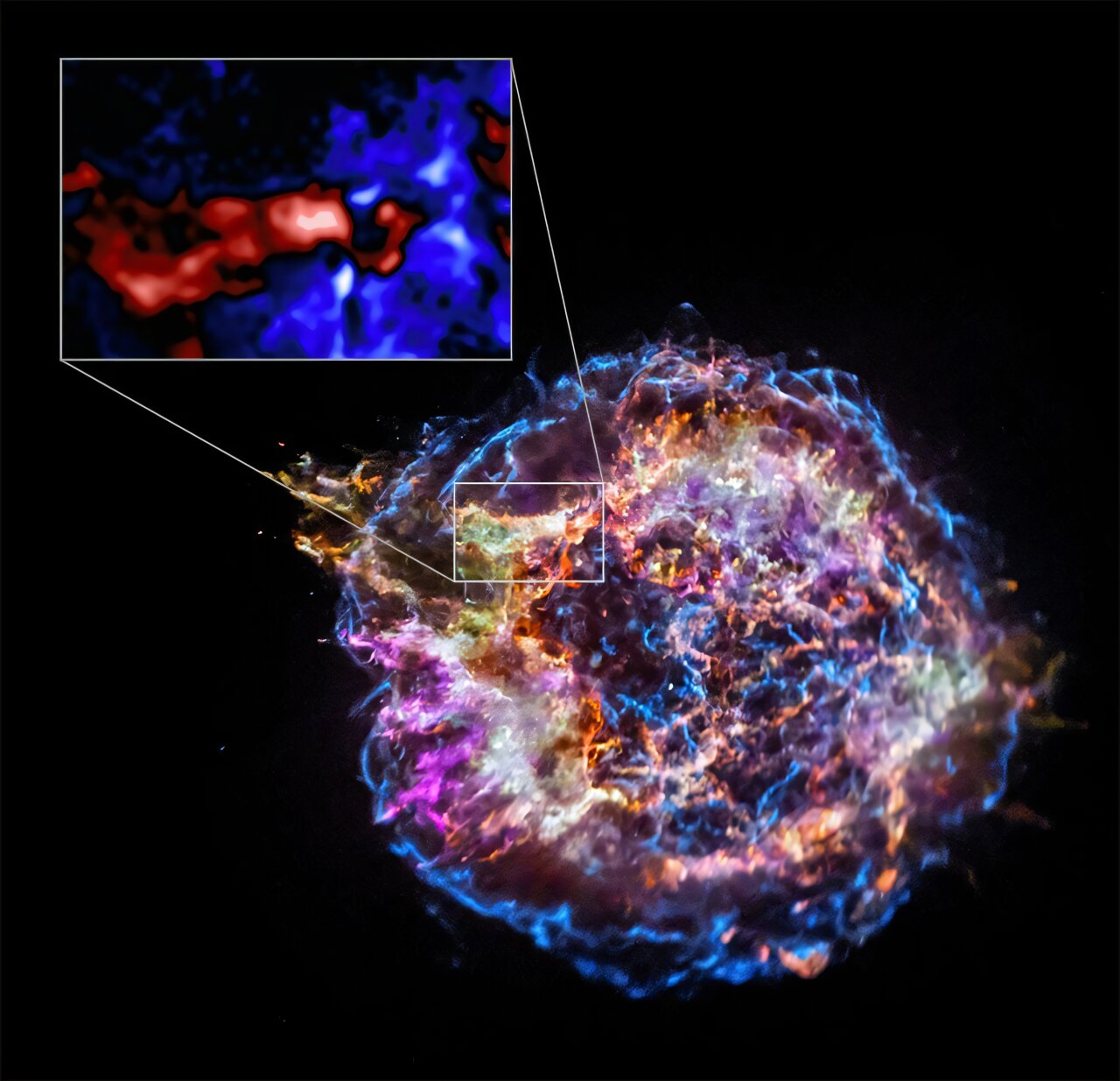
Astronomers using NASA’s Chandra X-ray Observatory have obtained new data on one of the most famous supernovae, Cassiopeia A (Cas A). These observations, the results of which are published in The Astrophysical Journal, have made it possible for the first time to see what happens inside a star just a few hours before it explodes.
Approximately 11,300 years ago, a massive star, the predecessor of Cassiopeia A, 15–20 times larger than the Sun, was living out its final hours. Various elements were “burning” sequentially in its depths: hydrogen on the outside, then helium, and even deeper down, carbon, neon, oxygen, and finally iron. This usually happens in an ordered manner, but new data from Chandra showed a different picture. Just before the explosion, the star underwent a “shell merger.”
“It’s a very violent event when the boundary between layers disappears and the material mixes inside the star,” explains study co-author Kai Matsunaga of Kyoto University.
This internal turbulence made the explosion asymmetrical. This is why the remains of Cas A look so complex and “scattered.” For a long time, it was believed that supernova explosions were symmetrical, but new findings show that the last hours of a star’s life are chaotic, shaping the future supernova.
“It seems that every time we study Chandra’s data on Cas A in more detail, we learn something new and exciting,” says lead author Toshiki Sato of Meiji University (Japan).
This discovery explains both the appearance of supernova remnants and why neutron stars formed after collapse often receive a “kick” and travel through space at tremendous speeds.
“Perhaps the most important thing about this restructuring is that it could help the star explode,” adds another co-author, Hiroyuki Uchida of Kyoto University.
Thus, observational evidence has been obtained for the first time that stars undergo chaotic internal restructuring before their death. This completely changes astronomers’ understanding of supernovae.
“For a long time, astronomers had one dream — to look inside a star before it exploded,” the authors write in the article. Our research has provided the first glimpse of this critical moment when a star’s future is determined: whether it will explode or not.

