

The Chandra and XMM-Newton X-ray telescopes have detected a mysterious “spot” near the very center of the Milky Way. Scientists suspect it may be the remnant of a supernova that exploded some time ago.
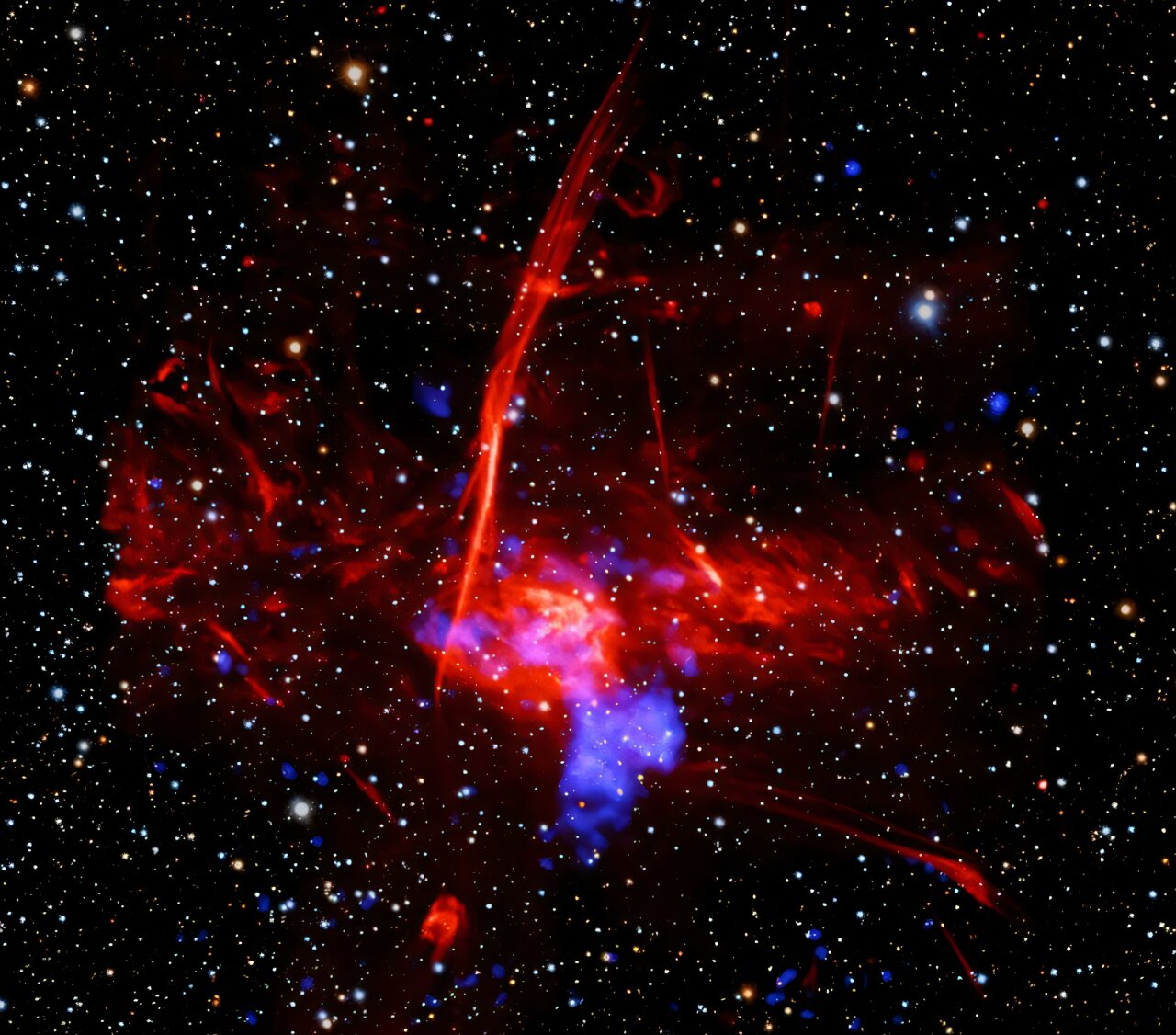
X-ray images show the remnants of a supernova
Using data from the Chandra X-ray Observatory, astronomers have likely discovered the remnants of a supernova in an intriguing region at the center of our galaxy. The article describing these new findings was published in The Astrophysical Journal.
Supernova remnants are what remain after massive stars explode at the end of their lives. These gaseous clouds quickly disperse into space, supplying elements such as iron, oxygen, and silicon, which are crucial for the formation of planets and for the emergence and flourishing of life as we know it.
If its existence is confirmed, this new supernova remnant will be one of the closest to the supermassive black hole at the center of the Milky Way—an exotic region filled with massive stars, long filaments of magnetic fields, and dense clouds of gas spinning rapidly around the galactic center.
This new composite image of the region combines X-ray data from the Chandra telescope and the European Space Agency’s (ESA) XMM-Newton mission (shown in blue) with radio data from the MeerKAT telescope (shown in red) in South Africa. These data were combined with an optical image obtained by the Pan-STARRS telescopes in Hawaii (red, green, and blue colors). The plane of the galaxy extends horizontally from left to right in the image, and the central black hole is located to the left of the image.
Evidence for the existence of a new supernova remnant, located approximately 26,000 light-years from Earth, is based on X-ray observations obtained using the Chandra and XMM-Newton telescopes. These data reveal a “blob” of X-ray radiation that likely originates from the remnants of a massive star that self-destructed as a supernova and is hidden within a larger, expanding cloud of gas.
A gas bubble surrounding the remnant
The location of this probable supernova remnant is circled in the image. It is situated within a bubble of gas—a so-called ionized gas region H II —surrounding a massive young star, from which electrons have been stripped from the hydrogen atoms. This bubble is a bright source of radio emission known as Sagittarius C.
If this is indeed a supernova remnant, it is expanding at a speed of approximately 3.2 million km/h (2 million mph) and is at least 1,700 years old. Previous observations conducted as part of NASA’s SOFIA (Stratospheric Observatory for Infrared Astronomy) mission, which has since ceased operations, revealed the presence of an expanding shell of gas surrounding Sagittarius C. This gave astronomers a clue that a stellar explosion had occurred at this location.
Chemical traces of the remnant
The long filaments visible in the radio image are formed by energetic particles moving along magnetic fields that are mostly oriented perpendicular to the plane of the galaxy.
The nuclear fusion engines of stars create elements from hydrogen and helium, which were abundant in the early universe. When stars explode at the end of their lives as supernovae, they eject these synthesized elements into interstellar space, providing the building blocks for the next generation of stars and planets.
A team of astronomers analyzed X-ray data for signs of an increase in the abundance of key elements in the remnants, which could have been caused by a stellar explosion that ejected them into space. Although they did not detect such an increase, this may mean that the star’s debris has already mixed with the surrounding gas.
X-ray radiation
An alternative explanation for the X-ray spot is that the hot gas originates from a cluster of massive stars in this region. The authors of a recent study do not consider this explanation likely, since the X-ray emission from the spot is more than 10 times brighter than the X-ray emission from large known star clusters containing bright massive stars.
The additional image shows data from NASA’s James Webb Space Telescope, superimposed on X-ray and radio data. The blue color indicates infrared radiation from gas in the H II region, while the dark blue indicates X-ray radiation from an object that is likely a supernova remnant, located on the right side of the image. The X-ray emission near the center of the image is associated with the H II region and is likely caused by material ejected by massive stars, which heated the gas to millions of degrees, producing X-ray radiation.
According to phys.org

