

Thanks to the James Webb Space Telescope (JWST), astronomers have obtained the most detailed data to date on how galaxies formed in the early Universe. It turned out that they were much more chaotic and disorderly than those we see today.
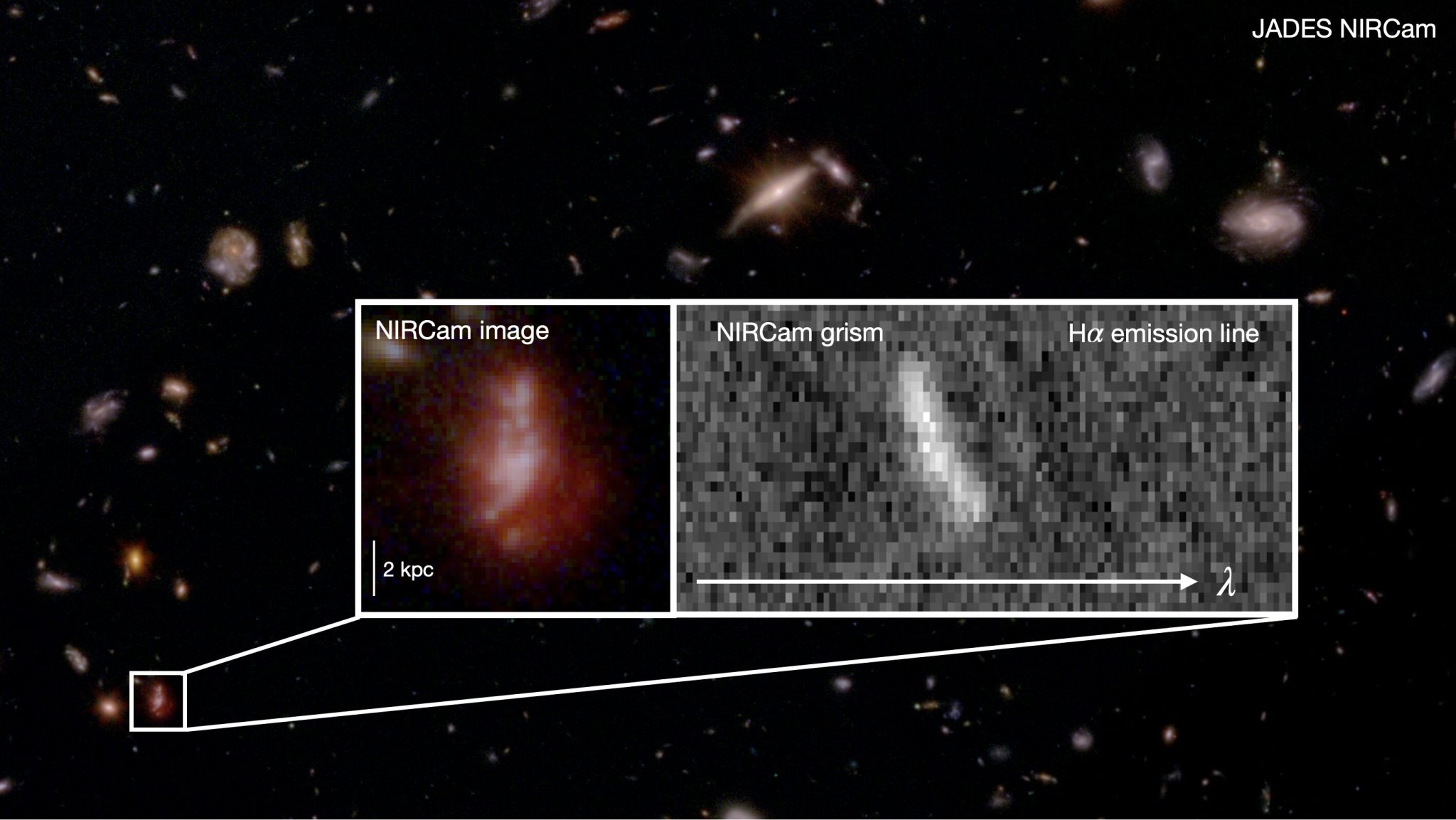
A team of astronomers led by researchers from the University of Cambridge analyzed more than 250 young galaxies that existed between 800 million and 1.5 billion years after the Big Bang. By studying the motion of gas within these galaxies, they found that most of them were turbulent, “clumpy” systems that had not yet settled into smooth rotating disks like our Milky Way.
According to scientists, galaxies gradually became calmer and more orderly as the universe evolved. But in the early Universe, star formation and gravitational instability caused such turbulence that many galaxies had difficulty calming down.
“We don’t just see a few spectacular outliers—this is the first time we’ve been able to look at an entire population at once,” said first author Lola Danhaive of the Kavli Institute for Cosmology at Cambridge. “We found huge variation: some galaxies are beginning to settle into ordered rotation, but most are still chaotic, with gas puffed up and moving in all directions.”
Scientists used the NIRCam instrument installed on JWST in a mode that captures faint light from ionized hydrogen in distant galaxies. Once they had the necessary data, they compared it with images from other JWST observations to measure how gas moves within each galaxy.
“Previous results suggested massive, well-ordered disks forming very early on, which didn’t fit our models,” said co-author Dr. Sandro Tacchella of the Kavli Institute and Cavendish Laboratory. “But by looking at hundreds of galaxies with lower stellar masses instead of just one or two, we see the bigger picture, and it’s much more in line with theory. Early galaxies were more turbulent, less stable, and grew up through frequent mergers and bursts of star formation.”
According to the authors of the study, their work helps bridge the gap between the era of reionization and the so-called cosmic noon, when star formation reached its peak. It shows how the building blocks of galaxies gradually transitioned from chaotic clusters to ordered structures, and how galaxies such as the Milky Way were formed.
Researchers plan to conduct additional observations. They hope to track how ancient turbulent systems grew and transformed into the elegant spirals we see in the Milky Way today.
Earlier, we reported on how James Webb confirmed the most powerful explosion in the universe.
According to Phys.org

