

On July 2, 2025, Earth’s radio telescopes recorded an event designated GRB 250702B. Now, thanks to the James Webb Space Telescope, we know that it was the most powerful gamma-ray burst in history.
Nature of gamma-ray bursts
Given the vast size of the Universe, it is not surprising that space still holds many secrets for us. Astronomers have recently come across a previously unseen type of cosmic explosion that challenges everything we used to think about the way stars die.
In an article published on the arXiv preprint server, scientists report on the longest gamma-ray burst (GRB) ever detected. This unique event was recorded by NASA’s Fermi telescope on July 2, 2025, and was named GRB 250702B.
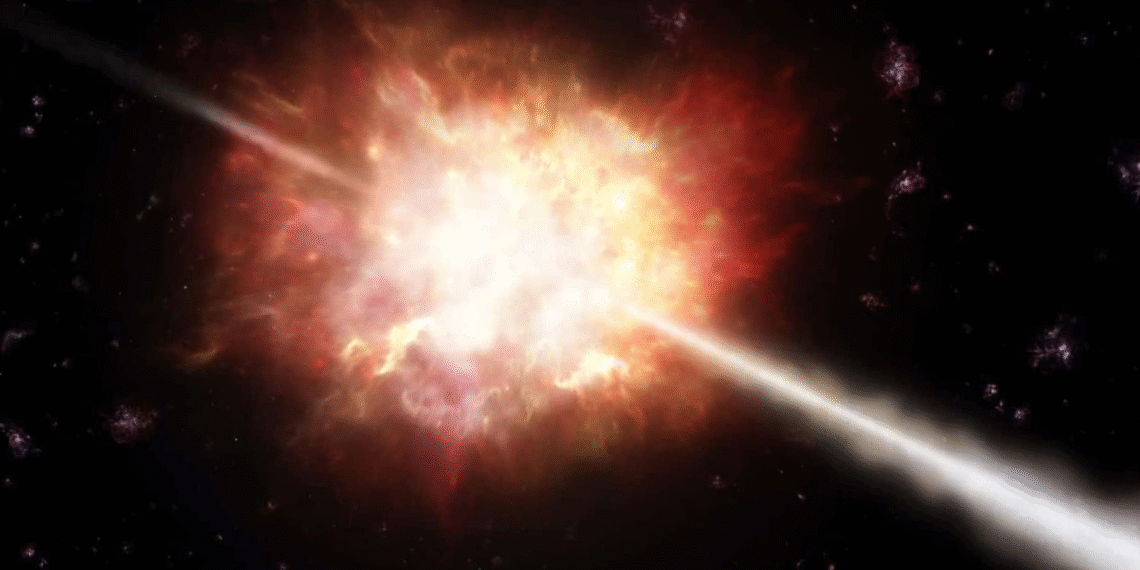
Gamma-ray bursts are the most powerful and violent explosions in the Universe, typically lasting from a few milliseconds to several minutes. They occur when the core of a massive star collapses into a black hole or when two compact objects, such as black holes or neutron stars, merge. Gamma-ray bursts are extremely bright and can briefly outshine entire galaxies.
The most powerful cosmic explosion
However, GRB 250702B flared up for an entire day. Normal cosmic explosions occur only once — it is impossible to explode a star twice. What was happening? To find out, astronomers needed to know the distance to the explosion, which would help them calculate its power and narrow down the list of possible causes.
The team used the powerful James Webb Space Telescope to calculate the distance, and by including this measurement in the energy calculation, they discovered that it was the most powerful cosmic explosion ever recorded. Since most long gamma-ray bursts are accompanied by massive supernovae, astronomers searched for one nearby. However, they were unable to find a bright supernova, although a weaker one may be hidden by dust in the host galaxy.
Possible causes of the explosion
The authors of the study suggested that GRB 250702B was caused either by a very unusual form of collapsing star or by a black hole that destroyed a small star. Another surprising discovery is that the host galaxy is extremely large and incredibly dusty. GRBs usually occur in small, young galaxies where stars are forming. This may mean that the environment played a significant role in creating the unusual GRB, as astronomers note in their article.
“The identification of such an exotic GRB in such an unusual galaxy raises the possibility that the environment was important in the progenitor channel creating GRB 250702B,” the authors conclude.
Thus, there are still many mysteries surrounding GRB 250702B that need to be solved. This involves searching for hidden supernovae, long-term monitoring of GRB afterglows, and creating new models to explain this rare phenomenon.
According to phys.org

