

China has announced plans for a demonstration mission that will strike an asteroid and measure the change in its orbit. This was announced by Wu Weiren, chief designer of China’s lunar program and head of the Deep Space Laboratory, at an international conference in Hefei in early September. If the project succeeds, China will become the second country in the world after the US to demonstrate kinetic deflection technology for celestial bodies.

According to Wu Weiren, the approach involves two spacecraft: the scout will reach the target first, perform close flybys, and collect accurate characteristics of the asteroid; then the striker will carry out a high-speed collision. The entire process will be observed in “fly-along → impact → fly-along” mode with simultaneous measurements from orbit and from Earth to record changes in orbit, morphology, and dust emission. The expected deviation is only a few centimeters, but that is enough for the angular difference to accumulate to kilometers over time.
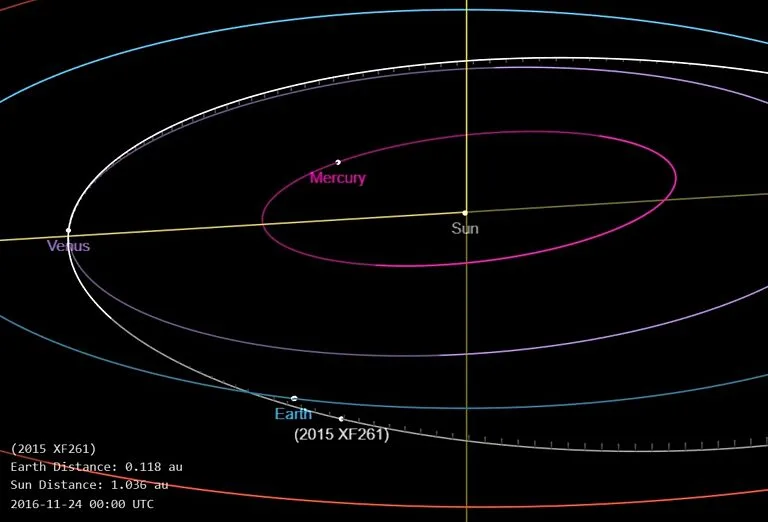
The exact purpose of the mission has not been officially disclosed. Previous publications mentioned candidates like 2019 VL5 and 2015 XF261, and the launch was pushed back from 2025 to 2027–2030, which shows how the project has evolved and how complex it is. The current announcement confirms that China is moving from concept to experimental testing of planetary defense technologies.
Kinetic impact provides unique data on regolith mechanics, debris distribution, and momentum amplification coefficient (β) – a key parameter for models of deflection of objects approaching Earth. This mission will improve early warning algorithms, NEO orbit catalogs, ground-based and space-based optics/radar technology, and joint international observation techniques. The practical result is a transition from theory to proven engineering solutions for a global planetary security system.
China is preparing a kinetic strike on an asteroid – but the real battles are already closer, in our atmosphere and in near-Earth orbits. How does THAAD intercept targets using the hit-to-kill principle, how do missile defense, air defense, and anti-space defense differ, what are co-orbital hunter satellites, and why is debris from ASAT tests a risk to all missions? Read more in the article “Ballistics, THAAD, and War in Orbit: Modern Technologies of Confrontation.”
According to globaltimes, cgtn, interestingengineering

