

Chinese scientists have developed a comprehensive mission to study asteroids. One of its targets could be the asteroid Apophis.
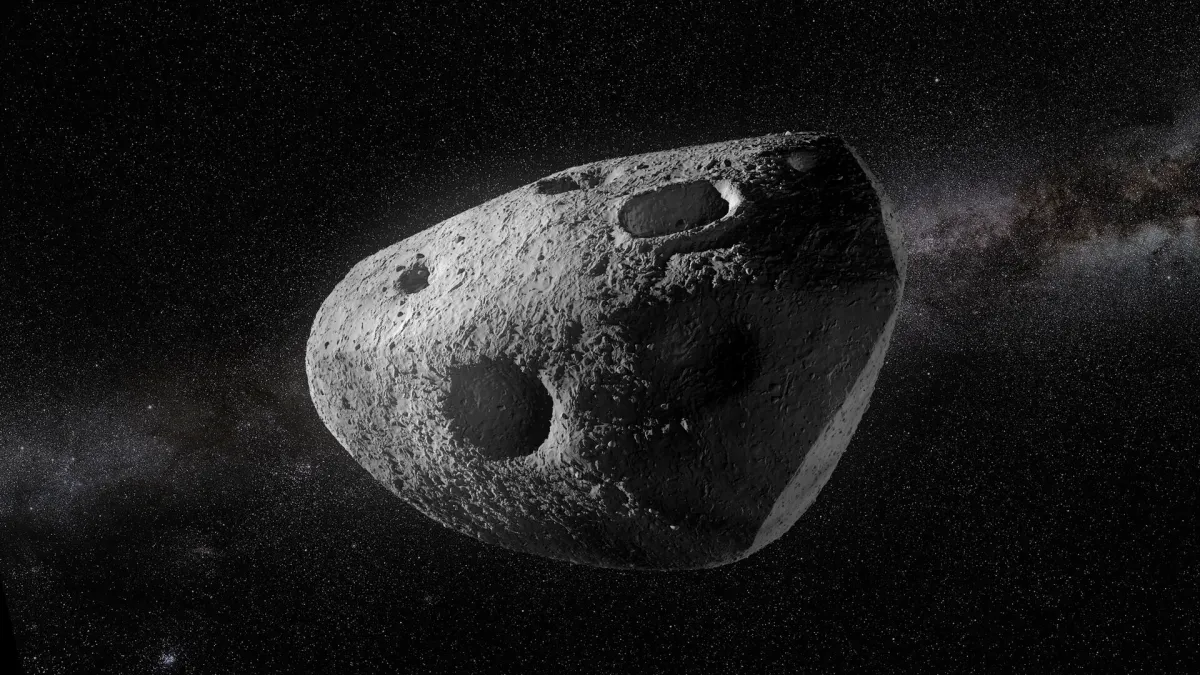
The asteroid Apophis has a diameter of 375 meters. On April 13, 2029, it will make a close flyby of Earth, passing at a distance of 32,000 km from its surface (i.e., inside the orbits of geostationary satellites). At that moment, the asteroid will be visible to the naked eye across most of Europe and Africa, as well as in some parts of Asia. The encounter with Earth is expected to affect the asteroid and cause landslides and shifts on it.
According to scientists’ estimates, such large objects approach Earth on average once every 5,000 to 10,000 years. It is not surprising that Apophis’ visit has attracted increased attention, and a number of countries and space agencies are considering options for sending missions to it. Currently, ESA and JAXA are working on the Ramses spacecraft, while NASA is focusing on the OSIRIS-APEX mission, which previously studied the asteroid Bennu.
Chinese scientists do not intend to miss such a rare opportunity and are also working on their own mission. It has been named CROWN/Apophis and is part of a larger project called CROWN, which aims to launch six different probes to study near-Earth objects in heliocentric orbits similar to those of Venus.
The main task of CROWN/Apophis will be to measure the fundamental properties of this potentially dangerous asteroid and the consequences of its approach to Earth. The goal of the project is to observe the processes that will occur on the surface of Apophis and how it interacts with Earth’s magnetosphere.
CROWN/Apophis will consist of two spacecraft. The larger one, weighing 44 kg, will use a combined chemical and ion propulsion system and will be equipped with cameras, a microwave rangefinder/Doppler system, and low-frequency radar. The 8 kg CubeSat will be equipped with some of the same systems as the main spacecraft.
The devices are proposed to be launched as accompanying cargo as part of a mission that has not yet been determined. After that, they will fly to the L1 Lagrange point of the Sun-Earth system, where they will wait for Apophis to arrive. They will make a close flyby of the asteroid shortly after it visits the vicinity of our planet. This will happen on April 13, 2029.
According to Spacenews

