

Currently, there are two orbiting stations in Earth’s orbit. The first is the ISS, which is already approaching the end of its life cycle. The second is China’s Tiangong station (literally translated as the Heavenly Palace), which is still relatively young. It is likely that after the ISS is de-orbited, China will remain the only country with its orbital station for some time.
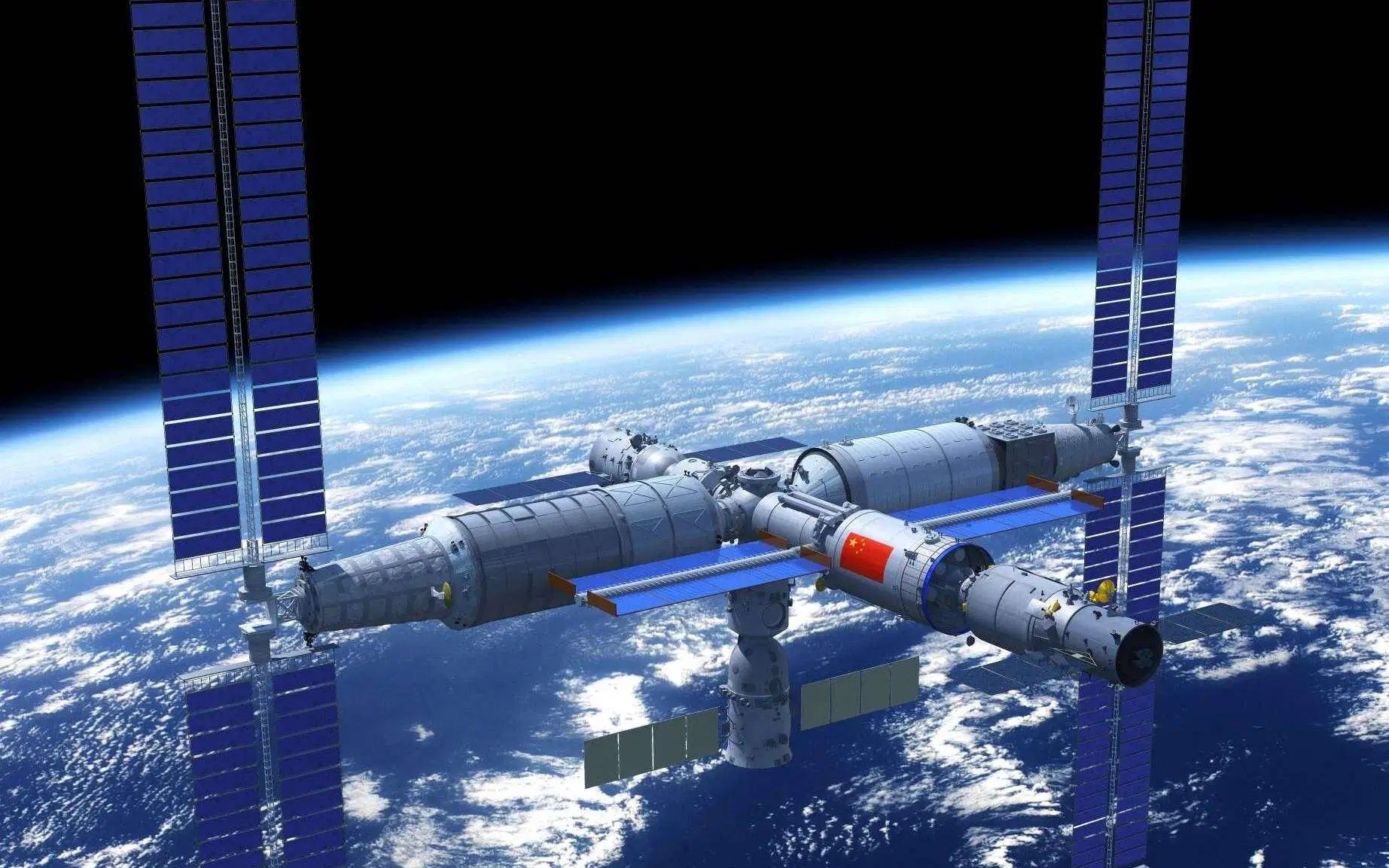
We will discuss the history, technical design, and future of the Chinese space station.
Predecessors of the Tiangong station
The Tiangong station did not appear out of nowhere. To gain the necessary experience and test key technologies, China launched two small orbital stations, also known as the Tiangong, in 2011 and 2016. They were built on the basis of the Shenzhou spacecraft and were so-called visiting stations. This means that they were not intended for permanent human residence and could only support short-term expeditions.
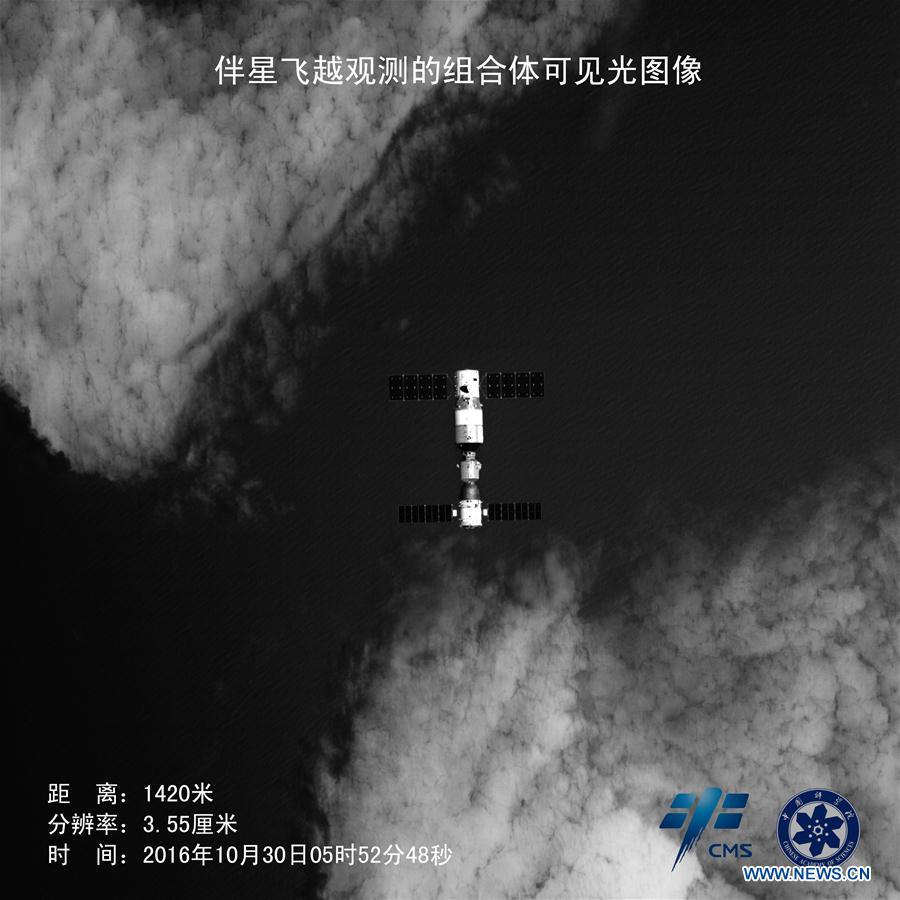
The Tiangong-1 received two crews in 2012 and 2013. After that, the station continued to fly autonomously. Communication with it was interrupted in 2016. In 2018, the Tiangong-1 entered the Earth’s atmosphere and crashed into the Pacific Ocean.
The Tiangong-2 received one expedition in 2016. Three years later, it was successfully de-orbited.
Assembly of the Tiangong station
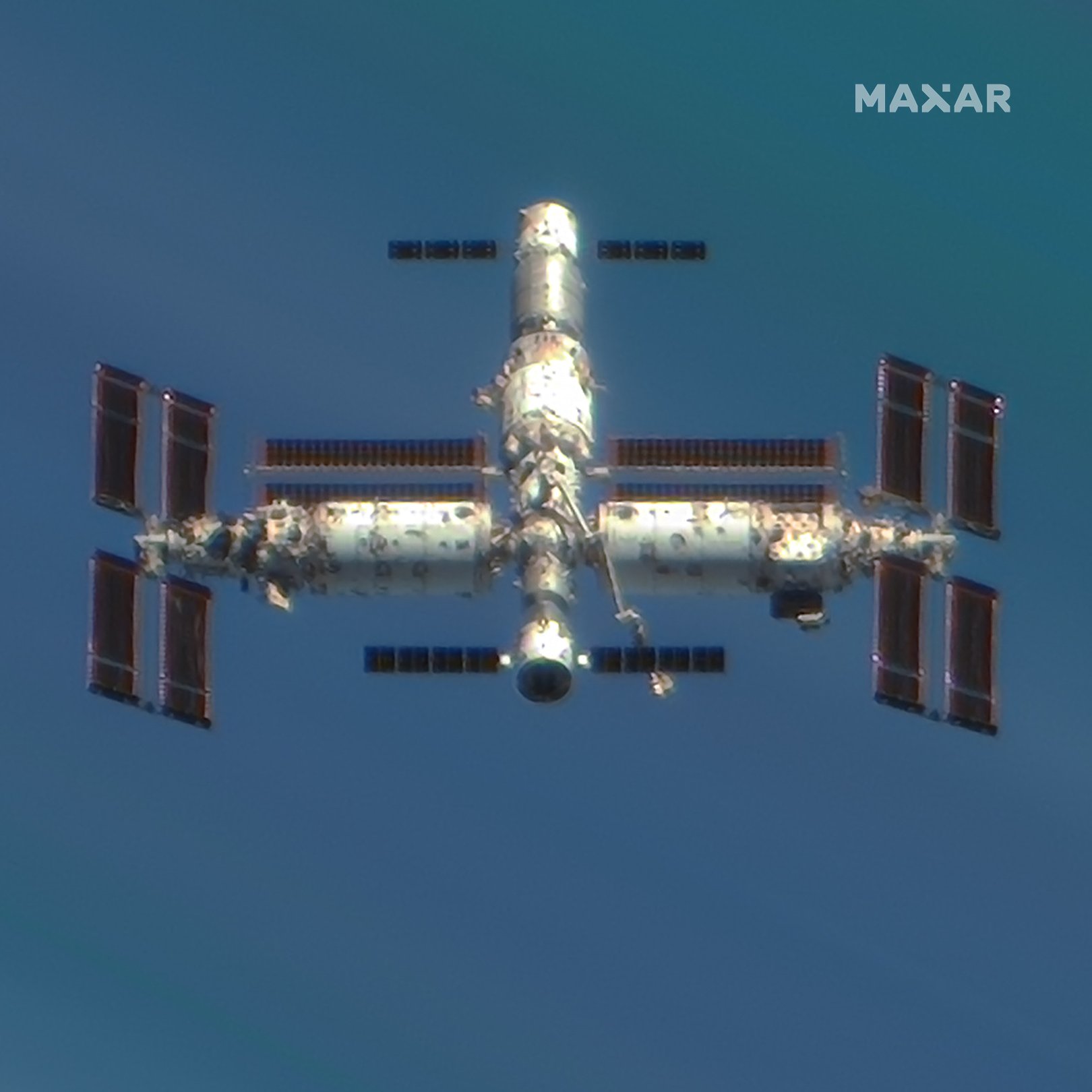
Despite its similar name (which sometimes creates confusion), the Tiangong is radically different in design from its predecessors. While those were essentially converted spaceships, the new Chinese station is a large multi-module structure designed for permanent human habitation and full-fledged scientific research.
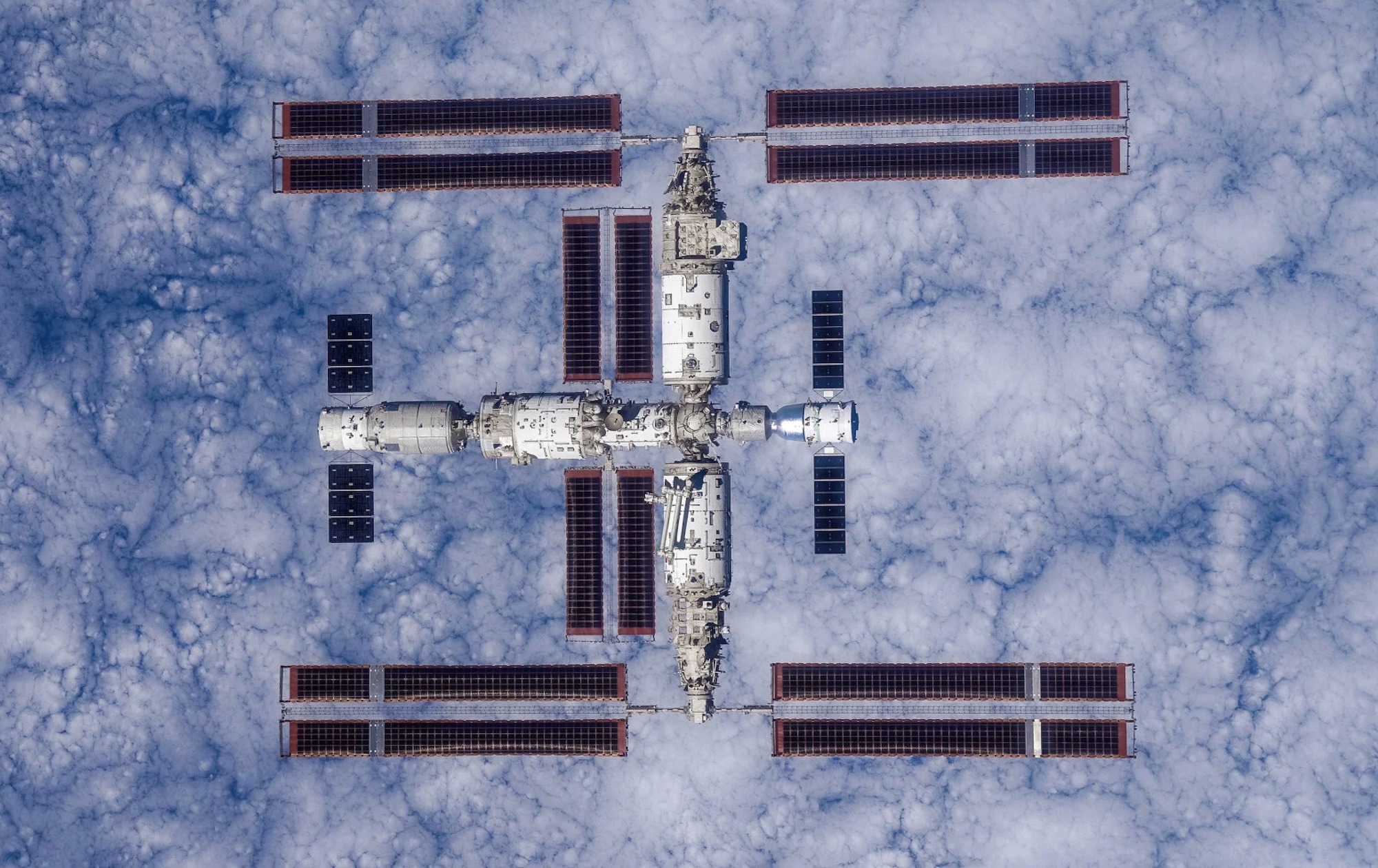
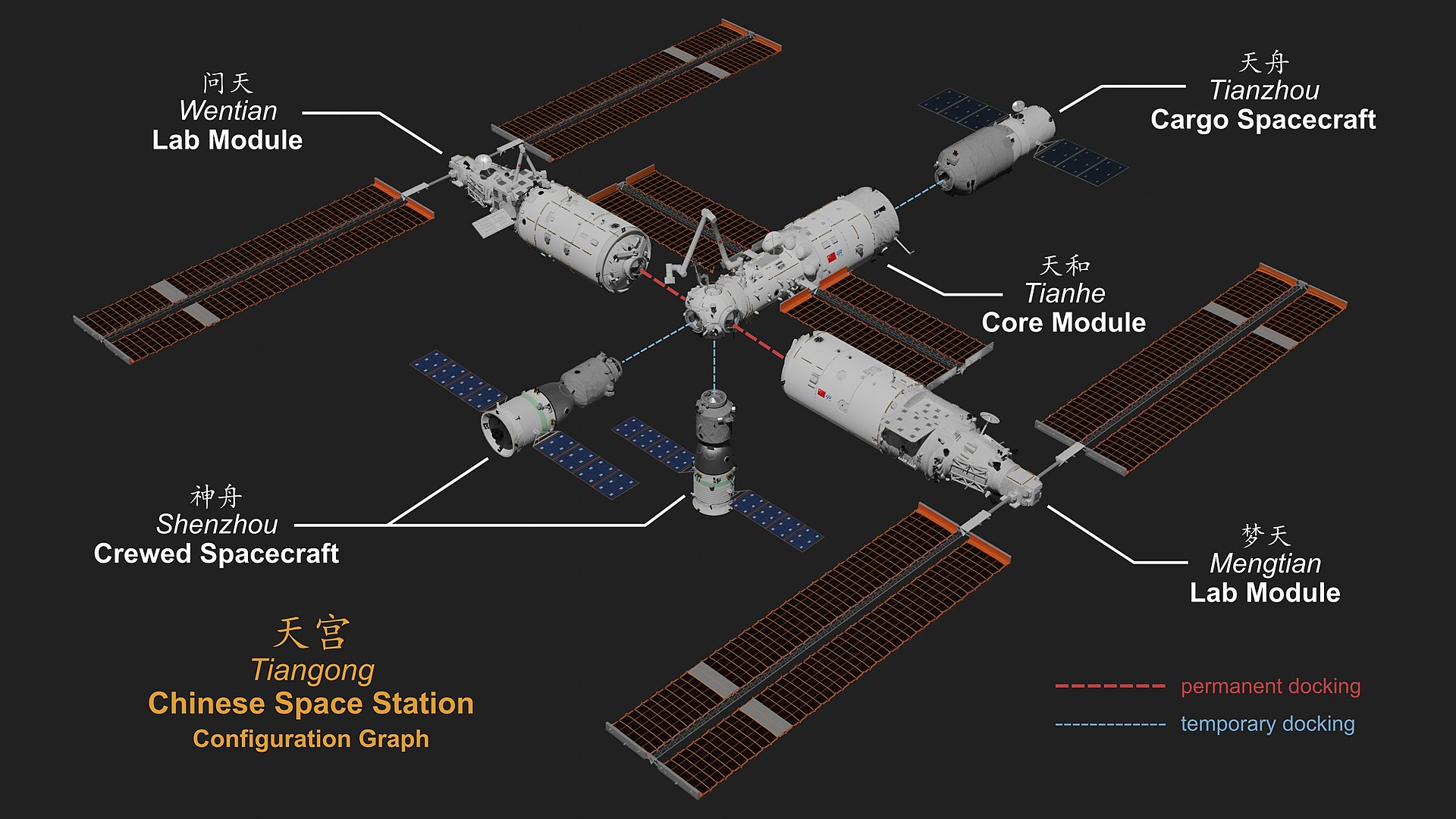
The assembly of the Tiangong began on April 29, 2021, when the base module called Tianhe was launched. On June 17 of the same year, the station received its first crew.
In 2022, the Wentian and Mengtian science modules were docked to it, after which the Chinese authorities solemnly announced the completion of the station.
Dimensions of the Tiangong station
In its current form, the Tiangong has the following physical characteristics. It is 55.6 meters long, has an internal volume of 340 m³ (of which 122 m³ is the living space), and an approximate weight of 100 tons. The station is located in a 390-kilometer orbit with an inclination of 41.5°.
The Tiangong has been permanently inhabited since June 2022. The station is designed for a permanent crew of three people and is also capable of accommodating a short-term stay of up to six people during shifts.
The Tiangong is supplied with taconite on board by Shenzhou ships, and Tiangzhou automatic ships are used to supply it with cargo. The station is equipped with five robotic manipulators and has two airlocks for spacewalks.
The future of the Tiangong station
Despite the fact that the Tiangong was formally completed in 2022, it is no secret that China plans to significantly expand the station in the future. Its first addition will be the autonomous Xuntian telescope module, which will be able to take images with the same resolution as the famous Hubble.
The idea is that Xuntian will be in the same orbit as the Tiangong and will occasionally dock with the station for maintenance and repair. However, it should be noted that the telescope was originally scheduled to launch in 2023. Since then, the date has been shifted several times. This indicates that the creation of the device turned out to be more difficult than expected. Now, the launch of Xuntian is scheduled for 2026.
In the future, China also plans to add a multifunctional module equipped with six docking ports to the Tiangong. This will allow more spacecraft to dock with the station and will also make it possible to expand the complex with new modules. It is expected that after the expansion is completed, the Tiangong will consist of six pressurized compartments with a total weight of 180 tons and will be able to support a permanent crew of six. This will make it the second-largest orbital station in history.
China is also making quite active attempts to “internationalize” the station by involving other countries in the project. This includes conducting experiments at the request of scientific institutions and space agencies, as well as flights of foreign astronauts. In 2025, China and Pakistan signed an agreement to send the first Pakistani astronaut to the Tiangong. It is possible that in the future, other countries will also want to take advantage of the Chinese invitation to send their compatriots into space.
The Tiangong is designed for a nominal service life of at least 15 years. This means that the Chinese station will almost certainly outlast the ISS, which is scheduled to retire in the early 2030s. Given the uncertainty about the timing of the commissioning of commercial orbital stations, which, according to NASA, should replace the ISS, it is possible that in just a few years, China will become the only country on Earth with its own space home.

