

China has successfully tested a prototype lunar landing module. On August 6, the China Manned Space Agency (CMSA) conducted the first full landing and takeoff test of the new manned lunar module “Lanyue” (translated as “embrace the moon”). The test was conducted at a special test site in Huailai (Hebei Province), where giant suspended masts were used to simulate weak lunar gravity, and the surface was covered with craters and debris to simulate the actual terrain. This is the first time China has comprehensively tested the ability of a manned spacecraft to land on and take off from another celestial body.
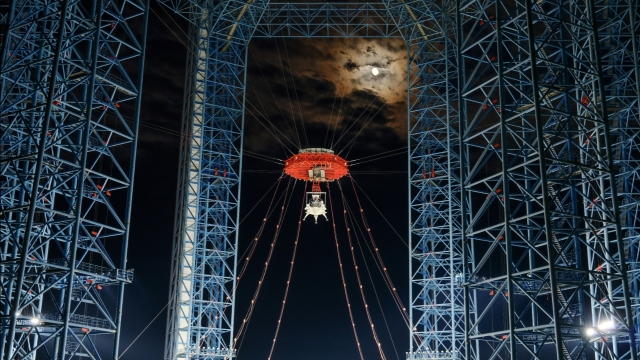
During the test, engineers evaluated the performance of the control systems, the accuracy of engine shutdown upon contact with the surface, and the coordination of the navigation, propulsion, and power systems. CCTV footage shows yellowish flames from the engines, indicating the use of nitrogen oxide.
Lanyue is designed for a crew of two astronauts. On the surface, the module will serve as a living compartment, power station, and data transmission center; it will be able to deliver the rover and scientific instruments. According to the mission plan, the Changzheng-10 rocket will first launch Lanyue into lunar orbit, and then the second rocket will launch the Mengzhou spacecraft. After docking, the crew will move to the landing module and descend to the surface. China plans to carry out its first manned landing by 2030.
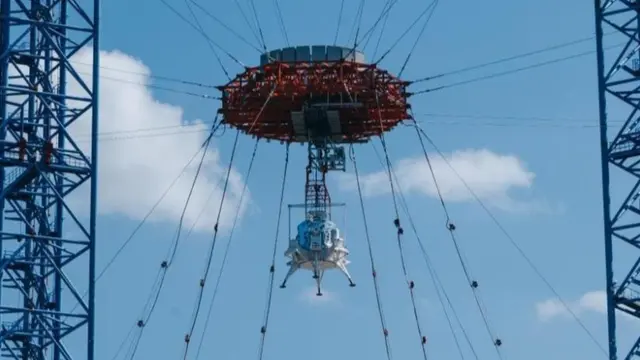
The successful test brings the creation of a permanent Chinese research base on the Moon closer. Lanyue is capable of transporting geological drilling equipment, installing radio telescopes on the far side of the Moon, and conducting experiments using local resources (ISRU). The stable presence of people and equipment on the moon will open up new opportunities for studying the early history of the Solar System, heliophysics without interference from the Earth’s ionosphere, and testing technologies necessary for future flights to Mars.
While Lanyue practices landing on a regolith, the sky is preparing its own show: in August, we will witness a rare phenomenon — the Black Moon 2025. Why does it occur, how can it be seen without a telescope, and will it affect future lunar missions? Find answers and tips in the article at the link — don’t miss the opportunity to discover another secret of the night sky!
According to interestingengineering, cmse

