

Several million years ago, two stars that are part of the constellation Canis Major came within a minimum distance of each other. They did not collide, but the interaction was so intense that we can still see its traces today.
Trace of a collision between stars
About 4.5 million years ago, two large hot stars flew close to the Sun. They left a trail behind them in the clouds of gas and dust swirling outside our Solar System — almost like the smell of perfume after someone has left a room.
This is one of the conclusions of a new study conducted by Michael Shull, an astrophysicist at the University of Colorado Boulder, and published on November 24 in The Astrophysical Journal. The study sheds new light on the details of Earth’s neighborhood in space.
Ionization of local gas and dust clouds
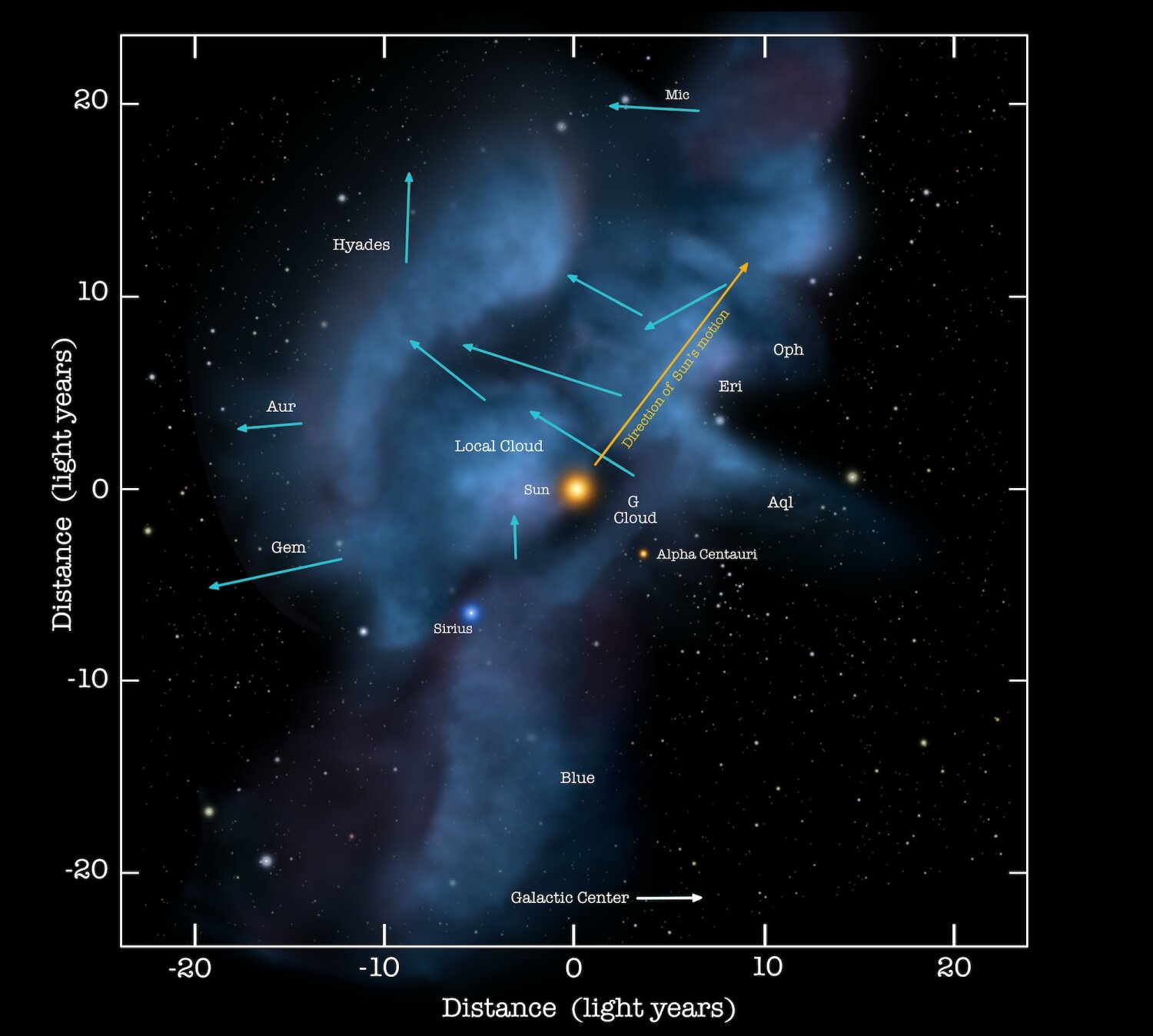
The Solar System is surrounded by what scientists call “local interstellar clouds.” These sparse clusters of gas and dust consist mainly of hydrogen and helium atoms and extend approximately 30 light-years, or about 175 trillion miles, from end to end. Beyond them lies our Sun, existing in a region of the galaxy known as the “local hot bubble,” where gas and dust are relatively sparse.
Shull noted that understanding these features was important because they could have influenced the evolution of life on Earth over millions of years. In the new study, he and his colleagues used a series of equations or models to catalog the forces that shaped our corner of the galaxy over time.
The team studied two stars: Epsilon and Beta Canis Majoris. Today, these stars are located in the front and rear parts of the constellation Canis Major. According to the team’s calculations, they probably flew past our Sun about 4.4 million years ago at a distance of 30 to 35 light-years, which is quite a short distance on a cosmic scale.
In the process, stars that are much hotter than the Sun emitted powerful ultraviolet radiation. This radiation “ionized” local clouds, stripping electrons from hydrogen and helium atoms and leaving them with a positive charge — a trace that scientists can still see today.
“If we go back 4.4 million years, these two stars were four to six times brighter than Sirius is today, and were the brightest stars in the sky,” said Shull.
Simulation of the Sun’s past environment
When scientists first began studying the region of space beyond our Solar System several decades ago, including with the Hubble Space Telescope, they discovered something surprising: about 20% of the hydrogen atoms and 40% of the helium atoms in local clouds were ionized—in particular, the amount of ionized helium seemed very high.
In the current study, Shull and his colleagues set out to compile a list of celestial phenomena that could have contributed to this ionization.
The team went back in time to model what Earth’s environment looked like millions of years ago — a difficult task, partly because the Sun is hurtling through local gas in the galaxy at a speed of 58,000 miles per hour.
The group reports that at least six sources could have contributed to the ionization of the clouds around our Solar System. Among them are three small white dwarf stars. The hot bubble may also have played a role.
Shull explained that this cavity in space was probably created by 10-20 stars that turned into supernovae — a bit like blowing bubbles in a glass of milk. These explosions heated the gas inside the hot bubble. These hot gases continue to emit ultraviolet and X-ray radiation today, heating the clouds around the Solar System.
Further fate of two stars — Epsilon and Beta Canis Majoris
Epsilon and Beta Canis Majoris probably contributed as much to the ionization of local solar clouds as the hot gas in the local bubble.
These stars, which are now more than 400 light-years away from Earth, are B-class stars, which tend to have fast and intense lives. Epsilon and Beta Canis Majoris will burn for only 20 million years. They are about 13 times more massive than our Sun and burn at temperatures of about 38,000 and 45,000 degrees Fahrenheit, making the Sun, which has a temperature of about 10,000 degrees Fahrenheit, cold in comparison.
Shall noted that the ionization of local clouds will likely disappear over millions of years as these positively charged atoms capture stray electrons in space.
Epsilon and Beta Canis Majoris do not have much time left. Shull believes that these stars will likely use up their last reserves of fuel and turn into supernovae within the next few million years.
According to phys.org

