
Astronomers working with the Hubble Space Telescope have published a new image. It shows the “turbulent” galaxy NGC 1792.
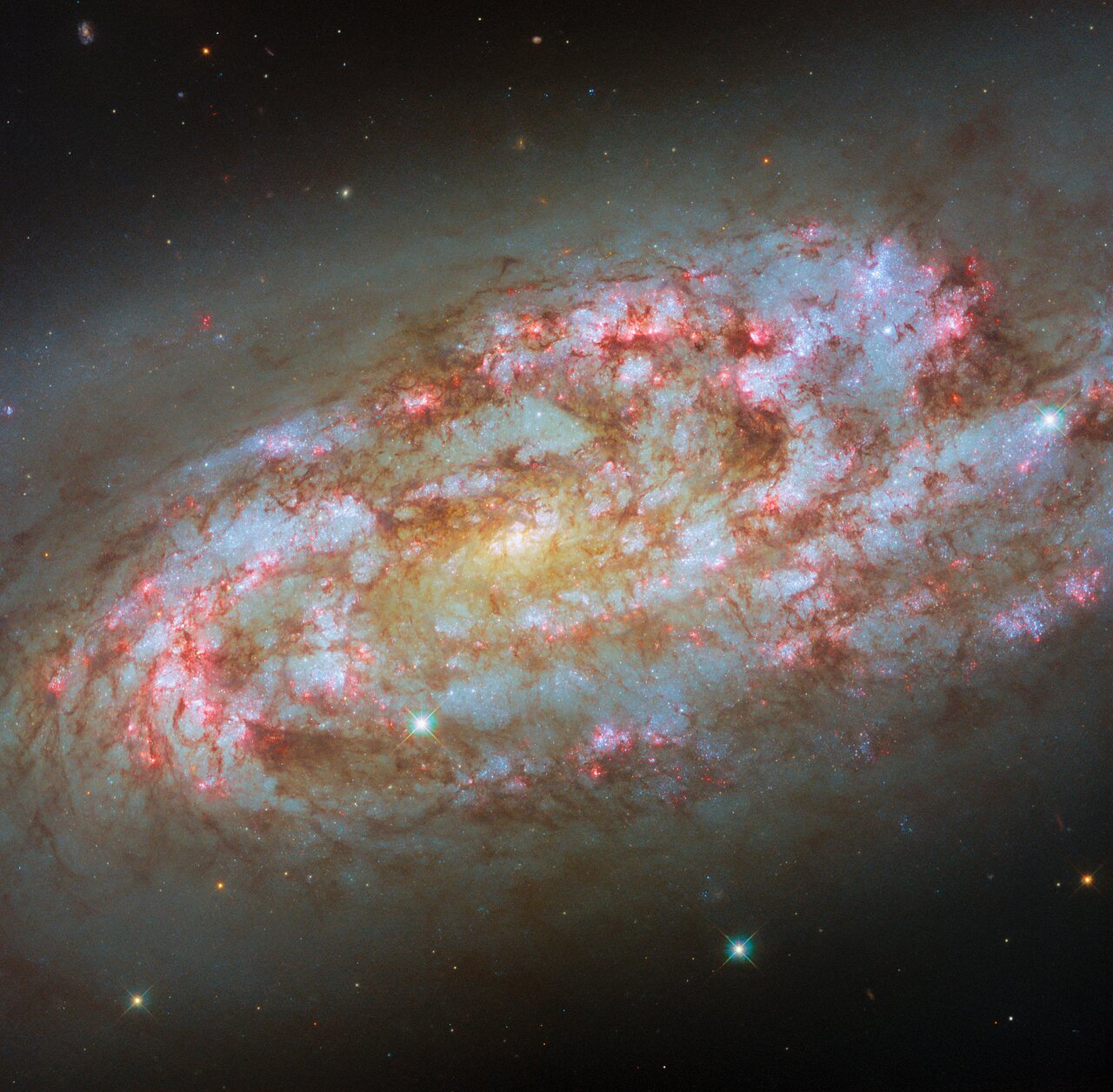
Source: ESA/Hubble & NASA, D. Thilker, F. Belfiore, J. Lee, and the PHANGS-HST Team
NGC 1792 is located 50 million light-years from Earth in the direction of the constellation Columba. It is a spiral galaxy, but unlike our Milky Way, it does not have a central bar in its core.
The Hubble photo clearly shows numerous bright star clusters in the spiral arms of NGC 1792, as well as its overall chaotic nature. Right now, it is undergoing a powerful burst of star formation and is intensively forming new stars. According to astronomers, NGC 1792 is surprisingly bright for its mass.
One possible explanation for this is NGC 1792’s proximity to the larger galaxy NGC 1808. It is believed that the strong gravitational interaction between them caused the gas reserves in this galaxy to become excited. The result was a burst of star formation in the part where gravity has a stronger effect. This makes NGC 1792 an ideal target for astronomers seeking to understand the complex interactions between gas, star clusters, and supernovae in galaxies.
Hubble has photographed this galaxy before. The new image includes additional data collected during 2025. This provides a deeper insight into the violent astrophysical activity taking place in NGC 1792. The bright red lights in the spiral arms indicate what is known as H-alpha emission from dense molecular clouds. Stars form inside these clouds and glow brightly with ultraviolet radiation. They ionize the gas around them, causing it to emit light with a very characteristic red wavelength – a clear sign of star formation.
You can also read about how newborn stars blew giant bubbles in a neighboring galaxy.
Provided by Esahubble

