

Astronomers working with the Hubble Space Telescope have published a stunning new image. It shows a giant stellar nursery in a neighboring galaxy.
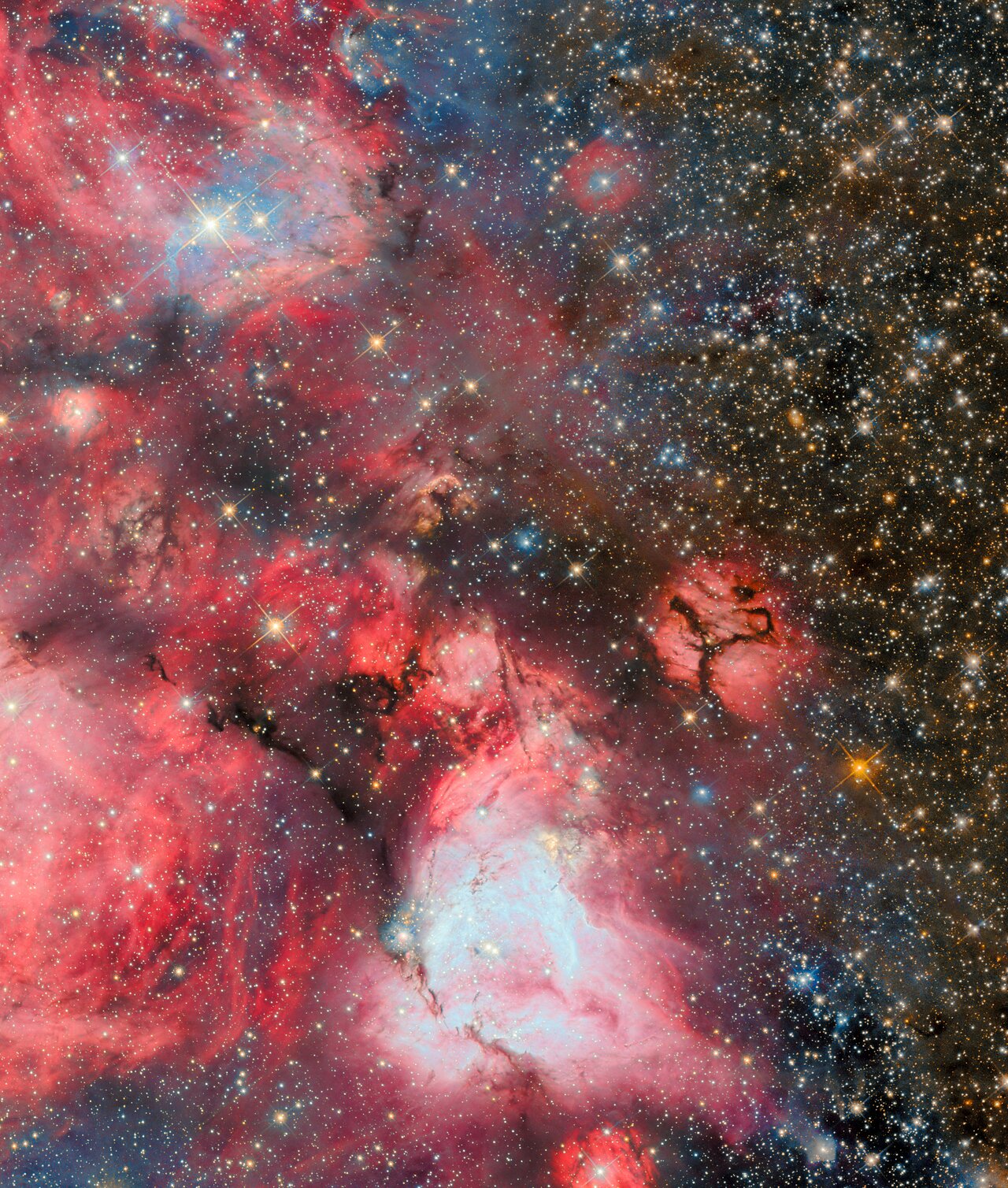
The area captured in the Hubble photo is located about 160,000 light-years from Earth in the Large Magellanic Cloud. It is a dwarf galaxy, which is the largest of several dozen satellites of the Milky Way. Despite its modest size, it is home to the largest regions of active star formation in our cosmic neighborhood.
Among them is the star-forming complex N159, a fragment of which is captured in the Hubble photo. It is a giant cloud of cold hydrogen with a diameter of about 150 light-years. This is 35 times greater than the distance from the Sun to Alpha Centauri.
Inside this gas cloud, where temperatures are far below zero and powerful gravitational forces are at work, young stars begin to shine in the darkness. Particularly hot and massive stars illuminate their birthplaces with red light. This red glow is characteristic of excited hydrogen atoms, to which Hubble is extremely sensitive.
Although some bright stars in N159 appear to be covered by reddish gas, others are located in the center of the reddish bubble, through which the dark background of space is visible. These bubbles are evidence of stellar feedback, in which powerful radiation from newborn stars affects the gas and dust clouds surrounding them, blowing giant bubbles into them.
Hubble last photographed this region in 2016. An additional wavelength of light has been added to the new version to highlight the hot gas surrounding the newborn stars.
According to Esahubble

